Latest Updates :
    Showing posts with label Mango. Show all posts
    Showing posts with label Mango. Show all posts

    Australian consultants call on Secretary TDAP

    Australian consultants call on Secretary TDAP agrinfobank.comThe Consultants of Australian Departments of Agriculture and Horticulture Peter Hofman, & Peter Johnson had a meeting with Rabiya Javeri Agha, Secretary Trade Development Authority Pakistan (TDAP) on December 2nd, 2013 along with Mahmood Nawaz Shah, Director, Sindh Mango Growers Association, the consultants apprised the Secretary, TDAP about their working on behalf of Australia and helping the Government of Sindh in 3 sectors namely Mango, Citrus and Dairy under the ASLP, Agri Sector Linkage Programme.
    The consultants informed that the test shipment of Mango of Sindh was made under the programme using controlled atmosphere technology, to UK to the Tesco Retail Company in 6 containers, which took almost 30 days from the picking / shipping to the retail level, leaving 7 clear days to the retailer to market the product - whereas in normal, regular by air shipment, the retailer has only 24 to 48 hours before the product perishes.
    It was also informed that UK buyers plan to visit the Mango growers in the month of January, 2014 in order to finalise arrangements for Mango shipments to UK in the forthcoming season.-PR
    News Source: Business Recorder   News Collected : agrinfobank.com Team

    Agriculture scientists urged to produce High quality mangoes nurseries

    Additional Secretary Agriculture (Planning), Ahmad Ali Zafar has urged upon the agricultural scientists to introduce high quality mango varieties to attract the US and European markets. Talking to newsmen after the visit of Mango Research Station Shujabad here on Sunday, Ahmad Ali Zafar said there was no alternate of Pakistani mango type 'Chaunsa' and Anwar Ratole across the world. He directed the agri scientists to produce nurseries of high quality mangoes and provide them to growers at cheapest rates. Agriculture scientists urged to produce High quality mangoes nurseries: agrinfobank.comHe said that agricultural scientists should introduce the disease resistant varieties. He said $30 million revenue was obtained by exporting mango to the US, European markets this year and it could be increased by producing high quality mangoes through better management of mango gardens.
    Earlier, talking to the training participants organised under agriculture sector linkages programme Ali Zafar stressed the participants to create awareness among mango growers regarding better management of mango for boosting mango yield.
    Khalid Mehmood said Multan, Muzaffargarh, Khangarh, Shujabad and Rahimyar Khan districts contribute 63 percent share from total mango gardens of Punjab. He said training was being imparted to agricultural officers (extension) for stepwise management of mango gardens.
    News Source; Business Recorder   News Collectd: agrinfobank.com Team

    Hot water treatment facility at Durrani Associates

    TARIQ ANWAR, SIDRA AHMED
    (4th Year plant protection, Department of Agriculture & Agribusiness Management, University of Karachi)
    Abstract: Pakistani mangoes have high export potential, particularly in neighboring markets of Iran and China and Golf countries. However, market access is conditional with hot water (HW) Phytosanitary treatment protocol for disinfestations of fruit fly as agreed with both countries (Iran: HW dip at 45°C for 75 min; China: HW dip at 48°C for 60 min). Objectives of present survey to Durrani Associate to evaluate Hot water treatment facility and found that the facility as per required by the USDA (Standards) the mango must treat by 48C for 60 minutes the Hot water treatment plant at Durrani Associate is 70m in length, 2m in width and 1.5m in height. Its effective to kill the eggs and larvae of fruit fly (Bactrocera dorsalis Bactrocera zonata Thrips palmi) and other bacteria and the organisms which cause the post harvest losses (Aspidiotus destructor Coccus viridis Dysmicoccus neobrevipes Parasaissetia nigra Rastrococcus iceryoides Sternochetus mangiferae) which is the requirement of the importing country and Pakistan will also willing to unlock some new destination including Australia to achieve this goal SPS standard must strictly regulate all around the country.
    Key words: Mango, Quarantine, Hot water treatment, Phytosanitary
    (1) Introduction:
    Report on the “Hot water treatment facility” at Durrani AssociatesMango (Mangifera indica L Family Anacardiaceae) commonly known as “King of fruits”. Mango is considered as fruit of excellence and thus has prominent position among commercial fruit grown in Pakistan. Mango plays an important role in the diet of human being by providing about 64-86 calories energy. Pakistan produces over 150 varieties of mango among them are Chaunsa and Sindhri that have great potential for finding buyers in the US and EU markets. Pakistan is the third largest producer of mangoes in the world and produces world’s finest quality of mangoes. In spite of these destinations Pakistani mangoes have high potential to get access in the other markets of Australia, USA and other countries how ever market access is conditional with the hot water treatment (HWT) and Phytosanitary protocols must followed for disinfestations of fruit fly (HW 48 C for 60 minutes). In Pakistan various HWT plants are working in public sector or by the facility center of Govt. Pakistan to unlock the new destinations world widely providing the Phytosanitary requirements. For this purpose department of plant protection conduct inspection surveys to the facilities of private and public sector in different occasion during the process of mangoes for export to issue the Phytosanitary certificate if the facility and processing unit meet to the Phytosanitary requirements of importing country.
    A field survey conducted by the department of plant protection to evaluate the Phytosanitary measure, the processing unit and the Hot water treatment facility execute by the Durrani Associates, either the facility meet with the SPS status or not. The survey carried out at the facility site of the Durrani Associates where the (HWT) facility and the processing methods including grading, packaging, ethylene treatment, storage structures was observed and also demonstrated by the facilitator and A.Q Durrani him self.
    (2) Methodology:
    The survey was carried out by the demonstration and practical observation of the HWT of mangoes and its packaging and cold storage facilities.
    According to the demonstrator, one of the greatest achievements of Durrani Associates is that they have found a breakthrough in the hot water and wax treatment of mango that enhances the shelf life of the product by as much as 35 days. This is a feat that others are still trying to achieve, And Durrani Associates can now capitalize on this attained competitive advantage by exporting processed mango by sea freight instead of air freight and keep the product fresh for 35 days fulfilling all SPS requirements in Europe, US, Middle East, China and the Far East and also willing to unlock more destinations to market their products including the Australia which have more critical SPS requirements.
    He further demonstrated that, their Cold Treatment Facility Designed according to International Quarantine needs and instructions. Automated Potato processing unit is one of its only kinds of facility available in Pakistan. He added that their processed tomato can remain farm fresh more then 8 weeks and Persimmons processing unit one of the only processing unit in Pakistan.
    (2.1) Processing unit and structures under observation
    (a) Hot water treatment plant of mangoes:
    As per required by the USDA (Standards) the mango must treat by 48C for 60 minutes the Hot water treatment plant at Durrani Associate is 70m in length, 2m in width and 1.5m in height.
    Processing can be briefly divided in the following steps:
    I) Initial Grading
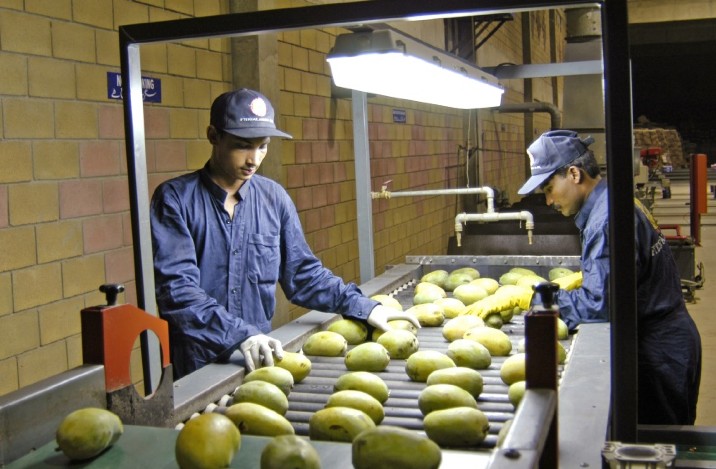
    At this stage the mangoes from the different certified orchards and the worker chose the fine disease free injury free and scalp free mangoes to enter into the processing unit. Initial grading is done by manually according to the physical appearance and collects the defected fruit by hand.
    II) Initial washing
    Mangoes after the initial grading let inside the washing tank of the HWT processing unit where the mangoes washed with the help of hot water about 45-48C with chlorine 200ppm for neutralization of the pesticides and get off the dirt and unwanted materials from the surface of the fruit.
    III) 48C hot water treatment tank
    This step is more impotent step of the HWT processing of mangoes in white the mangoes pass through the 48C Hot water for 60 minutes, while the pulp temperature must range from 46.1C - 46.6C. This activity kills the larvae and eggs of fruit flies and the bacteria.
    Some are enlisted below:
    1. Aspidiotus destructor
    2. Bactrocera dorsalis
    3. Bactrocera zonata
    4. Coccus viridis
    5. Dysmicoccus neobrevipes
    6. Parasaissetia nigra
    7. Rastrococcus iceryoides
    8. Sternochetus mangiferae
    9. Thrips palmi
    IV) Waxing tank
    After the treatment of mango with 48C water it is found that the shelf life of the mango decreases due to the rate of respiration increase. To prevent this loses and decrease the rat of dehydration waxing the treated mangoes in the waxing tank and the fruit get shine and glowing skin it will also increase the market value. In the waxing tank the pores of mangoes also semi sealed with wax.
    V) Air dryer
    Before go in for the packaging the mangoes must dry which were wet due to the waxing process. In this tank the air dryers are set up to dry the mangoes.
    (b) Packaging:
    After the HWT the next step is packaging during the inspection it is found that there is paper cartons of different sizes use for the packing of mangoes according to the sizes and tagging of the brand name also done at this stage for better representation and company promotion. The packaging cartons are 2kg, 5kg, 8kg, and 10kg
    (c) Cooling of mango and Storage:
    After the packaging the mangoes are let to cool at the room temperature for 2 hours. The infrastructure for cooling purpose in Durrani Associates is rectangular room like structure and the walls are seal with thermopol sheets and the aluminum foil to make it an insulating structure where the temperature can maintain and avoid the escaping of cooling. After the cooling the mangoes then transferred to the cold storage at 11-12C temperature.
    (3) Results & Recommendation:
    As the above report is representing the struggle of the Pvt Farm and the department of plant protection to unlock the destination to trade more mangoes to international market but the hurdle is fruit fly infestation. To get rid of this problem the HWT and the VHT hot forced air room is recommended universally including USA, UK, Australia, and China. During this survey it is found that the HWT treatment is more reliable and suitable for the exporters of the Pakistan. It’s so convenient to handle and get the better result and earn the handsome income by exporting these treated mangoes to the world market. A spoke man during the survey said that “we never let a mango exit from our premises with out treatment, and neither face any consignment reject from any destination”. On the other hand Pakistan is likely to suffer appallingly huge losses in the export of mangoes to Dubai and London this year. Till June 21, a total of 28, 700 tons of mango has been exported to different world markets of which due to being sub-standard, exporters have suffered a loss of $3 million whereas in UK 50 tons of mango has been destroyed due to the presence of fruit fly resulting in a loss of 1.5 lace this can be over come by proper inspection from field level to the departure of the consignment. And plant protection department strictly regulate the SPS standard from field level, processing level and then transportation. And every exporter must have the USDA standard HWT facility and regularly inspection carried out the facility and processing unit as done in Durrani Associate.
    (4) Summary and Conclusion:
    Pakistan has great potential to produce high quality mangoes and have near by destination to export and earn the foreign exchange particularly the neighboring countries china, Iran, Golf Countries but HWT is prerequisite to access that market. The present report the facility of private farm that meet the SPS standard and working facility having good results and got access to the international market and have good feed back, and this facility is registered by the several NPPOs of the words and also by the USDA. And here I must conclude this report by this line that we must improve our growing techniques, harvesting techniques, processing techniques and regulate the Phytosanitary measures from the field levels to the ports.
    (5) References:
    (6) Abbreviations

    HWP Hot water treatment
    VHT Vapor heat treatment
    USDA United state department of Agriculture
    SPS Sanitary and Phytosanitary standards
    NPPO National plant protection
    HW Hot water

    Pakistan mangoes sell at Rs 80/kg in Delhi as against Rs 150-200 for desi variety

    Madhvi Sally, ET Bureau
    Mangoes from Pakistan are giving a tough competition to local varieties in domestic and export markets this season. At the fag end of the season, Pakistan's chausa and fazli varieties are coming through Poonch and Srinagar to the north Indian market.Pakistan mangoes sell at Rs 80/kg in Delhi as against Rs 150-200 for desi variety
    In retail, Pakistani man goes are being sold at Rs 80 a kg while prices of the domestic crop are at Rs 150-200 a kg. "The taste is very sweet and the colour is good. Leading retailers are buying them as the prices are competitive," said Chamanlal Dhingra, a leading mango trader at the Azadpur mandi in Delhi. Traders said the king of fruits first came from Pakistan in 2012 through Jammu and Kashmir in small quantities.
    "This year, the harvest is good and we expect arrivals from Pakistan to continue for the next 15-20 days," said Paramjeet Singh, owner of the Surjeet Mango Trader at Azadpur mandi, which is Asia's largest fruits and vegetables market. The trader said more than 18 mantrucks of Pakistani mangoes arrived through Jammu and Kashmir on Saturday and over 8 trucks, each carrying 9-10 tonne, arrived on Monday.
    Demand is largely coming from the Delhi national capital region, Punjab, Haryana and parts of Uttar Pradesh. "The Indian crop from the Saharanpur belt of Uttar Pradesh is available barely for the next 5-7 days. To meet the huge demand in the domestic market, mangoes from across the border are welcome," said Singh. He said the fruit could not be sent to other parts of the country due to its short shelf-life.
    With increasing demand and supplies, traders expect the prices to crash. "If arrivals of the Paksitani mangoes increase, prices may fall to Rs40-50 a kg," said Dhingra. The crop was largely coming from Pakistan's Punjab province. In New Delhi, Naeem Anwar, minister (trade), Pakistan High Commission, said mango was one of the major export items from Pakistan.
    "In India, we think there is a good market for Pakistan's mangoes like sindhri, anwar ratol, dusheri and chausa. However, a custom duty on mango at 35% and above is discouraging Pakistani traders and exporters," he said adding that India and Pakistan were working to overcome the tariff and non-tariff barriers to ensure consumers get a taste of Pakistani varieties.
    Source
    The Economic Times


    Taste of Pakistani mango

    Saturday, July-13-2013
    The first-ever mango promotion event in South Korea “Taste of Pakistani Mango” was held in Seoul  on Friday at a local hotel. The event was organised by the Commercial Section of the Embassy of Pakistan, in collaboration with Ministry of Commerce, Pakistan Horticulture Export & Development Company (PHDEC) and TDAP. People from different walks of life in South Korea including a large number of Korean importers and distributors of fresh fruits and vegetables, chain store buyers etc attended the event.
    Taste of Pakistani mango
    Pakistani mangoes entered the Korean market for the first time in 2012 after years of sustained efforts by the Government and the Embassy of Pakistan. The Korean mango market is worth about $13 million and is dominated by Thai, Taiwanese and Philippines’ mangoes holding 90pc share. However, Pakistani mangoes can capture a substantial share in the Korean market due to their much superior quality and taste.
    Shinn, Tae Young, Chairman of the Korean Importers Association (KOIMA) was the chief guest of the event. In his remarks he expressed his delight at the availability of Pakistani mangoes for local consumers. The Ambassador of Pakistan Shaukat Ali Mukadam, in his welcome address spoke of the growing economic relations of the two countries and the potential of further growth in bilateral trade between the two countries.
    Bilateral trade between Pakistan and South Korea has witnessed a steady growth in the last few years, with the volume reaching $1.6 billion in 2012. Pakistan’s exports to Korea in 2012 were $776 million. Pakistan’s Commercial Consular in Seoul, Aamir Nazir Gondal, introduced the agri-products and urged Korean importers & distributors to source their horticulture needs from Pakistan. Chairman PHEDC, Hassan Ali Chaniho, in his address, highlighted the strengths of Agriculture sector in Pakistan and expressed his hope that in view of the increasing bilateral trade between the two countries, high quality fruits & vegetables of Pakistan are available to Korean consumers.
    This was followed by display and tasting of different varieties of mango as well as several dishes and delicacies prepared from it. It was thoroughly enjoyed and appreciated by the participants.
    Source: The Nation
    News Collected by agrinfobank.com Team

    A case of mediocre mangoes

    Friday, July-12-2013
    Climate changes have continuously taken their toll on Pakistan over the last few years – whether it’s an increase in flooding or a change in weather patterns.
    As a result, mango lovers are still waiting for the arrival of this year’s full-fledged mango crop in the market, which has been delayed because of changes in weather patterns.
    Stakeholders believe that Sindh would have come up with a larger mango crop had weather conditions not been erratic. An overall 20 percent drop in production is likely due to the late maturation of the fruit and hailstorms.
    Early varieties of mango like Almas, Saroli and Daseri are slowly reaching the market but mango afficiniados are still anxiously waiting for the seasonal favourite ‘Sindhri’ –according to market players they will have to wait for another one week or so.A case of mediocre mangoes
    Southern winds that usually visit orchards in early March didn’t come on time, and when they finally did the fruit’s size had already been affected. Hailstorms caused damage to the crop particularly in Mirpurkhas region, which was the main path of the storm.
    Sindhri, which is an exportable variety like ‘Chaunsa’, has an edge over other varieties because of its look and taste. Chaunsa has similar characteristics too but it follows Sindhri towards the end of the mango season in Sindh. Sindhri is widely used as a ‘gift’ in different circles extending from the civil bureaucracy, to the police, politicians and the ‘common man’.
    “Such weather conditions are not conducive for the mango’s development. Mangoes need the summer season to have a rapid growth in all respects,” says Atta Soomro, Director General Agriculture Research. He adds that not only the flushing of trees at the wrong time also negatively impacted the fruit’s production.
    Officials in the Pakistan Horticulture Development and Export Board (PHDEB) say that it was due to a delay in crop’s arrival that its export began on May 25 this year, although it usually begins by May 20.
    But exporters remain optimistic. According to PHDEB General Manager South Abdul Razaq Malkana, given the size of crop the PHDEB is optimistic to export around 120,000 tons of mango or so against last year’s 107,000 tons as around 400 to 500 tons alone will be exported to Korea.
    He added that the production of medium sized mangoes is likely to dominate the market and such medium sized fruit is the most sought after abroad.
    Pakistan’s total mango production reaches 1.7 to 1.8 million tons annually with the lion’s share coming from Punjab and 30 percent from Sindh. According to 2011-12 statistics of the Sindh Horticulture Research Institute (SHRI), Mirpurkhas is considered home to mango farming, although it takes place in Tando Allahyar and Sanghar as well.
    The orchards which are mostly located in the lower Sindh region on the left bank of River Indus were badly affected during heavy monsoon rains. Since rainwater accumulated in orchards it raised the water table substantially, badly affecting the texture of land. Such changes in the soil’s texture are considered one of the reasons for the belated flowering of the plant.
    According to traders – who get orchards on contracts from actual farm owners – currently varieties of Saroli and Daseri are being brought to the market. According to one such trader, Aslam, “Although the unripe Sindhri is reaching the market, it lacks taste and wholesalers use calcium carbide to ripen it.” He believes that if production of mangoes drops substantially, then price margins will increase – but in case of a large number of exports because of oversupply, prices will fall.
    Inferior farming methods
    Few farmers are interested in exporting to European countries, and using sophisticated procedures to take care of their orchards – most farmers outsource their farms to contractors for two to five years under an agreement. After that, it’s the contractor’s headache to look after orchards. Some estimates obtained through farmers and contractors indicate that millions are invested in this business. If a 200 acre orchard is let out for Rs100,000 per acre, then it means an amount of Rs20 million will change hands. A single contractor handles a multiple numbers of farms.
    “Growers do not manage mango orchards on their own. They are not ready to wait for one year and handle the crop properly. This is the general mindset among our mango growers,” says Imdad Nizamani, a farmer from Tando Allahyar. He believes that farm owners also feel that since there are certain varieties which give fruit on a rotational basis, they’re better off outsourcing the farms to earn money. Nizamani says he will not be surprised if production drops by 25 to 30 per cent this year.
    A trend, however, seems to be slowly emerging among farmers who are showing an inclination towards progressive farming and are keen to export the fruit to high-end supermarkets in Europe and other regions themselves instead of relying on conventional exporters. They are being encouraged to opt for ‘progressive’ mango farming if they want to fetch a better price for their crop. More technical methods for farming are being used as a result, such as ‘high density mango farming’ which controls the space between and height of mango trees. Perhaps a focus on such methods could help counter the fears of a declining mango crop in the long run.
    Source: The Dawn
    News Collected by agrinfobank.com Team

    Pakistani Mango Festival Exhibits 30 Varieties

    Wednesday, July-10-2013
    Dr Hamed bin Suleiman al Aufi, Undersecretary at the Ministry of Agriculture and Fisheries Wealth inaugurated the Pakistani mango festival at The Sultan Center in Qurm on Monday.
    The event was attended by several members of the Pakistani community.
    The festival exhibits 30 varieties of some of Pakistan’s most popular mangoes including dasehri, langra, chausa, sohnehra, al mas, badami, totapuri, yellow rose, rose mevvy, anwar ratole, fajree mousam, honey, saroli and many more.
    Pakistani Mango Festival Exhibits 30 VarietiesSpeaking on the occasion, H E Dr Aufi said, “I am delighted to see different varieties of mango at the festival. We are trying to develop our agriculture sector and I think we can learn a lot from Pakistan in this area. We should strengthen our trade ties with Pakistan. We can open doors to allow Pakistani products pass through Oman to the rest of the Middle East. I think some formal collaboration should also exist between the two countries in the area of science and technology.”
    K K Ahsan Wagan, chargé d’affaires at the Embassy of Pakistan, said, “We hope the festival will get a great response like last year.”
    Mahmoud al Sheikh, country marketing manager, The Sultan Center, said, “We always provide best products in terms of quality and variety at reasonable rates. Some of the finest Pakistani mangoes are on offer at this festival.”The festival will conclude on July 14.
    Source: Muscat Daily
    News Collected by agrinfobank.com Team

    'Pakistan to export mangoes to Turkey next year'

    July 08, 2013
    'Pakistan to export mangoes to Turkey next year'
    Image Source: www.fruitnet.com
    Pakistan's ambassador in Turkey, Haroon Shaukat has said Pakistan would export mangoes to Turkey from next year after signing a Preferential Trade Agreement between both the countries. He said this while addressing participants at "Mango Festival" held at Pakistan Embassy in Ankara, said a message received here on Sunday.
    The festival featured a display of popular varieties of Pakistani mangoes such as Sindhri, Chaunsa, Anwar Ratol and Dosehri. Haroon Shaukat said the basic purpose of the festival is to introduce Pakistani mangoes in Turkey.
    The ambassador said Pakistan is the fifth largest producer of mangoes in the world and produces world's finest quality of the fruit.

    Pakistan exports the fruit to 40 countries including the United States, Canada, many EU member countries, Middle East, and Far East while new markets for Pakistani mangoes are Japan, Korea and Australia.
    Copyright Associated Press of Pakistan, 2013

    Fruit flies: A Serious thread to Pakistan Mango Export

    Sunday, 7 July 2013
    This is with reference to the story “UK’s quarantine department destroying all shipments of Pakistani mangoes” (July 3, in Express tribune). It is the responsibility of the mango exporters and not the government to fumigate mangoes or any other fruit before shipment. Have Pakistani exporters even heard of fumigation? Mangoes could also be exported to the US, as well as the UK, and other Western markets if these are properly fumigated and shipped with certification, which is genuine and not fake.
    Fruit flies: A Serious thread to Pakistan Mango Export
    Image Source: www.mauijungalow.com
    It has become a habit with every other person, organisation and industry to blame the government for everything. To say that the government is not doing enough to control the “export” of fruit flies is not a very intelligent thing to do. When will people in Pakistan realise that it is not the government’s job to do everything? In this particular case, private mango exporters are responsible for thoroughly washing the mangoes to ensure that the fruit flies do not accompany the exported mangoes.
    This is reflected in the extremely poor packaging that Pakistani mangoes come in, complete with a few shiny scraps of streamer. I have never quite understood why that is added as it is not enough to cushion the fruit from damage and is also too little for decoration. Plus, the stickers on the fruit are made of terrible material, which separates when pulled, leaving some glue and paper sticking to the fruit. This happens with no other country’s fruit that I am aware of and I have bought apples from New Zealand and Chile. The packing is superb.
    I plead to Pakistani exporters to improve the packaging processes, including resolving the contamination issue, as it helps protect the fruit against damage. It is the exporters’ duty to ensure that the fruit reaches its destination in top condition.
    Source: Tribune.com.pk

    Mangoes and Pakistan

    Mango (Mangifera indica L Family Anacardiaceae) is the second largest fruit crop of Pakistan. At present it is grown on an area of 170.1000 thousand hectares with production 1727.9000 thousand tones (Agricultural Statistics of Pakistan 2008-09). The area under mango crop has increased but the rise in production is comparatively slow. The main mango growing districts in the Punjab province are Multan, Bahawalpur, Muzzaffargarh and Rahim yar Khan. In the province of Sindh it is mainly grown in Mir pur Khas, Hyderabad and Thatta in the province of NWFP it is grown in D.I Khan, Peshawar and Mardan. Mangoes have been produced in Pakistan for well over two thousand years, and the country is now the sixth largest producer in the world behind India, China, Mexico, Indonesia and Thailand (FAO STAT).
    Mangoes and PakistanThe climate of Sindh gets warmer about one month earlier than the Punjab which has given the province the privilege to grow early varieties of mango. Subsequently, a new trend of growing late varieties in Punjab has received a wide popularity which has extended the market period and added to the exportable surplus.
    Pakistan mangoes are sweet, aromatic, yellow skinned and soft. This delicious fruit is nutritionally superior, source of several vitamins and minerals. Mango farms range in size from less than 2ha to more than 400ha. It is very much unfortunate that mango industry of Pakistan is poorly developed. Production, post harvest and marketing systems are poorly developed and returns are distributed quite unevenly, favoring middlemen. Fruit quality is generally poor and 30 to 40 per cent of fruit is wasted in the harvest to market system. Modern infrastructure for cool storage, grading, post harvest treatment and transport is almost non-existent. Orchard owners do not take care of their orchards; they simply sell the fruit of the orchard to the contractors. So, very few mango farmers in Pakistan are responsible for selling or marketing their own crop. There is no processing plant installed to properly process mango for export.
    There are 6 Global GAP certified Mango Orchards in Punjab and only one in Sindh. The total area of the Orchards in Punjab is 2109 Acres and in Sindh is 135 Acres. Certification is in process for eight farms.
    Pakistan produced 1727.93 thousand tones of mangoes in the year 2008-09 (Agricultural Statistics of Pakistan 2008-09). Total world export of mangoes amounts to US Dollars 1,194,775,729 and Pakistan’s share of export is only USD 33,178,617 (UN comtrade).
    Source: http://trtapakistan.org

    Mango Export from Pakistan and WTO Regime on Food & Agriculture

    By Dr. Syed Wajid H. Pirzada
    The diversified natural resources [NR] and eco- systems, Pakistan is endowed with, gives Pakistan a comparative advantage in agro-livestock &fisheries [sub] sectors, over her competitors in this area.
    The agro-diversity best places the country to produce diversified goods in general and agro-livestock & fisheries products in particular;
    Which can cater to diverse market niches and satisfy the [diverse] demand and aesthetic tastes of consumers, in the [emerging] global trade context.
    Mango Export from Pakistan and WTO Regime on Food & AgricultureCheap and hardworking labor coupled with [indigenous] knowledge & skills the indigenous people are equipped with, puts Pakistan in an enabling environment, given the political will, to exploit the [comparative] advantage country enjoys in this sector.
    Be it refreshening buffalo milk with fat premium, basmati rice with [appetizing] aroma & quality unique to [Pakistani] rice belt, wool for hand-knit rugs & carpet industry, leather goods symbolic of craftsmanship of our people, citrus especially kinnow- a relished Vit. C drink or the king of fruits-the mango, the juicy delicacy of Pakistan, all are unique in their attributes, of commercial value.
    To underpin economic development of the country, sustainable trade development remains the cherished goal being an imperative. To this end, one needs to exploit, to national advantage, all export possibilities by unfolding the inherent potential of different [sub] sectors of economy. Such an initiative warrants capitalizing on the strength and managing the weaknesses of these sectors. One of such promising [sub] sectors is that of horticulture, which like livestock, fisheries & floriculture, has enough in store in terms of [future] trade prospects.
    With in horticulture sub sector, mango [cultivation &] export, like citrus, has great potential. Mango varaities such as Sindhry, Chaunsa, Fajri, Golden and Began Phaly, just to name few, are in great demand, especially in Middle & Far Eastern countries.
    Despite the fact that in a single year [2000], Pakistan was able to export 39,000 tones of mango, she [still] faces multiple problems in realizing the true export potential in this area.
    Some of the problems impacting mango trade are summarized below:
    General:
    .Cost of inputs: water, fertilizer, pesticide, and electricity tariff
    .Emerging disease problems e.g. declining productivity syndrome
    .(Lack of) value addition: no systematic effort
    .(Little) varietal development: inadequate research capacity
    .Poor quality management practices
    .(Poor) storage & processing: limited capacity e.g. cool chain, low processing levels
    .Intermediaries: from growers to retailers /exporters.
    .(Inefficient) marketing: no strategic planning.
    .(Unreliable) shipment: faces problem.
    .Trade Specific:
    Pakistan continues to face the embargo, on Pakistani mango, placed by USA 40 years back. Lately Australia, Germany & Japan have banned import of mango from Pakistan on the pretext of Fruit Fly issue.
    Post harvest losses account for some 20-40%. And according to one [considered] estimate saving 30% losses would help double mango exports from Pakistan.
    A continued ban on Pakistani mangoes, it self speaks of institutional shortfalls for, a country like Philippines was able to overcome this problem, and thus augmented her mango exports. Yet, other competitors in the world, for example, Mexico, Haiti, Brazil, have managed, like Philippines, securing sustainable market niche. Indonesia, India and Bangladesh have also a reasonable share in [global] mango exports.


    Pakistan, because of her comparative advantage, can [further] boost her mango exports by addressing the problems constraining mango trade, especially those related to health & hygiene standards and post harvest losses.
    As with the advent of WTO, food & agricultural trade has gone global, the food safety & quality issues have got a new prominence. In this context, two of WTO Agreements namely Agreement on application of Sanitary & Phyto-sanitary [SPS] Measures, and Agreement on Technical Barriers to Trade [TBT] are of special importance for, these address [food] safety & quality issues respectively and are binding on 145[WTO] Members. Whereas, the former [SPS] Agreement, reaffirms the rights of Member countries, afforded under Article XX (b) of GATT, that has [now] been re-enforced under SPS Agreement.
    This Agreement provides that Member should not be prevented from or enforcing measures necessary to protect human, animal and plants life or health, subject to the requirements that these measures are applied only to the extent necessary, are based on scientific principles and are not applied in a manner which would constitute a means of arbitrary or unjustifiable discrimination between Members where the same conditions prevail. The [SPS] Agreement also encourages the Members to base their [SPS] measures on international standards, guidelines & recommendations, as to avoid trade disputes.
    The later [TBT] Agreement [also] seeks to recognize international standards, where they exist. It [further] provides that, like SPS measures, technical measures enforced under the Agreement should not create unnecessary barriers in international trade, and that these should have a legitimate purpose, and the cost of their implementation should be proportional to the purpose of the measure. The technical measures [standards] under this [TBT] Agreement-The Standard Code, relate to quality aspects, fraudulent practices, packing & packaging and labeling etc.
    With [likely] dismantling of tariffs under WTO [AoA] regime, there is natural temptation, on part of the countries to use non-tariff and technical barriers to protect their agriculture from external competition. Industrially Advanced Countries [IACs] in particular have, at times, tendency to use higher [than actually required] health & hygiene and ecological & environmental standards, which tantamount to creating arbitrary & unjustifiable barriers to trade.
    Notwithstanding this intent of importing countries, food safety standards, as envisaged by SPS Agreement, and for that matter quality standards sought under TBT Agreement are to be adhered to, if we want to engage gainfully in mango trade. Needless to mention that [better] health & hygiene standards are [equally] beneficial to consumers at home, as these help avoid attended risks, associated with food trade and associated economic losses
    It is worth mentioning that if an [SPS], and for that matter a technical measure does not meat the criteria set by these [two] Agreements for example, if [subjective] intent of an [SPS] measure is protection of local industry, as against health & life of humans, animals & plants, it can be challenged in WTO dispute Settlement Body. This however, is not only costly but also a time consuming proposition. As WTO regulations are to be enforced on bilateral basis, it is in fitness of things to harmonize the standards or enter in to equivalence arrangement with trading partners.
    Both Agreements encourage harmonization and equivalence arrangement. Needless to mention that in the eventuality of trade dispute [both] trading partners have to make a convincing case to defend their view points, as burden of proof shifts from importing to exporting party during dispute settlement proceedings, based on risk assessment and scientific rationale. Most of the developing countries [DCs] don't have such a [techno-legal] capacity, and thus they stand to lose in such disputes.
    It is [thus] advisable that to avoid [trade] disputes and to sell the produce with confidence and certainty, efforts be made to improve food safety & quality, and [simultaneously] enter in to equivalence arrangements where possible. Such arrangements shall
    help contain losses in terms of value of [mango] crop lost as a result of rejections in export trade. [US] Estimates suggests that in food rejection cases, food hygiene problems, contamination with insects and rodent filth ranks at number 1, followed by microbiolo-gical contamination, failing to comply with food registration and labeling requirements, of importing country.
    Those in mango export therefore need to manage mango health & quality issues.

    Quality management:
    .Quality standards need to be introduced for fresh mangoes. These relate to inter alia maturity index of cultivars, post harvest behavior and other quality - related attributes such as injuries & defects, tolerance [limits] etc. Similarly, standards & grades related to packing & packaging and labeling are to be established.
    .Minimum requirements with regard to quality, for example, are:The [mango] fruit must be sound. Produce affected by rotting or deterioration such as to make it unfit for consumption is excluded. It should be free from damage and/external deterioration caused by heat and must be clean, practically free of any visible foreign matter. Free from any foreign taste and / or smell.
    .Training: In [mango] quality management, especially in the area of sampling & analytical methods needs to be imparted. To this end [specific] training material & courses in the form of manuals & modules are to be tailored and conducted.
    .Quality Promotion: Last, but by no means least, Quality Management Facilitators / Promoters, as against the concept of Quality Inspectors, are to be deployed to help mango growers & exporters adopt the required health & quality standards, employing a participatory development approach.
    It needs hardly any emphasis that, it is no longer [more] possible [these days] to export [fresh] mangoes without regard to quality & safety standards of importing country. The mango growers & exporters, with the active cooperation, of their Associations/Chambers and Export Promotion Bureau ,need to work proactively on evolving such standards & grades, as required by trading partners through bilateral arrangement, that can satisfy health safety & quality concerns of importing country.
    Mango Exporters of Mexico have benefited from such a proactive approach. Mexico used to export till mid nineties her mango with out any quality control. For example, in 1995 [alone] Mexico exported 30 million boxes of mango without resorting to quality standards. The Export Mango Packing Association [EMEX], realizing the challenge ahead got engaged proactively, with Mexican Research Center in Food & Development, for purpose of [quality] standards setting.
    In progressive economies,like Singapore, standards setting is carried out in private sector, which assists Government in quality management. Private sector in Pakistan too should embark upon this strategy.
    FacebookMango Health& hygiene and safety management
    Diseases & Quarantine Laws: number of diseases affect mangoes such as Powdery mildew, anthracnose, sooty mold, root rot & rot of mangoes malformation of inflorescence etc. Some 86+ species of insect pests alone have been recorded on mango. Fruit fly, scale insects, mealy bug & hoppers are important.
    The conditions laid down by importing countries, in terms of disease control measures; such as quarantine [SPS] laws need to be met. Most of these countries have regulations aiming at protection of life & health of flora, fauna and human being. For example, under Biosecurity Act 1993, of New Zealand, there have been provided [explicit] import health standards for fresh mango [Mangifera indica]. And until and unless these import health standards under section 22 of the Biosecurity Act are satisfied, entry in to New Zealand of [all] plants & plant products is prohibited.
    Plant Protection Department, Government of Pakistan needs to engage in [proactive] dialogue with countries like New Zealand & Australia to harmonize plant [mango] Protection measures.
    New Zealand in the recent past has also introduced legislation, under Hazardous Substances Act 1996 that regulates deliberate introduction of new organisms including inter alia Genetically Modified Organisms [GMOs]. Relevant agencies in Pakistan like Ministry of Environment and Ministry of Food, Agriculture & Livestock need to study these regulations and coordinate with Risk Management Authority, Government of New Zealand. This shall help formulate national strategy on GMOs.
    The [se] quarantine laws address the issue(s) related to Regulated Pests [Actionable]-those organisms for which phyto-sanitary actions would be undertaken, if they were intercepted or detected. These pests have been categorized, under the Act, into different groups, based on [possible level] of risk associated with these organisms. These groups are, Quarantine: Risk Group 1, 2 & 3 Pests Regulated non-quarantine pests and Regulated non-plant pests.
    Similarly Vectors -associated Quarantine Pests, Vectored Organisms, Strains [variants] of pests, Unidentifiable Organisms; and unlisted Organisms have been dealt with under the category of Regulated Pest in the Act. Under Non-regulated Pests [Non-actionable]-those organisms for which Phyto-sanitary actions would not be undertaken, if they were intercepted/detected; categories like Non-regulated non-quarantine pests, Non-regulated non-plant pests and Contaminants such as soil, leaf litter etc have been addressed. For example, lots with more than 25 gms of soil per 600 unit samples shall be treated, reshipped or even destroyed.
    Each [mango] consignment thus has to carry Phyto-sanitary Certificate from [mango] exporting country, stating specifically inter alia that the mangoes have been inspected in accordance with appropriate official procedures and found to be free of visually detectable Regulated Pests, as specified by the New Zealand Ministry of Agriculture & Forestry.
    The aforementioned conditions are specific to mangoes imported from Philippines. Other countries need to enter in to [similar] bilateral quarantine arrangement such as agreement & work plan (s), with their trading partners.
    In addition to the [aforementioned] requirement of Phyto-sanitary Certification, there are[pre] conditions specific to protection, packaging & shipping materials, which for example under the New Zealand Biosecurity Act, 1993, need to be inert/synthetic. Other preconditions could [possibly] relate to transit requirements e.g. mango must be packed & shipped in a manner to prevent contamination by Regulated Pests.
    Needless to underline that [mango] consignments, destined for target market, are expected to carry mangoes in intact form, color and at required level of maturity. For this, mangoes must have been carefully picked and have an appropriate degree of development & ripeness in accordance to the criteria appropriate to the variety and to the area in which these are grown. The state of ripeness must be such as to allow the fruit to withstand transport& handling pressures, and thus arrive in satisfactory condition at the place of destination.
    The importing country [in this case New Zealand] will only issue Biosecurity Clearance, if she is satisfied that Regulated Pests are not detected and consignment is free of Contaminants.
    Capacity Building Initiatives: Following initiatives can help build trade capacity in mango [sub] sector:
    .Mobilization of mango growers & exporters as Associations/ Chambers
    .Credit Program for value-added exports
    .Investment in Mango R &D
    .Gene Banks
    .Disease control/disease free zones
    .Development of quality infrastructure
    .Grading/Export Standards
    .Training in quality management
    .Packing, packaging & labeling facilities
    .Specific initiatives are to be taken in the following areas:
    Monitoring & surveillance of contaminants:
    .Contamination: Food, as we know, itself is a good indicator of environment, in which it is produced. Because of urbanization and concomitant industrialization phenomena, risk of food being contaminated with industrial and other potential pollutants has increased. Surveillance & monitoring of contaminants[thus] alone [thus] help identify and avoid problems.
    .Infestation: Constraints on trade resulting from fruit fly especially needs to be managed through appropriate scientific methods. Disinfestation with ethylene dibromide 20 g/m3 for 2 hr was earlier recommended as a [possible] treatment for disinfestation for fruit fly. With the discouraging trends and [consequent upon that] phasing out of this chemical world wide since 1984, it has become imperative to find better alternatives, such as dips and packing line flood treatments with dimethoate (400 mg/L) or fenthion (400 mg/L), and gamma irradiation at 75 Gy. Heat treatments, particularly vapor heat, are yet other alternatives. Irradiation and heat treatments are preferred for these are free of chemical residues.
    Improper & unsanitary handling practices e.g. washing with contaminated water are the leading cause of food borne diseases.
    Irradiation can serve to decontaminate the surface of these commodities, without residual effects associated with chemicals.
    It also slows down the ripening process, and can thus facilitate safer transportation to destined markets.
    Doses range from 0.15-1kGy can be applied without appreciable loss of food quality.
    .Value Addition:
    Some of the value added [mango] products, other than pickles, preserves etc are differenttypes of juice products:
    .100% pure or 100% juice
    .Cocktail, Punch, Drink & Beverage-less than 100% juice with added sweeteners.
    .Fresh Squeezed Juices- not pasteurized
    .From Concentrate-reconstituted from Concentrate
    .Not from Concentrate-never been concentrated
    .Fresh Frozen-freshly squeezed, packaged & frozen.
    .Juice on refrigerated shelves-shelf stable products
    .Canned Juice-Heated & sealed
    .Juice industry can be promoted through value addition and by adopting Hazard Analysis & Critical Control Points [HACCP].
    Recommendations:
    .Multan be declared and developed as Mango Export Zone
    .Mango Development Fund be established [as a share out of [EPB] available sources; and financial support e.g. up to 25,000 per acre .of plantation & nature of crop, may be provided for 5 years, on lines with Konkan India.
    .Establish VHT, Irradiation, Cold Chain and Laboratory facilities at Multan.
    .Packaging facility and tax holiday for value-added processing & exports may be provided.
    .The mango traders need to seek help of professionals in popularizing - in a creative and aggressive manner - their firms/ products.
    .Establish an immediate marketing presence in the destined market [even] prior to physical presence.
    .Strengthen their position/ linkages with their trading partners/agents.
    .Affiliate with trade group, before they [even] open the office.
    .Acquire the critical marketing tools-product information representation in trade fairs, web sites; and for this they need to begin now and act strategically.
    Courtesy: The World Trade Review

    ASSESSMENT ON POSTHARVEST HANDLING METHOD OF MANGO

    There are many kinds of mango postharvest handling methods in East Java which were conducted by farmers, whole-salers and exporters, so that fruits quality were varied. Prime quality of mango will be received by the consumers if good and properly handling method of fruits is conducted. The aim of this assessment was to determine properly and profitable handling method of mango cvs. Arumanis and Manalagi so that prime quality of harvested fruits would be obtained. This assessment used a completely randomized design with 3 treatments, replicated 8 times. Treatments used were (1) harvesting was done before 10 a.m., fruits were packed using cartoon boxes with fruit cell, (2) harvesting was done at 10 a.m.to 4 p.m, fruits were washed with 75 ppm chlorine, dipped in hot water (53°C) for 5 minutes, packed in cartoon boxes with fruit cell and fruit net, (3) harvesting was done at 10 a.m. to 4 p.m., fruits were washed with 75 ppm chlorine, packed in cartoon boxes with fruit cell and fruit net. Capacity of all boxes were 10 kg each. Each treatment was consisted of 2 boxes. Observation were done on physical and chemical characteristics, the length of storage life in ambient temperature and cost of each postharvest handling method. mango-fruit-on-mango-tree
    Results showed that there were no significantly different on physical and chemical characteristics between the three treatments, but treatment 2 showed longer storage life than the other treatments. After 9 days at ambient temperature storage, fruits of treatment 2 were damaged as much as 8% for Arumanis cultivar and 6% for Manalagi cultivar Treatment 3 gave 25% of damaged fruits for Arumanis cultivar and 39% for Manalagi cultivar, while for treatment 1, damaged fruits reached as much as 29% for Arumanis cultivar and 66% for Manalagi cultivar Treatments 2 and 3 gave good result on organoleptic evaluation, which were better than treatment 1. Cost of handling method using treatment 2 around of Rp. 4,170.-/box for Arumanis cultivar and Rp. 3,910.-/box for Manalagi cultivar, for treatment 3 were Rp. 3,890.-/box for Arumanis cultivar and Rp. 3,630.-/box for Manalagi cultivar, while for treatment 1 was Rp. 1,950.-/box for Arumanis cultivar and Rp. 1,950.-/box for Manalagi cultivar. Handling method using treatment 2 and 3 could increased fruits' value at about 2–15% than that using treatment 1.

    Mango nutrition facts: How a mango is nutritious

    “The king of the fruits," mango fruit is one of the most popular, nutritionally rich fruits with unique flavor, fragrance, taste, and heath promoting qualities making it a common ingredient in new functional foods often labeled “super fruits."
    Mango is one of the delicious seasonal fruits grow in the tropics. The tree is believed to be originating in the sub-Himalayan plains of Indian subcontinent. Botanically, this exotic fruit belongs within the family of Anacardiaceae, a family that also includes numerous species of tropical-fruiting trees in the flowering plants such as cashew, pistachio,...etc.Mango nutrition facts How a mango is nutritious 2
    Mango nutrition facts How a mango is nutritious 3Mango is a tropical seasonal fruit, which saw its origin in the sub-Himalayan plains of India. There are different types and varieties of mango available in the market today. There are extremely juicy variants of mangoes available. Some mangoes have a small seed while some retain a big one. It is better to opt for those which are more fleshy, sweet and juicy to avail of maximum flavor. Alfonso is one of the breeds of mangoes, which is immensely popular, amongst people of all countries.
    Mango is considered to be the king of fruits. It is widely popular in different corners of the world. Its unique flavor manages to turn on, even a non-fruit consumer. It also serves as a perfect beverage if blended with milk and sugar. The prepared beverage is also often termed as a mango smoothie or a mango-shake. It has a unique color and fragrance, which always manages to capture the attention of fruit lovers. Mango stands tall amongst the list of new functional foods known as ‘super fruits’. Along with providing a delicious and delectable taste, numerous health benefits are also offered by the king of fruits. Numerous mango nutrition facts are there, which should be first understood, before digging in to devour the delightful fruit.
    Mango is considered to be one of the most nutritious food items. Numerous health benefits are offered by mangoes. Let us vide at some of the important mango nutrition facts which are there. Mangoes are rich in pre-biotic dietary fiber. They are also rich in vitamins and minerals which are essential in strengthening body parts. They are also helpful in maintaining a healthy body. Poly-phenolic flavonoid antioxidant compounds are present in mangoes which help in expelling harmful toxins from the body. Such compounds also help in fighting various diseases. The antioxidant compounds present in mango offer excellent protection against breast and colon cancers.
    Other mango nutrition facts boast of a mango’s high vitamin quotient. Mangoes are an excellent source of Vitamin-A. Deficiency of Vitamin-A might cause night blindness. It is very important to increase the intake of mangoes in one’s diet to get rid of eye related problems. Mangoes are also rich in potassium which helps in controlling the heart rate and blood pressure. Another fact that could be placed in the list of mango nutrition facts is that, a mango poses as an excellent source of beta-carotene and alpha-carotene and beta-cryptoxanthin, all of which retain antioxidant properties and are considered essential for vision. Such compounds are also necessary for the maintenance of healthy mucus membranes and skin. Vitamin-C and E are also available, which are necessary for creating resistance against infectious agents and harmful radicals. Mangoes are also ingested in their raw form in many countries. The raw form of a mango offers a unique sour taste, which is turned delicious by the addition of condiments and spices, in various places. Ingesting beverages made of raw mangoes, helps a person to avoid getting hit with sun strokes.
    Health benefits of Mangoes
    • Mango fruit is rich in pre-biotic dietary fiber, vitamins, minerals, and poly-phenolic flavonoid antioxidant compounds.
    • According to new research study, mango fruit has been found to protect against colon, breast, leukemia and prostate cancers. Several trial studies suggest that polyphenolic anti-oxidant compounds in mango are known to offer protection against breast and colon cancers.
    • Mango fruit is an excellent source of Vitamin-A and flavonoids like beta-carotene, alpha-carotene, and beta-cryptoxanthin. 100 g of fresh fruit provides 765 mg or 25% of recommended daily levels of vitamin A. Together; these compounds are known to have antioxidant properties and are essential for vision. Vitamin A is also required for maintaining healthy mucus membranes and skin. Consumption of natural fruits rich in carotenes is known to protect the body from lung and oral cavity cancers.
    • Fresh mango is a good source of potassium. 100 g fruit provides 156 mg of potassium while just 2 mg of sodium. Potassium is an important component of cell and body fluids that helps controlling heart rate and blood pressure.
    • It is also a very good source of vitamin-B6 (pyridoxine), vitamin-C and vitamin-E. Consumption of foods rich in vitamin C helps the body develop resistance against infectious agents and scavenge harmful oxygen-free radicals. Vitamin B-6 or pyridoxine is required for GABA hormone production within the brain. It also controls homocystiene levels within the blood, which may otherwise be harmful to blood vessels resulting in CAD and stroke.
    • Further, it composes moderate amounts of copper. Copper is a co-factor for many vital enzymes, including cytochrome c-oxidase and superoxide dismutase (other minerals function as co-factors for this enzyme are manganese and zinc). Copper is also required for the production of red blood cells.
    • Additionally, mango peel is also rich in phytonutrients, such as the pigment antioxidants like carotenoids and polyphenols.
    Did You Know?
    One cup of mangos is just 100 calories, so it’s a sweet treat that won’t weigh you down.
    Each serving of mango is fat free, sodium free and cholesterol free.
    Mangos contain over 20 different vitamins and minerals.
    Mango nutrition facts How a mango is nutritious 1
    References:
    1. http://www.mango.org
    2. http://nutritiondata.self.com
    3. http://www.nutrition-and-you.com
    4. http://mangonutritionfacts.net/

    Pakistan: Mango export season begins

    By Tanveer Sher
    Mango export has started in the country on Saturday with an ambitious target of 175,000 tonnes, which is 52 percent higher than the previous season’s target of 115,000 million tonnes.
    Export of mango this season is expected to fetch $60 million.
    The Ministry of Commerce granted permission to exporters to start export across the country. The objective of the decision was described by exporters on account of avoiding losses through unplanned and premature export of the fruit as witnessed during previous years.
    Some 400 metric tonnes of the most favourite fruit of the summer season was airlifted to a number of European and Gulf countries UAE, Qatar, Saudi Arabia, Kuwait, Bahrian, UK and Germany where demand of Pakistani mango is growing with the period of time.

    According to All-Pakistan Fruit and Vegetable Importers-Exporters and Merchants Association (PFVA) Chairman Waheed Ahmed, the production of mango is being expected at 1.55 million tonnes, while export target of 175,000 metric million tones mango has been set for this year.
    Pakistan Mango export season beginsSindh was the most affected province of the climatic hazards facing 150,000 tonnes drop in production with an estimated decline of 25 percent in 2013. The production of mango in Hyderabad, Tando Allayar, Mityari, Mirpurkhas and others parts of the province was badly affected which has also delayed the season by two weeks.
    Citing hindrances, which hampered mango exports, he said they include international barriers on trade with Iran, which also declined Pakistan’s exports to that country, as Pakistani banks had stopped trade services with Iran, which previously was importing 30,000 tonnes of mangoes from Pakistan. The country suffered a loss of $10 million for not exporting mangoes to Iran, he said adding that the illegal trade or smuggling via land routes was not benefiting the country in terms of revenue.
    Besides, despite of being approved for US market mango exports to the foreign country on commercial basis could not take place due to the condition of treating the mangoes at a radiation plant near Chicago and unavailability of direct air service. Treating and processing the fruit in US, according to him is not only a costlier business but also highly risky for the exporters. Besides, the export of the perishable items via sea routes was also not feasible to the businessmen in horticulture sector due to long transit. The only way out to tap the US market is to provide the radiation facility in Pakistan preferably in Karachi and Multan.
    Exports to Australia also could not begin because of quarantine issue. Though Australian quarantine team had visited facilities and orchards in the country to check the quality of the fruit for their market, however no development was made in this regard. The Ministry of Commerce and other concerned authorities should move to approach the authorities in the foreign country to have another highly valued market tapped.
    Ahmed said during the current year exporters would focus on exports to Japan, Australia, South Korea, US, Mauritius and Lebanon markets and initiatives would be taken to uplift the quality of Pakistani mangoes to increase exports. Pakistan was presently exporting mango to at least 40 countries of the world including Canada, Germany, UK, France, Italy, Island, Denmark, Holland, Switzerland, Belgium, UAE, Saudi Arabia, Bahrain Kuwait, Singapore, Malaysia, South Korea, Lebanon and others. The varieties those commercially exported from Pakistan are Sindhri, Sunhaira, Fajri, Began Phali, Summar Chaunsa, Black Chaunsa and White Chaunsa.
    Owing to the holy month of Ramazan falling in the second week of July, the local and international demand of mango is likely to go up as Muslims across the world are sure to enhance their daily consumption of the most demanding fruit of the summer season.
    Responding to a query, he said as pledged by the officials of national flag carrier Pakistan International Airlines (PIA) during a meeting with office bearers of the fruit exporters some one month ago, a pro-active role on its part would be highly beneficial for the export of mango during the current season which may ultimately help realisation of ambitious target of 1.75 million tonnes.
    Previous year, PIA had been under criticism for not providing enough space and facilities to mango exporters, but this year it has finally formed a new ‘business strategy’ to lift the fruit with maximum quantity. Providing new equipments and space to its cargo facility, the national flag carrier will be grabbing 25 percent share in the country’s cargo revenue this year. By airlifting maximum cargo for European destinations, the airline would easily be getting substantial revenue from mango exports in 2013, which would enable it to reduce its mounting financial losses.

    Types Of Mango - King of Fruit

    The Indo-Pakistan mangoes are monoembryonic and seedlings differ invariably from each other. The wide variations among the seedling progeny have been responsible for the evolution of several choice varieties in both the countries which have been further multiplied by vegetative means and grown on large scale. These varieties have thus been called as “Horticulture Varieties”. That is how a large number of standard varieties have come onto being and is cultivated in the different parts of Indo-Pakistan. The varietal nomenclature is so much confusing that one variety carries many names at various places and some cases on name is applied to several varieties.
    Pakistan produces over 150 varieties of mango and among these Chaunsa and Sindhri have great potential for finding buyers in the international markets.
    Types Of Mango - King of FruitTalking to APP on Monday Secretary Agriculture Punjab Muhammad Mushtaq Ahmed said Punjab holds 67 percent of the total area and produces 80 percent of country's mango.http://www.agrinfobank.com
    He said total production of mangoes in Punjab during 2011-12 was 1.304 tons and Pakistan is of high quality with good aroma, excellent appearance, special taste and flavor along with sufficient quantity of fiber content thus enjoying a prominent position in the international market.http://www.agrinfobank.com
    To a question, he said Pakistan produces over 1.75 million tons of mangoes out of which 127 tons are exported, currently only 5 percent of the total mango produce is processed in to value added items like pulp for use in drinks and ice cream, canned mangoes and dried mangoes.http://www.agrinfobank.com
    He said Pakistan exported mangoes worth $ 29 million to the Middle East and EU in 2009 and Malaysia, China and Hong Kong are other valuable trading partners.
    Pakistan Mango Varities: Chaunsa, Chok anan, Dusehri, Langra, Desi, Anwar Rataul, Sindhri, Fajri, Saroli, BaganPali, Alphonso, Muhammad Wole, Neelum,Shan e Khuda
    It has originated as a superior chance seedling near Benares. Size medium to large, ovate, base round to slightly flatten, shoulders equal. Beak minute but distinct, sinus slight to absence, skin green and thin, flesh fibreless, yellowish brown in color, scented, highly melting, very sweet. Stone very small, flattened, oval. Weight of an average fruit is about ¼ kg. Fruit quality very good, bearing heavy. Season (Early to mid Season). 1st to 3rd week of July. Heavy yielder.
    It derives its name form village between Lucknow and Malihabad where it was originated as a superior chance seedling. Size small to medium, oblong, ventral, shoulder higher than dorsal, beak and sinus absent, color yellow when ripe, skin thin, pulp fibreless, flesh firm, very sweet, flavor nice. Stone very small, oblong, variety good to very best, bearing heavy, mid season (July), keeping and peeling quality good.
    ALPHANSO, BOMBAY                                                                                    
    This is a leading commercial variety of Bombay State and is one of the best in India. Because of its better adaptability to humid climate it has not been able to maintain its esteemed position in the dry districts of Pakistan. The Alphanso is successful in some districts of Sindh. Size medium, ovate, oblique, base obliquely flattened, Ventral structure boarder and much higher than dorsal, beak just a point, sinus not prominent, color of the ripe fruit yellow or brownish yellow, skin thin, pulp yellowish brown, flesh firm, taste very sweet, flavor excellent, almost fibreless. Fruit quality is good. Mid season variety harvested in July.
    It has originated as a superior chance seedling in Muzaffernager U.P. It got its name because of its pleasant flavor. Fruit medium, base slightly flattened, shoulders equal, sinus very light, beak point prominent, skin greenish yellow, thin, pulp yellow, very sweet, sparsely fibrous, flavor pleasant to delicious. Stone medium and oblong, oval. Quality of the fruit is very good, keeping and peeling qualities well. Ripening season July-August.
    It has originated as superior chance seedling in Bihar and gor its name after the name of lady Fajri who selected and brought up its trees. Size big, oblong, obliquely oval, base rounded, shoulder unequal, with ventral higher than the dorsal, beak distinct, sinus very shallow with rounded apex. Skin thin, pulp color pale, fibreless, taste sweet with pleasant flavor. Juice moderate to abundant. Stone large, oblong. Fruit quality good to very good bearing late season August, Keeping quality good.
    Size small to medium, skin thick, yellow brown, pulp sweet, juicy, stone medium sized, fiber very little. Very hard variety. Season early August.
    It is originated as choicest seedling in a village Chausa in Malihabad, Tehsil of Lucknow. It is also known as “Kajri” or “Khajri”. There is resemblance between the foliage of Fajri and this variety but there are marked difference in fruit shape and quality. Fruit medium to large ovate to oval, base obliquely flattened, ventral shoulder raised than the dorsal, beak distinct, sinus shallow, apex round, skin medium in thickness, smooth, flesh firm, fibreless with pleasant flavor and sweet taste. Juice moderately abundant. Stone somewhat large oblong. Fruit quality good, bearing heavy, keeping quality medium to good. Ripening season in August (late).
    It has originated as a chance seedling in “Shohra-e-Afaq” Garden in Rataul. Now is has become popular in mango growing areas of Punjab because of its high flavor. Fruit medium, ovate, base flattened with equal shoulders, which are rounded, beak not prominent, absent in some cases, sinus absent, and apex round. Skin medium thick. Flesh firm, fibreless, flavor very pleasant, with very sweet taste. Juice moderately abundant. Some medium oval. Fruit quality very good. Ripening season in July (Mid-Season). Keeps well in storage.
    It is a leading variety of Sindh. Fruit shape ovalish long. Size big, length 15 cm, breadth 8 cm. Thickness 7.4 cm. Weight 14.0 oz. Base obliquely rounded, cavity absent, Ventral shoulder rising and round, dorsal ending in a curve. Skin color lemon yellow when ripe. Surface smooth. Pulp color Yellowish cadium. Texture fine and firm fibreless. Stone medium size. Flavor pleasantly aromatic, taste sweet. Heavy yielder, early season.http://www.agrinfobank.com
    Another variety of Sindh. Fruit shape is obliquely oval, Size is big, length about 14 cm. Breadth 9.1 cm Thickness 8.2 cm. Weight 22.0 oz. Base obliquely flattened. Cavity not prominent. Stalk inserted obliquely. Shoulders ventral typically razed, broader and much more higher than dorsal. Back almost rounded. Skin color dark green and glazy when unripe. Yellowish light green with very light crimson patches when ripe. Surface smooth, shining. Dots small distinct. Glands small, crowded.
    Quality variety of Sindh. Fruit shape ovate, size small, length 7.7cm breath 5.9cm thickness 5.6cm weight 5.0oz. The base is rounded. Stalk inserted squarely. Cavity slight to absent, Shoulders unequal. Ventral is higher than dorsal, back rounded. Sinus slight to shallow, Beak acute to obtuse. Apex rounded, Skin color sea green when unripe & yellow with reddish tinge when ripe. Surface smooth. Small dots with numerous small glands. http://www.agrinfobank.com
    References:
    Important Note: This article is copyright and sole property of agrinfobank.com, In case of republished or reproduced on your blog/website/Magazine, Kindly contact with us at contact@agrinfobank.com. In case of copyrights violation a strong action must be taken.
     
    Support : agrinfobank.com | Oasis Agro Industries Pakistan
    Copyright © 2012. Agriculture Information Bank - All Rights Reserved
    Template Created by agrinfobank.com Team Published by agrinfobank Blog Team
    Proudly powered by Blogger