Latest Updates :
    Showing posts with label UAF. Show all posts
    Showing posts with label UAF. Show all posts

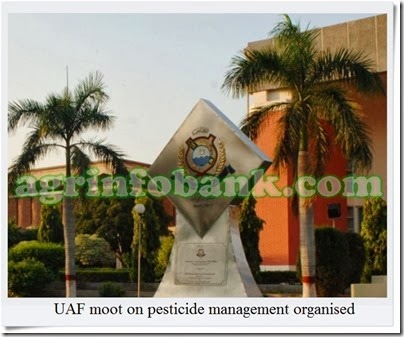
    UAF moot on pesticide management organised

    Excessive use of pesticides is not only increasing the resistance among insects but also affects human health because pesticide residues contamination reaching at alarming level. The country imports 12,000 metric tons of active ingredients of pesticides in a year.
    It was revealed by the speakers at an International Conference on Integrated Pest Management (IPM) of Fruits and Vegetable arranged by the Department of Entomology, University of Agriculture Faisalabad. The session was chaired by UAF Vice Chancellor Professor Dr Iqrar Ahmad Khan while Dr Oscar E Liburd from the University of Florida, USA was guest of honour UAF moot on pesticide management organised
    Professor Dr Oscar E Liburd said that it was need of the hour to adopt and promote the IPM techniques. Pesticides can be used as the last resort, he added. He said that over reliance on pesticides can have negative consequences including worker's safety issue, contamination of ground water, and negative effect on beneficial arthropods including honey bee and others.
    He was of the view that the world population will touch to 9 billion by 2050. Keeping the situation in view, it is must to ensure the food security and safety to feed the growing population. Professor Dr Iqrar Ahmad Khan stressed the need to adopt the Integrated Pest Management in order to lowering down the impact of the pesticides. He said that IPM is an approach of pest management which considers the whole agro-ecosystem.
    He said that Pakistan is cultivating fruits and vegetables on 4 percent of land. He said fruits production was standing at 0.70 million tonnes whereas vegetables share is 0.72 million tones. He said Pakistan's share in global market of fruits and vegetables is fetching $625 million. He said with the use of IPM, not only the production can be increased manifold but also a move to minimise hazardous affect on human health.
    Plant Breeding and Genetic Chairman Professor Dr Abdus Salam Khan called for stepping up efforts to ensure the food security. He said that residues from the misuse of pesticides are major concern in many countries including Pakistan. He said that 28.5percent of fruits and 37percent of vegetables exceeded the maximum residual limits (MRL). Department of Entomology Chairman Professor Dr Jalal Arif said that it is a matter of grave concerns that Pakistan's annual losses to fruits and vegetables are standing as many as $200 million because of the attack of fruit flies. Almost 1/3rd of the total harvest is destroyed by the potential pest. He said that the use of pesticide in Pakistan has increased manifold in the last 20 years. The trend must be curtailed and replace with IPM.
    News Source: Business Recorder    News Collected: agrinfobank.com Team

    Solar Engery in Agriculture Sector

    www.agrinfobank.com
    This energy source is widely distributed and abundantly available in the country. This was stated by speakers at an International Seminar on "Prospects, Development & Utilization of Alternate Energy in Pakistan" organized by Pakistan Society of Agricultural Engineers in collaboration with Faculty of Agricultural Engineering & Technology University of Agriculture, Faisalabad (UAF) at New Senate Hall here on Saturday.
    FAISALABAD: Pakistan being in the Sunny Belt is lucky to have long sunshine hours coupled with high insolation levels and is ideally located to take advantage of solar energy technologies.
    Prof. Dr. Iqrar Ahmad Khan, Vice Chancellor UAF Presided over the Seminar and Prof. Dr. Muhammad Abbas Chaudhary, Vice Chancellor UET Texilla was Chief Guest on this occasion.
    www.agrinfobank.com
     Rana Muhammad Afzal Khan, MPA, Dr. Muhammad Ashraf Chaudhary, Member Parliament New Zealand, Khalid Javed Ranjha, Additional Secretary Energy Punjab, Shehzada Khurram from Clean Alternative Energy (CAE) ex-Livestock Minister, Mumtaz Khan, PAEC Representative Dr. Nawaz Akhtar, Dean Faculty of Agri. Engineering UAF, Dr. Rai Niaz Ahmad, Dr. Muhammad Ghaffar Dogar, Mushtaq Ahmad Gill and Dr. Allah Bukhsh spoke on the occasion.   Scientists from Switzerland, Mr. Anton Joseph, Scientist from Italy, Mr. Ing Fausto Distante made presentation.

    The scientists said that the main global irradiation falling on horizontal surface is about 200-250 watt per m2 per day. They said that this amounts to about 1500-3000 sun shine hours and 1.9 - 2.3 Mwh per m2 per year.
    www.agrinfobank.com
     The speakers said Pakistan could make use of this freely available and widely distributed solar energy for improving the socio-economic conditions of the people living in remote areas and to reduce the poverty level.    Dr. Iqrar Ahmad Khan said that there was nexus between agriculture, energy and water so that scientists have to focus their attention to maintain this momentum.

    He revealed that a centre for International Standard Bio-Gas Energy would be established at UAF Campus with the help of Punjab Government.

    He was of the view that a Solar Panel Manufacturing plant as well as 3.8 Megawatt Solar Power Generation Plant would be established at the university campus which would provide affordable Solar Panel to the consumers.

    UET Texilla Vice Chancellor, Abbas Chaudhary said that Technical Universities can play significant role in order to provide solution to the Energy Crises being faced by the Country.
    www.agrinfobank.com Dr. Rae Niaz said that a state of the Art Bio-Gas Plant had been established with collaborative solutions to the farming community. Rana Muhammad Afzal said that Chief Minister Punjab, Muhammad Shahbaz Sharif utilizing all resources to generate energy through hydel, Coal, Bio-Gas and Solar Resources in the Province.

    Khalid Javed Ranjha said the Punjab Government was going to set up Mega Project on Tonsa Barrage for generating 120 Mega Watt Power.

    Mumtaz Khan Manhais stressed the need for small Solar Units for farming community at subsidized packages at village level.

    Shehzada Khurram said that his company would establish ever First Solar Energy Technology Development Plant at Faisalabad in which Solar Panels and other machinery would be manufactured at Local Level.

    Mushtaq Ahmad Gill said that "We have to switch over our traditional power generation system to renewable energy mechanism."
    Source of Article: http://www.brecorder.com/ 

    Potato prodution in Pakistan; A Review Article

    Pakistan is blessed with four seasons, having ideal environmental conditions for diversified agriculture production systems. Total geographical area of Pakistan is 79.6 million hectares ranging from great Himalayas to fertile Indus basin and deserted areas in Sindh and Baluchistan. Presently out of this total area, only 24.6 million hectares is under cultivation including 4.2 million hectares covered with forests. Remaining area accounts for deserted, mountainous and barren lands. Area classified as irrigated is about 18 million hectares while 6.6 million hectares is subjected to natural arid environmental conditions, completely depending upon natural precipitation to meet the crop irrigation requirements.
    Agriculture sector plays the role of backbone for the country pertaining to its socio-economic matters. Contribution of this sector to National Gross Domestic Production is 21.62% and involves about 44.7% of the total employment of the country. There is no blinking the fact that agriculture is the sector which has great potential to be explored for amelioration of economically strained circumstances, in which our country is entangled. Substantial growth of agriculture sector will not only tackle the menace of food security but will also resolve the severe issue of unemployment to great extent. Agronomic as well as horticultural crops are of great importance for feeding the 200 million people of the country. Major horticultural produce of the country are vegetable and fruit crops. Among the vegetables potato ranks higher position regarding area under cultivation and total yield.
    Globally potato is fourth largest food crop after rice, wheat and maize. China is the top country on global scale for potato production where 74.79 million tonnes were harvested in 2010. India produced 36.57 million tonnes of potato in 2010. In 2010-2011 potato was cultivated over an area of 159.4 thousand hectares (0.159 million hectares) and 3726.5 thousand tonnes (3.73 million tonnes) of potato were harvested in Pakistan. Surplus potato produced locally is exported to Dubai, Malaysia, Sri Lanka, Indonesia, Singapore and Iran. In 2009-2010, 245.329 million kg potato was exported to above mentioned countries and about Rs. 15 Billion export revenue is generated by potato yearly. Russia is another big market where demand of Pakistani potato is on rise.

    Domestication of potato is reported to be between 8000 BC-5000 BC in the regions of modern Peru and Bolivia. Present cultivated species of potato (Solanum tuberosum) is considered to be originated from Solanum brevicaule found in Peru. International Potato Center (Peru) holds the position of ISO-Accredited Collection Authority for potato germplasm. Potato plants are herbaceous perennials and require 25 0C temperature for germination, 20 0C for vegetative and 16-19°C for tuber formation. It is an entomophilic cross pollinated crop. Protein and energy production of potato crop is 1.4 kg/ha/day and 216 MJ/ha/day, respectively while for wheat crop protein production is 1.3 kg/ha/day and energy production is 135 MJ/ha/day. These figures make potato superior to wheat crop.
    Freshly harvested potato tubers contain about 79% moisture contents and 21% dry matter. Of total dry matter about 60-80% is starch in the form of amylose and amylopectin. Its nutritional value can be revealed by the presence of vitamins (B1, B2 and B6), minerals (potassium, phosphorus and magnesium), falate, pantothenic acid and riboflavin. In addition to this research activities explored its medicinal value. Presence of soluble and insoluble fibers help in preventing constipation, protect from colon cancer and decrease absorption of dietary cholesterol which leads to lower plasma LDL cholesterol. Recent studies suggest that flavonoids, antioxidants and querceton present in potato tubers have anticancer and cardio-protective properties and also protect our human body from infectious agents and scavenge harmful, pro-inflammatory free radicals.
    Starch from potato tubers is extensively used in paper, wood, textile and pharmaceutical industry where it is used as binder, texture, adhesive and filler agent. Oil drilling firms make use of potato starch for washing the boreholes. Tubers may contain toxic alkaloids as solanine and chaconine. Formation of solanine in tubers is indicated by greenish discoloration with sprouts on potato skin.

    In our country potato cultivation is categorized in three growing seasons as spring, summer and autumn crop with different geographical locations. In spring season it is grown in plains and lower hills of Balochistan and KPK province in January-February with harvesting in April-May. Summer crop is sown in northern hilly areas and Azad Jammu and Kashmir in March-May with harvesting in August-September. Autumn sowing is done in plains and
    southern Punjab, Sindh and plains of Balochistan in September-October and harvesting is done January-February. In total annual production, share of spring, summer and autumn crop is 7-10%, 15-20% and 70-75% respectively. For total area under cultivation for potato, share of Punjab is 83%, Sindh is 1%, KPK is 10% and Baluchistan is 6%. Punjab has highest share for production and area which is contributed by autumn and spring crop. Major potato producing districts in Punjab are Okara, Sahiwal, kasur, Sialkot, Sheikhupura, Narowal, Lahore, Pakpattan, Jhang, Tobe Tek Singh and Gujranwala, in KPK are Nowshera, Dir and Mansehra, in Baluchistan are Pishin, Kila Saaifulla and Kalat. Although, Pakistan is a large potato producing country yet per hectare yield is only 19.34 tonnes which is about 45.66 tones lower than that of developed countries as USA and Holland where average per hectare yield is 65 and 45.5 tonnes respectively.
    About 5000 varieties of potato exist worldwide. In Pakistan both white and red skin varieties are cultivated but red skinned are mostly liked by consumers. Red skin varieties include desiree, asterix, lady roseta, krouda, rodeo, cardinal, ultimas, lal-e-faisal, and simphonia while diamant, santana, ajax, patrones, multa and sante are white skin varieties being cultivated commercially.

    Sowing of virus contaminated uncertified seed, imbalanced use of NPK fertilizers, low level use of potassium, occurrence of copious diseases and insect pests are factors responsible for low yield. More than 18 potato diseases have been reported in Pakistan and 13 of which are of common occurrence including early blight, late blight, powdery mildew, common scab, stem rot, soft rot, and wilt caused by Alternaria solani, Phytophthora infestans, Erysiphe cichoracearum, Streptomyces scabies, Erwinia carotovora spp. carotovora, Fussarium spp and Verticillium dahlia, respectively. Potato viruses damaging the crop above threshhold level include potato virus X, potato virus Y, potato leaf roll virus and potato mop top virus. Major insect pests attacking crop include green peach aphids (Myzus persicae), cutworms (Agrotis spp.), colorado potato beetle, white grubs (Phyllorphaga spp.), wire worms (Elateridae spp.), potato leaf hoppers (Empoasca Fabae) and field cricket (Gryllus bimaculatus). Besides that potato cyst nematode (Heterodera rostochiensis) and root knot nematodes (Meloidogyne incognita) hamper root and tuber formation.
    Seed involves about 35-40% of total cost of production so virus free seed gains attention. White fly is the major vector of potato viral diseases. Although, certified seed production in country is limited due to lack of technical, economical and managerial skills and is unable to meet total seed requirement, yet Punjab Seed Corporation is a milestone from public research sector which started sale of virus free seed by using modern tissue culture technology. Limited quantities of caroda, santee, burna, easterx, desiree, cardinal and diamente produced by tissue culture are supplied to farmers. Major importers and distributers of potato seed are PEPSICO, AGRICO and Bari Seeds. National public sector organizations working in potato seed production are Agricultural Biotechnology NARC Islamabad, Plant Virology AARI Faisalabad, Hazara Agriculture Research Station Abbottabad, Potato Seed Unit Deptt. of Agri. Gilgit and Punjab Seed Corporation Sahiwal. While Syko International Company Lahore, Bari traders Lahore, Okara Potato, Vegetable & Fruit Growers Co-operative Society, Bhatti Brothers Lahore, Hammad & Company Sahiwal, Haji Sons Lahore, Stamex International Lahore, AGB Seed Company Lahore, Trade Channels Lahore and Punjab Agri. Farms Lahore are private sector organizations working in potato seed production locally.

    Biotechnological tools are also in application for developing genetically modified potato varieties. By the application of genetic engineering techniques Rpi-Vnt1.1 gene from Solanum venturrii has been introduced in commercial variety “Desiree” as this gene confers resistance to Phytophthora infestans (late blight).
    In conclusion, by following crop advisory recommendations for sowing time, plant population, balanced use of fertilizers, increased use of potassium, integrated disease and insect pests management, we will not only step forward to sustainable agriculture but will also reap economic benefit by increasing per acre yield to fetch foreign exchange by exporting the surplus produce.
    *Pictures source: Google
    About author: Qamar Shahzad Anjum is a PhD scholar at Institute of Horticultural Sciences, University of Agriculture Faisalabad Pakistan. Email: qamar2005.uaf@gmail.com

    Mushroom Farming: The Fungal Goldmine

    By Muhammad Zeeshan Farid & Dr Amjad Farooq
    A global trend in agriculture has been a shift away from simple systems that rely on traditional crops, to those that increasingly seek new varieties of plants that cater to advanced dietary needs. To this end, scientists and growers have recommended several new crops that can augment the spectrum of agricultural produce.
    Mushrooms, known locally as “khumbi”, are among this emerging cropping system. Mushrooms are essentially fungi, a group of organisms distinct from plants, animals and bacteria. They convert inedible plant waste into palatable food, which is savoured due to its biting texture and flavour. They form a complete diet as mushrooms contain essential vitamins and minerals, and are the best substitute for protein. They also contain traces of carbohydrates and fat.
    Dr Amjad Farooq works as an assistant professor at the Department of Horticulture of the PMAS-Arid Agriculture University, Rawalpindi. He explains that, according to estimates, there are more than 1,500 types of mushrooms found on planet earth – some of them are edible, but others are poisonous. The four most popular types are the button or European mushroom, the Japanese mushroom, the Chinese mushroom and the oyster mushroom. The best quality mushrooms available in Pakistan are the oyster mushroom, the white mushroom, the golden oyster mushroom, the phoenix (grey) oyster mushroom and the pink oyster mushroom. These strains grow all over the country, and are available usually after the monsoon season.

    Mushrooms can be cultivated between October and March. Cultivation does not require land and can be grown in small houses and huts as a part-time activity. Mushroom cultivation does not require full time-labour, and all family members can look after different operations easily. There are two modes of propagation for a mushroom crop: open-air field cultivation and controlled cultivation.
    After seven days of cultivation, small pin-like heads emerge from the mushroom, which turn into more mushrooms after three to five days. Branches which grow five to seven inches long, called flushes, are removed from the plants and dried. These can be used in cooking, or can be sold in the market. Flushes keep regenerating from the plant after every ten days of the removal of old ones: the cycle is very short, and as a result, highly productive.
    “A single flush or branch of mushroom can yield more than half a kilogramme (kg) of edible food after each week for three months,” says Dr Muhammad Nadeem, from the Institute of Horticultural Sciences, University of Agriculture Faisalabad (UAF).
    Thus, 100 beds of mushroom can yield more than 120kg of mushrooms a week. At the rate of Rs150 per kg, they can generate a lump sum profit of Rs18,000 a week, or Rs72,000 in a month. Dr Nadeem says the “production of mushrooms touches approximately 1.5 million tons in the world, while about 90 tons of mushrooms are exported to Europe from Pakistan every year.”
    Oyster mushrooms currently sell for around $6 a pound in the US. A growing area of around 200 square feet can produce 800 pounds per crop; or 5,000 pounds of mushrooms per year. This is worth almost $30,000 at current prices. It’s clear that growing oyster mushrooms for profit is a great way to make some extra cash.
    However, it should be kept in mind that, given the large variety of poisonous strains of mushrooms, spawn should be developed only under the supervision of experts. It is available at the UAF, the National Institute of Biotechnology and Genetic Engineering, the Ayub Agricultural Research Institute and other government research stations.
    Farmers who wish to cultivate mushrooms should book spawn well before the cultivation season, because it may not be readily available during the peak demand period. The UAF laboratory has developed some thermo-tolerant strains of the most widely grown button mushroom (Agaricus bisporus) and the oyster mushroom (Pleurotus cystidiosus).
    As basic training is required for profitable mushroom cultivation, the Continuing Education Department of the UAF offers a short course suited for farmers. Furthermore, the UAF’s Mushroom Lab can be contacted for guidance and information, and it can give proper suggestions and recommendations to those willing to invest in this lucrative business.
    Source: The express tribune
    Published on: 10/01/2012

    Flowers: Adding Rainbow Colors To Landscape

    By Adnan Younis, Dr. Atif Riaz and Dr. Muhammad Nadeem, Institute of Horticultural Sciences, University of Agriculture Faisalabad Pakistan
    Annual flowers are non-woody plants that complete their life cycle in one season, ending with seed production. Annual flowering plants can be propagated through seeds, unlike many biennials and perennials. They are thus best suited to environments that have a short growing season. Annual flowers can play an imperative role in a well-designed landscape and are an excellent way to draw attention to building and home entrances, walkways and outdoor living spaces and to provide homeowners and visitors with pleasing welcome.

    Flowers: Adding Rainbow Colors To Landscape

    Selection of flowers for garden needs a careful attention and should be carried out on the basis of plant height, color of flowers, nature of growth, and type of environment they need. Typically, a flower border has the tallest plants in the back, medium height plants in the middle and short plants in the front. The style of the annual bed should be compatible with the overall style of your landscape design. Plantation can be done either in a formal or informal design, depending on the arrangement of the planting. In formal designs are made up of geometric lines and symmetry, with strong focal points that attract the eye. In contrast, informal designs have curved, flowing lines and natural forms, follow natural terrain and create an asymmetrical balance within the planting.


    Before planting flowers, the physical characteristics of the site must be evaluated. Check the site's soil type, fertility status, drainage and its exposure to sun and wind. Compare site characteristics with specific plant requirements. An annual plant adapted to site conditions grows and flowers more vigorously and has fewer pest problems. Some plants intolerant of heat and sun may perform adequately when planted in part shade. Annual flowers offer flexibility in landscape design and planting can be changed each growing season, creating an entirely new design. As a part of their quick change potential, annuals are called “Temporary Visitors” of Garden.


    Designing a garden with plants exhibiting many different colors requires some coordination and color schemes. Consider the color of the house and any other fixed structures such as fences or utility buildings. Pink flowers can be used against a brick walls with orange tones would not produce a pleasant combination. Mostly it is more recommended to use masses of a single color instead of mixing colors in flowering beds because a mass planting of a single color or planting in bands of colors will produce a stronger impact.

    It is important to look location and how the flowers will be viewed from different angles. Bright colors stand out, while dark colors fade into the background. Bright colors catch attention to an area, so do not use red and yellow flowers near an eyesore or unattractive area. Bright colors seem closer, while dark colors make the area appear further away. White is the last color to fade from sight as darkness falls and thus is good for areas used at night.
    About author: Dr. Adnan Younis is Assistant Professor in Floriculture & Landscape Horticulture at Institute of Horticultural Sciences, University of Agriculture Faisalabad Pakistan. He got his Ph.D degree frm UAF Pakistan and Post Doc from USA. He is very active in teaching, research, seminars, writing, landscaping and a lot of other activities at national and international level.

    Export of Agricultural products much lower than potential

    "We can exploit our export potential by adopting international standards,” UAF vice chancellor.
     
    Exports of agricultural and livestock products from Pakistan have consistently increased in recent years, but these are much less than actual potential and are restricted to old wholesale markets, says the University of Agriculture Faisalabad (UAF) vice chancellor.
    “The share of our agricultural products in the fast growing high-price super markets is meagre,” said Dr Iqrar Ahmad while addressing the inaugural session of a five-day training course. The course was organised by the Endowment Fund Secretariat and AUS Aid.
    Ahmad said the close proximity of markets in the Middle East, Iran and Afghanistan, and market access to Malaysia, offered enormous potential for the export of agricultural and livestock products from Pakistan. “We can exploit our export potential by adopting international standards,” he stressed.
    Tariq Qamar, an international auditor, said: “New pressures from consumers, retailers and legislation have placed new demands on farmers,” he said.
    Published in The Express Tribune, December 11th, 2012.
     
    Support : agrinfobank.com | Oasis Agro Industries Pakistan
    Copyright © 2012. Agriculture Information Bank - All Rights Reserved
    Template Created by agrinfobank.com Team Published by agrinfobank Blog Team
    Proudly powered by Blogger
