


The amount of spray retention by foliage after postemergence applications can affect selectivity. This selectivity is usually due to the crop plant’s having a waxy cuticle that repels the spray solution.Examples include onions, peas, cereal grains, Brassica vegetable crops, and conifers. Medium to high spray volumes usually provide better selectivity, and adding an adjuvant can decrease selectivity as a result of enhanced adhesion of the spray droplets. 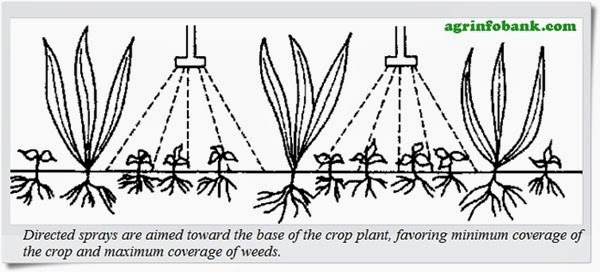 Differences in leaf shape, size, and orientation between weed and crop can provide some selectivity differences. This is most common for controlling dicot weeds in small grain crops (the grain leaves retain less herbicide because of shape, orientation, size, and granular epicuticular wax). Postemergence selectivity can be due to the growing point of the crop being protected from direct contact by the herbicide while the growing point of the weed is exposed. The best example is dicot weed control (growing point not well protected by emerging leaves) in small grains (growing point well protected by the whorls of emerging leaves). The herbicide must not have a high degree of phloem mobility for this selectivitymechanism to work. For more detail regarding the influence of plant morphology on herbicide absorption, see the review by Hess (1987).
 Differences in leaf shape, size, and orientation between weed and crop can provide some selectivity differences. This is most common for controlling dicot weeds in small grain crops (the grain leaves retain less herbicide because of shape, orientation, size, and granular epicuticular wax). Postemergence selectivity can be due to the growing point of the crop being protected from direct contact by the herbicide while the growing point of the weed is exposed. The best example is dicot weed control (growing point not well protected by emerging leaves) in small grains (growing point well protected by the whorls of emerging leaves). The herbicide must not have a high degree of phloem mobility for this selectivitymechanism to work. For more detail regarding the influence of plant morphology on herbicide absorption, see the review by Hess (1987).
Preemergence selectivity can be due to a difference in root morphology between the weed and the crop. Grass weeds usually have a fibrous root system, whereas dicot crops usually have a taproot system. Thus,growth inhibitor herbicides, such as trifluralin, applied to the soil come directly in contact with the growing root tips in grass weeds, but not with those of the deeper-rooted dicot crops. For this selectivity mechanism to be useful, the water solubility and soil binding characteristics of the herbicide must be such that movement isrestricted to the upper soil profile.
Morphology differences within stem tissue of grass plants can provide differences in selectivity. The growing point of many grass weeds (crabgrass and wild oat) are more exposed to herbicide-treated soil than wheat and barley where the growing point is protected inside the coleoptile.
Morphology differences within stem tissue of grass plants can provide differences in selectivity. The growing point of many grass weeds (crabgrass and wild oat) are more exposed to herbicide-treated soil than wheat and barley where the growing point is protected inside the coleoptile.


