Latest Updates :
    Showing posts with label Weeds Management. Show all posts
    Showing posts with label Weeds Management. Show all posts

    Anatomical Differences Between Crop and Weed

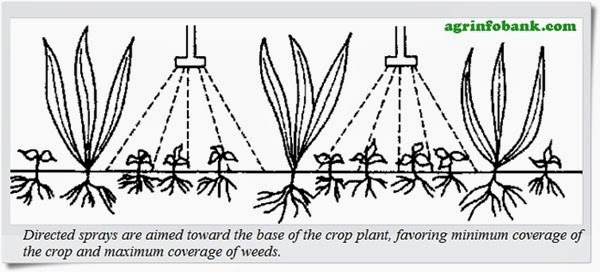
    The amount of spray retention by foliage after postemergence applications can affect selectivity. This selectivity is usually due to the crop plant’s having a waxy cuticle that repels the spray solution.Examples include onions, peas, cereal grains, Brassica vegetable crops, and conifers. Medium to high spray volumes usually provide better selectivity, and adding an adjuvant can decrease selectivity as a result of enhanced adhesion of the spray droplets. Anatomical Differences Between Crop and WeedDifferences in leaf shape, size, and orientation between weed and crop can provide some selectivity differences. This is most common for controlling dicot weeds in small grain crops (the grain leaves retain less herbicide because of shape, orientation, size, and granular epicuticular wax). Postemergence selectivity can be due to the growing point of the crop being protected from direct contact by the herbicide while the growing point of the weed is exposed. The best example is dicot weed control (growing point not well protected by emerging leaves) in small grains (growing point well protected by the whorls of emerging leaves). The herbicide must not have a high degree of phloem mobility for this selectivitymechanism to work. For more detail regarding the influence of plant morphology on herbicide absorption, see the review by Hess (1987).
    Preemergence selectivity can be due to a difference in root morphology between the weed and the crop. Grass weeds usually have a fibrous root system, whereas dicot crops usually have a taproot system. Thus,growth inhibitor herbicides, such as trifluralin, applied to the soil come directly in contact with the growing root tips in grass weeds, but not with those of the deeper-rooted dicot crops. For this selectivity mechanism to be useful, the water solubility and soil binding characteristics of the herbicide must be such that movement isrestricted to the upper soil profile.
    Morphology differences within stem tissue of grass plants can provide differences in selectivity. The growing point of many grass weeds (crabgrass and wild oat) are more exposed to herbicide-treated soil than wheat and barley where the growing point is protected inside the coleoptile.

    Effect of weed management practices and spacing on weed control

    By MUHAMMAD IQBAL
    To study the effect of weed management practices on weed control in wheat, an experiment was conducted at two locations Such as Agricultural Research Farm, NWFP Agricultural University, Peshawar and Agricultural research Farm, Faculty of Agriculture, Gomal University, D.I.Khan for the year 1998-1999 and 1999-2000. The experiment was laid out in split-split plot Design with three replications. The factors included in the experiment were varieties (Bakhtawar-92, Ghaznavi-98, and Inqilab-91) being assigned to main plots, while herbicides such as broad-spectrum herbicide, (2.4-D 72EC + Isoproturon 75 WP @ 623 and 649 g a.i. ha-1, respectively), broad Leaf herbicide, (2,4-0 72 EC @ 711 g a.i. ha-1), grasses weeds herbicide, (Isoproturon 75 WP @ 968 g a.i. ha1), and weedy check (no herbicide) were kept in sub-plots.
    Effect of weed management practices and spacing on weed control: agrinfobank.comThe row spacing (18, 25, and 32 cm) were allotted to sub-sub -plots. The experiment was planted on 31 October and 15 November in both years at Peshawar and D.I.Khan, respectively. Data were recorded on weed density and some agronomic, morphological and physiological traits of wheat and net profit and cost benefit ratio were calculated. The data for the individual trait were subjected to analysis of variance (ANOVA) and the means were separated by LSD. Variety Bakhtawar-92 was more productive and profitable than Ghaznavi-98 or Inqilab-91. It produced higher number of tillers m-2 (6% and 13%), grain yield (5% and 10%) and net profit (8% and 17%) than Ghaznavi-98 and Inqilab-91, respectively. The plots sown to Inqilab-91 variety, which is tallest and has vigorous early growth, had lesser number of grasses and broad leaf weeds than other verities. In Inqilab-9 I grasses weeds were reduced to 11% and 5%, and broad leaf weeds by 8 and 10% as compared to Bakhtawar-92 and Ghaznavi-98, respectively. The application of broad-spectrum herbicide consistently controlled both grasses and broad leaf weeds in all varieties at all row spacing in both locations and years. The increase in number of tillers m-2 (17%), number of productive tillers m-2 (18%), spikelets spike-1 (5%), 1000-grain weight (4%), biological yield (19%), grain yield (21%), straw yield (18%), harvest index (11%), and net profit (32%) over weedy check was due to application of broad spectrum herbicide, which controlled both grasses and broad leaf weeds. The interaction effect of broad- spectrum herbicides with variety Bakhtawar-92 produced significantly higher grain yield (24%) and net profit (34%), respectively. The interaction of broad spectrum with 18 cm row spacing was also significant in controlling both grasses and broad leaf weeds. The reduction in grasses and broad leaf weeds over the weedy check was 85 and 81%, respectively. The effect of 18 cm row spacing on reduction of both grasses and broad leaf weeds was significant, which ultimately increased number of tillers m-2 (9%), grain yield (10%) and net profit (23%), respectively over the weedy check. The 18 cm row spacing x Bakhtawar-92 interaction significantly increased grain yield (3% and 11 %) and net profit (8% and 23%) over 25 and 32 cm row spacing. In the light of the findings, it is suggested that for the integrated weed management in wheat, the broad-spectrum herbicide may be integrated with planting of aggressive varieties of wheat.
    Source: This is Abstract of thesis entitle “EFFECT OF WEED MANAGEMENT PRACTICES AND SPACING ON WEED CONTROL IN DIFFERENT WHEAT CULTIVARS IN N.W.F.P PAKISTAN” by MUHAMMAD IQBAL Affiliated with GOMAL UNIVERSITY D. I. KHAN / AGRONOMY, Published in 2002 under Agriculture Chemistry.

    Listen to Your Weeds!

    Put your ear to the ground and hear what your weeds are saying about your soil.

    What do you do when you see a weed in the garden? Jump in and frantically hack away with a hoe? Throw up your hands in despair? Learn something?
    Yes, learn something! Those weeds are excellent indicators of soil conditions. In fact, experts known as geochemical botanists often look for specific weeds to help them locate minerals in the soil and to pinpoint geological features. You can apply this science in your own backyard in two ways: to plant garden crops that will thrive in the same conditions as those weeds or to amend your soil so that the conditions are less inviting to the weeds you find there.
    Here are the most reliable weedy indicators and what they reveal about your soil.
    Weeds That Say Your Soil Is SoggyListen to Your Weeds!
    If you see dock, foxtails, horsetail, and willows, you can expect your site to suffer swampy conditions some time during the year. Other weeds that thrive in wet soil include goldenrod, Joe-Pye weed, oxeye daisy, poison hemlock, rushes, and sedges.
    What could you possibly grow in such conditions? How about a fabulous garden filled with plants that like wet feet? Ornamental willows, including pussy willow and curly willow, will flourish here and provide plenty of material for flower arrangements. You can also grow dogwoods, Japanese iris, Siberian iris, yellow flag, ligularia, cardinal flower, and turtlehead. Don't grow invasive wet-loving plants like purple loosestrife or meadowsweet, however. They can overwhelm the area and destroy the natural balance of the wetlands.
    Also, don't try to change these conditions. Wetlands are priceless natural habitats that are rapidly being lost to development. Besides, trying to "correct" such a site usually is a lost cause—in Nature, water almost always wins.
    Weeds That Cry Out "Compaction and Crust"
    Chicory and bindweed are telltale signs of compacted soil. That's why you often see the blue flowers of chicory along highways. Chicory also is common in gardens where beds have been left empty or, worse still, where soil has been worked when it's wet.
    If your weeds indicate compacted soil, plant a cover crop of white lupines and sweet clover. They have roots as strong as those of pesky chicory, and they help to break up the soil. At the same time, these cover crops replenish the nitrogen levels in the soil.
    Although a hard crust on your soil's surface can prevent many vegetables and flowers from breaking through, it doesn't deter quackgrass or mustard family weeds at all.
    If weedy mustard is flourishing in your garden, pull it up and plant closely related brassica crops such as broccoli, cabbage, cauliflower, and choy instead. They can push through crusty soil with ease. Replace quackgrass with a fast-growing grassy cover crop (such as rye) in fall, then till it under the following spring. The cover crop will loosen the soil and choke out the weeds.
    To aerate and lighten crusty and compacted soil, add compost. Prevent future problems by working your soil only when it's dry.
    Weeds That Signal Your Soil Is Sour
    Dandelions, mullein, sorrel, stinging nettle, and wild pansy all thrive in "sour" acidic soil (pH below 7.0).
    If you find these pests in your garden, grow plants that also like their soil on the tart side: hydrangeas (whose flowers achieve their most beautiful shades of blue in acidic soil), blueberries, rhododendrons, and azaleas. In the vegetable garden, endive, rhubarb, shallots, potatoes, and watermelon all tolerate soil with a pH as low as 5.0.
    Or, if you'd rather grow plants that thrive in neutral soils, you could raise your soil's pH by applying dolomitic limestone. To determine how much lime to use, send a soil sample to a lab for testing, then follow the lab's recommendations. Wood ashes also will raise soil pH, but don't use any more than 25 pounds per 1,000 square feet, and avoid applying them more often than every 2 or 3 years. Compost is a better buffer: Just add enough to raise your soil's pH to 6.5 or 6.8.
    Weeds That Say Your Soil Is Sweet
    Campion, field peppergrass, nodding thistle, salad burnet, scarlet pimpernel, and stinkweed all indicate a "sweet" alkaline soil (pH higher than 7.0).
    Ornamentals that do well in alkaline soil include lilacs, Persian candytuft, dianthus, baby's breath, helianthemum, dame's rocket, lavender, and mountain pinks. Some edibles also tolerate soil that's a little on the sweet side, including asparagus, broccoli, beets, muskmelons, lettuce, onions, and spinach.
    If you want to lower the pH of your alkaline soil, add peat moss or elemental sulfur at a rate suggested by soil test results. Or, again, simply add compost regularly to bring the pH closer to neutral.
    Weeds That Warn of Worn-Out Soil
    Biennial wormwood, common mullein, daisies, mugwort, wild carrot, wild parsnip, and wild radish are sure signs that your soil has poor fertility.
    Luckily, many perennials actually flower better when the amount of food in the soil is on the lean side. This list includes achillea, antennaria, artemisia, asclepias, centranthus, cerastium, coreopsis, echinops, eryngium, gaillardia, salvia, santolina, solidago, and stachys. In the edible department, beans (and other legumes), beets, carrots, parsnips, peas, radishes, sage, and thyme tolerate soil that's low in fertility.
    Of course, you could and should improve the fertility of at least some of that soil. First, have your soil tested. If the test reveals major deficiencies, correct them with organic fertilizers such as fish meal (for nitrogen), bonemeal (for phosphorus), and greensand (for potassium). From then on, use compost and cover crops to maintain your soil's fertility.
    Weeds That Reveal Your Soil Is Rich
    Fertile soil will often make its richness known by supporting happy and vigorous colonies of chickweed, henbit, and lamb's-quarter. In addition, a flush of redroot pigweed indicates an abundance of nitrogen in the soil, while knapweed and red clover reveal an excess of potassium. Spot lots of purslane and mustard? They could be telling you that your soil is rich in phosphorus.
    To take full advantage of your soil's fertility, plant heavy feeders, such as corn, broccoli, lettuce, melons, squash, tomatoes, and peppers.

    One year Seeding seven years Weeding

    One year Seeding seven years WeedingDormancy is a state of seeds and buds in which they are alive but not germinated. If all weed seeds were to germinate at one time, their seedlings could be destroyed. Dormancy allows storage of millions of weed seeds in soil and enables them to grow in flushes over years. In this context, the old gardeners saying “One year Seeding seven years weeding” is very appropriate. In fact, weed seeds have been found viable even after 20-80 years of burial in soil.
    Weed seeds exhibit three types of dormancy.
    1. Enforced dormancy - It is due to deep placement of weed seeds in soil during ploughing of the field. Weed seeds germinate readily when they are restored to top 3-5 cm. Enforced Dormancy is a non-specific character of seed. Cultivation encounters enforced dormancy by bringing the weeds to surface where they are exposed to light besides better aeration. High soil temperature and NO3 content of surface soil may further help in breaking seed dormancy.
    2. Innate dormancy - It is a genetically controlled character and it is a feature of specific weed seeds, which fail to germinate even if they are present in the top 3–5 cm soil, and adequate soil moisture and temperature provided to them. The possible reasons are the presence of (i) hard seed coats e.g., Setaria, Ipomoea, Xanthiums pp. and (ii) immature embryos e.g., Polygonum. In certain weed seeds particularly of Xerophytic origin, presence of inhibitors is responsible for innate dormancy. It can be overcome with passage of time, or under the influence of some climatic pressure.
    3. Induced dormancy - Induced dormancy results from some sudden physiological change in normally non-dormant weed seeds under the impact of marked rise in temperature and or CO2 content of soil, low O2 pressure, water logging etc. Wild oat (Avena fatua) seeds exhibit all three kinds of dormancy.

    Weeds Control in Upcoming Era

    Asad Manzoor
    Department of Agriculture and Agribusiness Management University of Karachi
    asad@gardener.com
    In the upcoming era, weed control methods currently being intensively researched will allow prolonged weed control options away from herbicides and mechanical methods in agricultural, horticultural and nonagricultural weed management. Biological control by insects and plant disease producing micro organisms, foretelling modeling of weed/crop relations, and the use of herbicide antidotes, more viable crops, allelopathy, and genetic engineering/modify will become more widespread as their consistency is enhanced.
    Weed Control In new EraThe generally purpose of additional approaches is to find out innovative, more environmentally suitable and friendly weed management methods/techniques that not only control weeds successfully, but advance our understanding and knowledge of weed ecology/biology and permit us more sustainable management of the agro ecosystem. Biological control of weeds by insects and plant disease organisms has had significant achievement in several weed management situations, and current research will direct to supplementary uses of natural agents. Significant biological research involves the potential introduction of natural control species commencing an invasive weed species site of origin (Watson, 1993). The use of herbicide antidotes (Hatzios and Wu, 1996) to defend crop plants has been doing well for some herbicides in some crops—for example, chloroacteamide herbicides in corn and sorghum. One of the supreme recent changes in weed control has occurred through the genetic transformation of crops with herbicide-resistant genes and the incorporation of herbicide resistance through conventional breeding. In 1999 and 2000, more than 50% of the U.S. soybean acreage and more than 30% of the corn acreage was planted to cultivars resistant to one of several herbicides. Genetic engineering offers marvelous potential in all areas of weed science for enhanced understanding of plants and of weed control. Genetic engineering, along with current advances in sequencing the genome of Arabidopsis (and in the future, other plants), will allow a clear understanding of specific gene function. My Pic for Article
    Such knowledge will authorize gene manipulation and modification in our agricultural activities, such as the finding of genes that add to weediness, competitiveness, allelopathy, dormancy, or a plant’s being a perennial, with functions (Weller et al., 2001; Gressel, 2000). Genes of interest in weed control methods once revealed may then be engineered into crops or used to manipulate weeds to achieve a wanted effect in crop productivity and reduced weed influences. One area in especially where genetic engineering may play a role is allelopathy. Allelopathy (Rizvi and Rizvi, 1992) results from any direct or indirect inhibitory or stimulatory effect by one plant (including microorganisms) on another through the production and release into the surroundings of a chemical compound. Although no marketable breakthroughs have yet occurred in engineering plants to produce higher concentration/amount of allelochemicals, rather a few such genes have been recognized in Arabidopsis. Genetic engineering of crop plants or cover crops with genes for allelochemicals could allow key strides in rising plants helpful in weed management. The future for weed control is thrilling, as there are many opportunities for challenging fundamental and applied approaches for weed management in our environment (Hall et al., 2000).
    References:
    Gressel, J. 2000. Molecular biology of weed control. Transgenic Res. 9:355–382.
    Hall, J. C., L. L. van Eerd, S. D. Miller, M. D. K. Owen, T. S. Prather, D. L. Shaner, M. Singh, K. C. Vaughn, and S. C. Weller. 2000. Future research directions for weed science. Weed Technol. 14:647–658.
    Hatzios, K. K., and J. Wu. 1996. Herbicide safeners: Tools for improving the efficacy and selectivity of herbicides. J. Envir. Sci. Health. B31:545–553.
    Rizvi, S. J. H., and V. Rizvi. 1992. Allelopathy: Basic and Applied Aspects. Chapman and Hall, London.
    Watson, A. K., ed. 1993. Biological Control of Weeds Handbook. WSSA Monograph Ser. #7.WSSA, Lawrence, KS.
    Weller, S. C., R. A. Bressan, P. B. Goldsbrough, T. B. Fredenburg, and P. M. Hasegawa. 2001.The impact of genomics on weed management in the 21st century. Weed Sci. 49:282–289.

    Mother Nature deplores a vacuum

    Crop rotations help prevent the buildup of weeds adapted to a particular cropping system. Certain weeds are more common in some crops than others. Pigweed, lamb’ squarter, common ragweed, velvetleaf, cocklebur, foxtail species, and crabgrass are found in summer-cultivated crops such ascorn. Mustards, wild oat, wild garlic, chickweed, and henbit are associated with fall-sown small grains. Pastures often contain perennial weeds such as ironweed and thistles. Changing crops changes the cultural conditions (planting date, crop competition, fertility, etc.) that a weed must tolerate. Rotating crops also often means that a different set of management tools (especially herbicides) will be used. The overall success of crop rotation in managing weeds depends on the ability to control the weeds in each crop grown in the rotation.

    Crop RotationRotation will prevent a weed species from becoming dominant in a field but will also maintain a diversity of weed species in the same area.  Crop rotation historically was very important for managing weed problems. Today, rotation is used more for managing diseases and insects than weeds. Rotation requires the farmer to have additional knowledge and to use additional equipment to manage the various rotational crops. Even with an abundant supply of fertilizers and diverse herbicides that make it possible to minimize the need of crop rotation for weed control, there are still sound reasons to rotate crops for environmental and pest management reasons. For example, corn rotated with soybeans consistently yields more than corn grown continuously in the same field. Rotation of vegetable crops is important to avoid buildup of soil diseases that reduce crop yields. However, rotation is not an option with long-term perennials such as orchards, forest trees, nurseries, and perennial forages. Some of the benefits of rotation can be retained in monoculture cropping systems by the selection of a variety of herbicides, especially those differing in mode of action, and the use of various cultural practices, especially cultivation.
    Herbicide diversity and cultivation help prevent the development of resistant weed populations that are adapted to an unchanging herbicide program and crop.  Problems tend to arise when farmers do not rotate their crops and pest management strategies in an integrated manner. For example, in the past the corn–soybean rotation avoided the buildup of corn rootworm in the corn cycle, as rotation for 1 year to soybean broke the insect life cycle. However, the insect has adapted to these cropping strategies to be able to survive on soybean and has once again become a major corn problem. Similar examples are available in weed control. With the availability of a variety of glyphosate-resistant crops, there will be a tendency to continually use glyphosate for weed control even as we rotate crops. This is poor management, and it will become necessary to rotate herbicide-resistant crops with nonresistant crops to avoid a buildup of weeds not well controlled by glyphosate. The same holds true for herbicides that inhibit branch chain amino acids and can be used in many of our major acreage crops. There is a law of nature that holds true for agriculture that one should always remember: “Mother Nature deplores a vacuum.” Repeated use of any successful pest management practice without appropriate integration with a variety of other tactics and rotation over time will result in that tactic’s selecting for its own extinction. There are many good examples of this phenomenon in weed science, and they are called herbicide-resistant weeds
     
    Support : agrinfobank.com | Oasis Agro Industries Pakistan
    Copyright © 2012. Agriculture Information Bank - All Rights Reserved
    Template Created by agrinfobank.com Team Published by agrinfobank Blog Team
    Proudly powered by Blogger