Latest Updates :
    Showing posts with label vegetables. Show all posts
    Showing posts with label vegetables. Show all posts

    Vegetables, fruits: supply system made further effective: minister

    Punjab Food Minister and Chairman Price Control Committee Bilal Yaseen said supply system of vegetables and fruits have been made further effective in all markets of districts across Punjab. He said, as a result of government steps, prices of everyday items have been reduced, due to which edible items have now become accessible to the common man. Vegetables, fruits: supply system made further effective: ministerThe Provincial Food Minister expressed these views while monitoring auction of vegetables and fruits at Badami Bagh Market early morning. He said Punjab government has made foolproof planning to provide relief to the common man, due to which price hike has been controlled to a great extent. He said profiteers and illegal overcharging elements have now been brought under the grip of strict law, due to which citizens have been made available vegetables, fruits and everyday items at affordable rates. Food Minister directed staff deputed at Badami Bagh Fruit Market to ensure their presence at the hour of auctioneering at the market, along with prominently displaying rate list of vegetables and fruits.

    Courtesy Business Recorder  I News Collated by agrinfobank.com

    R&D to unlock $7 billion fruit and veg export potential in Pakistan

    Pakistan has the potential to increase the value of its fruit and vegetable export from $25 million to $7 billion over the next decade, if it were to invest more in research and development.
    The issue was discussed between Pakistan Council of Scientific and Industrial Research (PCSIR) and All Pakistan Fruit and Vegetable Exporters, Importers and Merchants (PFVA) at a meeting at PCSIR head office on Friday. R&D to unlock $7 billion fruit and veg export potential in Pakistan
    The participants included: Director General, Dr S Naimat Ali Rizvi, Dr Omer and Dr Khalid Jamil, and Ms Beena Naqvi, Senior Scientific Officer from PCSIR while PFVA was represented by Waheed Ahmed and Mohammad Ilyas Khan, Chairman and Secretary General respectively of PFVA.
    it has long been the plan of the PFVA Chairman to initiate improved processes for research and development across the country.
    The agenda of the recent meeting was to: Share the concerns of the PFVA about the issues/problems related to export of fruits and vegetables, share the vision of the PFVA about R&D in this segment of agribusiness, seek technical assistance, advice and support of the PCSIR in establishment of R&D facilities for the PFVA, and get familiar with their labs and research work in agribusiness.
    The Chairman, PFVA expressed his keen desire that the PCSIR play an active role in conducting training workshops/seminars for bridging the communication gap between growers and exporters.
    The Director General, Dr Rizvi, assured the PFVA Chair that the PCSIR would be happy to provide assistance on the following items:
    - Developing a specific pesticide for a particular issue.
    - Assist PFVA in developing Ethylene Chambers for ripening various fruits.
    - Conduct seminars for growers/exporters for bridging the communication gap.
    - Assist growers in multiplying the yield significantly by use of "Plant Tissue Culture Technology" (PTCT) which would ultimately benefit exports as well.
    - Provide "soli testing" facility to the growers, and provide technical expertise to PFVA in resolution of any specific issue referred to the PCSIR.
    Source: Business Recorder

    Vegetables, fruits prices on rise in retail market

    June 20, 2013 N H ZUBERI
    Vegetables, fruits prices on rise in retail marketVegetables and fruits prices have started climbing as retailers feared that onion and tomato may become dearer in coming days. They said that consumption of onion, green chili, tomato, potato and fruits increased and alleged that the people had started hoarding of onion to make money.
    Onion price has registered an increase from Rs 8 to Rs 10 per kg to Rs 40 to 45 per kg in last few days. Similarly price of tomato has been raised by Rs 8-10 to Rs 80 to 85 per kg, lemon to Rs 160 per kg. Besides vegetables, prices of different varsities of mango are higher as compared to last year.
    At retail, Langra is being sols at Rs 60 to Rs 65 per kg, Sindhri Rs 80 to Rs 95 per kg, Dasari Rs 70 to Rs 80 per kg, Jamon Rs 100 per kg and Leachy Rs 250 to Rs 300 per kg, bananas Rs 50 to Rs 70 per dozen, peach Rs 100 to Rs 130 per kg. Green chilly is being offered at Rs 20 per 100 gram, garlic at Rs 200 to 250 per kg, ginger at Rs 150 per kg in the retail market
    .

    Big Vegetables, Small Space


    Vegetable gardening is still gaining in popularity and I can certainly understand why. What other activity lets you eat your work? What's really nice seeing how people aren't letting limited space stop them. I've seen pots strapped to railings and foundation yews under planted with hot peppers. If you're on the fence about adding more veggies in your garden, here's some inspiration to convince you.

    If you have any tricks or tips of your own, for squeezing in more vegetables, for goodness sake, let us know!

    You don't need a farm to grow Sitting Considerations

    Sun: Vegetables need a good 6 or more hours of sun each day. Without sun, the fruits will not ripen and the plants will be stressed. There are a few vegetables that can survive in light shade, lettuce and other greens, broccoli and Cole crops, but if you can't provide sun, you might want to reconsider having a vegetable garden.
    Water: Vegetables also require regular watering. Without regular water, vegetables will not fill out and some, like tomatoes, will crack open if suddenly plumped up with water after struggling without for awhile.
    You can't always rely on rain. If you have the means, a drip irrigation system is a definite plus for a vegetable garden. The new component systems are really quite easy to install and cost a lot less than most people think. And you'll save money on water, because it goes directly to the plant's roots. Less is lost to evaporation.
    If you don't want to opt for drip irrigation, try and site your vegetable garden near a water spigot. You'll be more likely to water if you don't have to drag the hose out.
    Soil: The final consideration is essential. Vegetables need a soil rich in organic matter. Soil is important to the growth of all plants, but more so with vegetables, because even taste is affected by the quality of the soil. That's part of why wine from the same grape variety can vary from region to region and why some areas grow hotter peppers than others.
    If you can provide these three basics: sun, water and great soil, you can vegetable garden.


    How Much Space Does it Take

    Granted, a small space vegetable garden may not be enough for subsistence farming, but it will be enough to grow great tasting tomatoes, some beautiful heirloom eggplants or an endless supply of cutting greens. If you have limited space, consider what vegetables you can purchase fresh in your area already and what vegetables you truly love and/or miss.
    Compact Varieties: If you must have a beefsteak tomato or a row of sweet corn, the variety in your small space vegetable garden will be limited. But you can choose varieties that are bred to grow in small spaces. Anything with the words patio, pixie, tiny, baby or dwarf in their name is a good bet. Just because a plant is bred to be small doesn't mean the fruits will be small or the yield will be less.
    Most seeds and seedlings will tell you the mature size of the plants you are selecting. Knowing that, you can space things out and see how much you can fit into your space. More likely however, you will do what most gardeners do and squeeze in as many seedlings as you can fit into your garden and deal with the crowding later. That's one way to get a large yield from a small space.
    If you are truly short of space, interplant your vegetables with your flowers. There's no rule that says you can't mix the two. It can be a bit harder to harvest, but many vegetables are quite ornamental in their own right.
    Growing Up: If you do opt for a variety of vegetables in your garden, I would recommend the compact varieties and also vining crops that can be trained up on supports. Pole beans take up less space than bush beans. Vining cucumbers and squash, as aggressive as they can be, actually take up less area than their bush cousins.
    Companion Planting: Companion planting is often touted for the benefit of cutting down on pest infestations. It also serves well to conserve space. Shade tolerant plants will benefit from being planted next to taller crops. Basil likes a respite from hot sun and does well next to tomatoes. Lettuce will keep producing all summer if shaded by almost any taller plant. Early harvested crops, like spinach, radishes and peas, can be planted with slower growing crops like broccoli or peppers, which will take over once the spring crops are gone.
    Companion planting is an art and it can be one of the more fun challenges of gardening. Why limit it to the vegetable garden. Mix your vegetables and flowers.
    Succession Planting: Succession planting is a great technique for any vegetable garden large or small. But it is all the more valuable when space is limited. Succession planting means reseeding quick growing crops every 2-3 weeks during the growing season. It is especially popular with crops like beans, zucchini and lettuce, that tend to exhaust themselves producing so much. By successively planting, you will have just enough produce for your family's appetite and you'll have it all summer, not all at once.
    Crop Rotation: Rotating crops to different areas of the garden each year is an excellent way to cut down on diseases and insect pests that over winter in the soil. This really isn't possible in small vegetable gardens. You'll just have to be vigilant about not letting problems get out of hand. If a large scale problem should occur, such as squash beetles or septoria leaf spot on tomatoes, seriously consider not growing the crop for a year. It will be a sacrifice, but one year without is better than several years of a disappointing crop.


    Growing Fruits and Vegetables in Containers

    Virtually any fruit, vegetable or herb can be grown in a container, if the container is large enough. As with ornamental container gardening, this is a great way to control the soil, sun and growing conditions of your edible plants. It is also a great way to squeeze edible gardening into the smallest spaces, by siting them on your patio, front steps or driveway.


    Windowsill Gardens

    Growing edibles indoors on a windowsill is an easy, low space option for plants that are frequently harvested, like herbs and lettuce. This idea isn't just for gardeners with limited space. Any gardener can extend their growing season by potting up some herbs for indoor growing.

    Management of Thrips in Garlic

    Garlic is widely used as a condiment in Indian cuisine, especially for its medicinal properties.

    It is grown in Maharashtra, Gujarat, Rajasthan, Orissa, Madhya Pradesh, Utter Pradesh, Punjab, Haryana and Tamil Nadu (Nilgiris and Kodaikanal hills).

    Among the insect pests, the onion thrips, Thrips tabaci is a major one injuring garlic.

    Damage symptoms

    Both nymphs and adults cause injury to the plants by sucking the vital leaf sap.

    They remain in dense concentrations at leaf bases and whorls and feed by lacerating the tissues and imbibing the oozing cell sap.

    The infestation develops a spotted appearance on the leaves, subsequently turning into silvery white blotches. The leaf tips fade and the basal portions get blighted and distorted from tip downwards and finally the plant dries up. The affected plants yield less, with small sized bulbs.

    Adults are slender, yellowish brown and measure about 1mm in length and have narrow fringed wings.

    Eggs are laid singly in tender leaves by making slits with sharp ovipositors by the females.

    A single female lays 40-50 eggs which hatch after 4-9 days. The entire life cycle is completed in 11-21 days. There are more than ten generations per year. The pest occurs on garlic from November to May and migrates to other crops from June.

    Management

    Varieties with open type growth and circular leaf structure are not preferred by thrips.

    Tolerant varieties of Garlic viz. G-2, G-19, LCG-1, Ooty-1 may be utilised for cultivation.

    Higher doses of nitrogenous fertilizers and close planting should be avoided.

    Clean cultivation, regular hoeing and flooding of infested field will check the thrips population.

    Insect predators like green lacewing fly and tiny ladybird beetles check the population of this pest.

    Application of profenofos or malathion 0.05 per cent, methyl demeton 0.025 per cent , monocrotophos 0.036 per cent, formothion 0.025 per cent, dimethoate 0.03 per cent, carbaryl 0.1 per cent or phorate 10G at 10kg/hectare could control the pest.


    Mr.Jayaraj (Author)
    About Author:

    J. Jayaraj, associate prof and R.K. Murali Baskaran Professor & Head, Dept of Entomology, Agricultural College and Research Institute, Madurai 625 104, email: vu2jrj@rediffmail.com, phone: 0452- 2422956 Extn: 214
    Source of Article: Return to frontpage

    Cucumber nutrition facts

    BY: A M Awan
    Ever wonder how to beat the scorching summer heat? Remember humble crunchy cucumber! This wonderful, low calorie vegetable indeed has more nutrients to offer than just water and electrolytes.
    The vegetable is one of the oldest cultivated crops and believed to be originating in the northern plains of Indian subcontinent. The plant is a creeper (vine) like other members of Cucurbita family, for example, gourds,squashes,melons,zucchini, etc.
    Botanically; it belongs to the Cucurbitaceaefamily; and is known scientifically as Cucumis sativus.
    Cucumber is easy to grow. Varieties, varying in size, shape, and color, are cultivated all around the world. In general, the fruit features dark-green skin, crispy moisture rich flesh, and small edible seeds concentrated at its core.
    As in other squash members, cucumbers too are best-harvested young, tender and just short of reaching maturity, at the stage when they taste sweet, have crunchy texture, and unique flavor. If left uninterrupted, the fruit continues to grow in size, its skin becomes tougher and turns yellow, and seeds become hard and inedible. Fresh cucumbers are available throughout the season and can be eaten raw as is or in vegetable salads or juicing.
    Armenian cucumbers (Cucumis melo var. flexuosus) are long, crispy, and thin-ribbed, curved, and have light green color. Although grouped botanically in the melon family, they appear and taste just like cucumbers.
    Miniature varieties such as gherkins, American-dills, and French-cornichonsare very small indeed and usually preferred in pickling.

    Health benefits of Cucumber

    • It is one of the very low calorie vegetables; provide just 15 calories per 100 g. It contains no saturated fats or cholesterol. Cucumber peel is a good source of dietary fiber that helps reduce constipation, and offer some protection against colon cancers by eliminating toxic compounds from the gut.
    • It is a very good source of potassium, an important intracellular electrolyte. 100 g of cucumber provides 147 mg of potassium but only 2 mg of sodium. Potassium is a heart friendly electrolyte helps bring a reduction in total blood pressure and heart rates by countering effects of sodium.
    • Cucumbers contains unique anti-oxidants in moderate ratios such as ß-caroteneand α-carotene, vitamin-C, vitamin-A,zea-xanthinand lutein. These compounds help act as protective scavengers against oxygen-derived free radicals and reactive oxygen species (ROS) that play a role in aging and various disease processes. Their total antioxidant strength, measured in terms of oxygen radical absorbance capacity (ORAC value), is 214 µmol TE/100 g.
    • Cucumbers have mild diuretic property, which perhaps attributed to their free-water, and potassium and low sodium content. This helps in checking weight gain and high blood pressure.
    • They surprisingly have a high amount of vitamin K, provides about 17 µg of this vitamin per 100 g. Vitamin-K has been found to have a potential role in bone strength by promoting osteotrophic (bone mass building) activity. It also has established role in the treatment of Alzheimer's disease patients by limiting neuronal damage in their brain.
    1.Quick pick me-up - Cucumbers are a good source of B vitamins. Put down your sodas and coffee and eat a cucumber slice.

    2. Rehydrates body and replenishes daily vitamins - Cucumbers are 95 percent water, keeping the body hydrated while helping the body eliminate toxins. Cucumbers have most of the vitamins the body needs in a single day. Don't forget to leave the skin on because the skin contains a good amount of vitamin C, about 10 percent of the daily-recommended allowance.

    3. Skin and hair care - If you don't like to eat the skin, it can be used for skin irritations and sunburns as aloe would be used. Place a slice over puffy eyes and its anti-inflammatory properties help reduce puffiness. The silicon and sulfur in cucumbers help to stimulate hair growth.

    4. Fight cancers - Cucumber are known to contain lariciresinol, pinoresinol, and secoisolariciresinol. These three lignans have a strong history of research in connection with reduced risk of several cancer types, including breast cancer, ovarian cancer, uterine cancer and prostate cancer.

    5. Home care - Eliminates a foggy mirror. Before taking a shower, rub a cucumber slice along a mirror and it will eliminate the mirror fogging up. Instead of WD40, take a cucumber slice and rub it along a squeaky hinge and your door will stop squeaking.

    6. Relieves bad breath - Take a slice of cucumber and press it to the roof of your mouth with your tongue for 30 seconds, the phytochemcials will kill the bacteria in your mouth responsible for causing bad breath.

    7. Hangover cure - To avoid a morning hangover or headache; eat a few cucumber slices before going to bed. Cucumbers contain enough sugar, B vitamins and electrolytes to replenish many essential nutrients, reducing the intensity of both hangover and headache.

    8. Aids in weight loss and digestion - Due to its low calorie and high water content, cucumber is an ideal diet for people who are looking for weight loss. The high water content and dietary fiber in cucumbers are very effective in ridding the body of toxins from the digestive system, aiding digestion. Daily consumption of cucumbers can be regarded as a remedy for chronic constipation.

    9. Cures diabetes, reduces cholesterol and controls blood pressure - Cucumber juice contains a hormone which is needed by the cells of the pancreas for producing insulin which has been found to be beneficial to diabetic patients. Researchers found that a compound called sterols in cucumbers may help reduce cholesterol levels. Cucumbers contain a lot of potassium, magnesium and fiber. These work effectively for regulating blood pressure. This makes cucumbers good for treating both low blood pressure and high blood pressure.

    10. Promotes joint health, relieves gout and arthritis pain -Cucumber is an excellent source of silica, which is known to help promotes joint health by strengthening the connective tissues. They are also rich in vitamin A, B1, B6, C & D, Folate, Calcium, Magnesium, and Potassium. When mixed with carrot juice, they can relieve gout and arthritis pain by lowering the uric acid levels


    Sorces:
    http://www.healthonlinezine.info/15-health-benefits-of-cucumber.html
    http://www.eatingwell.com
    http://www.naturalnews.com/035719_cucumbers_anti-aging_vegetables.htmlhttp://www.nutrition-and-you.com/cucumber.html

    Cucumber nutrition facts

    BY: A M Awan
    Ever wonder how to beat the scorching summer heat? Remember humble crunchy cucumber! This wonderful, low calorie vegetable indeed has more nutrients to offer than just water and electrolytes.
    The vegetable is one of the oldest cultivated crops and believed to be originating in the northern plains of Indian subcontinent. The plant is a creeper (vine) like other members of Cucurbita family, for example, gourds,squashes,melons,zucchini, etc.
    Botanically; it belongs to the Cucurbitaceaefamily; and is known scientifically as Cucumis sativus.
    Cucumber is easy to grow. Varieties, varying in size, shape, and color, are cultivated all around the world. In general, the fruit features dark-green skin, crispy moisture rich flesh, and small edible seeds concentrated at its core.
    As in other squash members, cucumbers too are best-harvested young, tender and just short of reaching maturity, at the stage when they taste sweet, have crunchy texture, and unique flavor. If left uninterrupted, the fruit continues to grow in size, its skin becomes tougher and turns yellow, and seeds become hard and inedible. Fresh cucumbers are available throughout the season and can be eaten raw as is or in vegetable salads or juicing.
    Armenian cucumbers (Cucumis melo var. flexuosus) are long, crispy, and thin-ribbed, curved, and have light green color. Although grouped botanically in the melon family, they appear and taste just like cucumbers.
    Miniature varieties such as gherkins, American-dills, and French-cornichonsare very small indeed and usually preferred in pickling.

    Health benefits of Cucumber

    • It is one of the very low calorie vegetables; provide just 15 calories per 100 g. It contains no saturated fats or cholesterol. Cucumber peel is a good source of dietary fiber that helps reduce constipation, and offer some protection against colon cancers by eliminating toxic compounds from the gut.
    • It is a very good source of potassium, an important intracellular electrolyte. 100 g of cucumber provides 147 mg of potassium but only 2 mg of sodium. Potassium is a heart friendly electrolyte helps bring a reduction in total blood pressure and heart rates by countering effects of sodium.
    • Cucumbers contains unique anti-oxidants in moderate ratios such as ß-caroteneand α-carotene, vitamin-C, vitamin-A,zea-xanthinand lutein. These compounds help act as protective scavengers against oxygen-derived free radicals and reactive oxygen species (ROS) that play a role in aging and various disease processes. Their total antioxidant strength, measured in terms of oxygen radical absorbance capacity (ORAC value), is 214 µmol TE/100 g.
    • Cucumbers have mild diuretic property, which perhaps attributed to their free-water, and potassium and low sodium content. This helps in checking weight gain and high blood pressure.
    • They surprisingly have a high amount of vitamin K, provides about 17 µg of this vitamin per 100 g. Vitamin-K has been found to have a potential role in bone strength by promoting osteotrophic (bone mass building) activity. It also has established role in the treatment of Alzheimer's disease patients by limiting neuronal damage in their brain.
    1.Quick pick me-up - Cucumbers are a good source of B vitamins. Put down your sodas and coffee and eat a cucumber slice.

    2. Rehydrates body and replenishes daily vitamins - Cucumbers are 95 percent water, keeping the body hydrated while helping the body eliminate toxins. Cucumbers have most of the vitamins the body needs in a single day. Don't forget to leave the skin on because the skin contains a good amount of vitamin C, about 10 percent of the daily-recommended allowance.

    3. Skin and hair care - If you don't like to eat the skin, it can be used for skin irritations and sunburns as aloe would be used. Place a slice over puffy eyes and its anti-inflammatory properties help reduce puffiness. The silicon and sulfur in cucumbers help to stimulate hair growth.

    4. Fight cancers - Cucumber are known to contain lariciresinol, pinoresinol, and secoisolariciresinol. These three lignans have a strong history of research in connection with reduced risk of several cancer types, including breast cancer, ovarian cancer, uterine cancer and prostate cancer.

    5. Home care - Eliminates a foggy mirror. Before taking a shower, rub a cucumber slice along a mirror and it will eliminate the mirror fogging up. Instead of WD40, take a cucumber slice and rub it along a squeaky hinge and your door will stop squeaking.

    6. Relieves bad breath - Take a slice of cucumber and press it to the roof of your mouth with your tongue for 30 seconds, the phytochemcials will kill the bacteria in your mouth responsible for causing bad breath.

    7. Hangover cure - To avoid a morning hangover or headache; eat a few cucumber slices before going to bed. Cucumbers contain enough sugar, B vitamins and electrolytes to replenish many essential nutrients, reducing the intensity of both hangover and headache.

    8. Aids in weight loss and digestion - Due to its low calorie and high water content, cucumber is an ideal diet for people who are looking for weight loss. The high water content and dietary fiber in cucumbers are very effective in ridding the body of toxins from the digestive system, aiding digestion. Daily consumption of cucumbers can be regarded as a remedy for chronic constipation.

    9. Cures diabetes, reduces cholesterol and controls blood pressure - Cucumber juice contains a hormone which is needed by the cells of the pancreas for producing insulin which has been found to be beneficial to diabetic patients. Researchers found that a compound called sterols in cucumbers may help reduce cholesterol levels. Cucumbers contain a lot of potassium, magnesium and fiber. These work effectively for regulating blood pressure. This makes cucumbers good for treating both low blood pressure and high blood pressure.

    10. Promotes joint health, relieves gout and arthritis pain -Cucumber is an excellent source of silica, which is known to help promotes joint health by strengthening the connective tissues. They are also rich in vitamin A, B1, B6, C & D, Folate, Calcium, Magnesium, and Potassium. When mixed with carrot juice, they can relieve gout and arthritis pain by lowering the uric acid levels


    Sorces: 
    http://www.healthonlinezine.info/15-health-benefits-of-cucumber.html
    http://www.eatingwell.com
    http://www.naturalnews.com/035719_cucumbers_anti-aging_vegetables.htmlhttp://www.nutrition-and-you.com/cucumber.html
       

    Cabbage nutrition facts

    BY: A M Awan
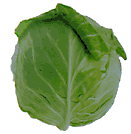
    cabbageRich in phyto-nutrients, this cool season leafy vegetable belongs to the "Brassica" family of vegetables, which also include brussels sprouts,cauliflower,bok choy, kale, and broccoli. It is one of the widely cultivated crops around the world.
    Scientific name: Brassica oleracea (capitata group).
    Cabbage structurally consists of clusters of stiff leaves superimposed one over the other in compact layers, giving it a round or globular shape. Several varieties are cultivated worldwide including green, purple, red, and savoy (loose-wrinkled leaves).
    Bok-choyor "Chinese-cabbage" features similar appearance, but derived from different species of the same Brassica genus vegetables. Bok-choy characteristically has a vigorous growth pattern. The whole plant has a long cylindrical shape, comprising of short, compact leaves.


    Health benefits of cabbage

    • Fresh, dark green-leafy cabbage is incredibly nutritious; however, very low in fat and calories. 100 g of leaves provide just 25 calories.
    • The vegetable is the storehouse of phyto-chemicals like thiocyanates, indole-3-carbinol, lutein, zea-xanthin, sulforaphane, and isothiocyanates. These compounds are powerful antioxidants and known to help protect against breast, colon, and prostate cancers and help reduce LDLor "bad cholesterol" levels in the blood.
    •  
    •  

      Fresh cabbage is an excellent source of natural antioxidant, vitamin C. Provides 36.6 mg or about 61% of RDA, more than that of in the oranges. Regular consumption of foods rich in vitamin C helps the body develop resistance against infectious agents and scavenge harmful, pro-inflammatory free radicals.
    • Total antioxidant strength measured in terms of oxygen radical absorbance capacity (ORAC value) is 508 µmol TE/100 g. Red cabbages contain more antioxidant value, 2252 µmol TE/100 g.
    • It is also rich in essential vitamins such as pantothenic acid (vitamin B-5), pyridoxine (vitamin B-6) and thiamin (vitamin B-1). These vitamins are essential in the sense that our body requires them from external sources to replenish.
    • It also contains a adequate amount of minerals like potassium, manganese, iron, and magnesium. Potassium is an important component of cell and body fluids that helps controlling heart rate and blood pressure. Manganese is used by the body as a co-factor for the antioxidant enzyme, superoxide dismutase.Iron is required for the red blood cell formation.
    • Cabbage is a very good source of vitamin K, provides about 63% of RDA levels. Vitamin-K has the potential role in bone metabolism by promoting osteotrophic activity in them. So enough vitamin K in the diet gives you healthy bones. In addition, vitamin-K also has established role in curing Alzheimer's disease patients by limiting neuronal damage in their brain.

    A Vegetable Garden at home


    A Vegetable Garden at home
    .
     
    Support : agrinfobank.com | Oasis Agro Industries Pakistan
    Copyright © 2012. Agriculture Information Bank - All Rights Reserved
    Template Created by agrinfobank.com Team Published by agrinfobank Blog Team
    Proudly powered by Blogger