


| Nutrient | Functions |
| Nitrogen (N) | Synthesis of proteins (growth and yield). |
| Phosphorus (P) | Cellular division and formation of energetic structures. |
| Potassium (K) | Transport of sugars, stomata control, cofactor of many enzymes, reduces susceptibility to plant diseases. |
| Calcium (Ca) | A major building block in cell walls, and reduces susceptibility to diseases. |
| Sulphur (S) | Synthesis of essential amino acids cystin and methionine. |
| Magnesium (Mg) | Central part of chlorophyll molecule. |
| Iron (Fe) | Chlorophyll synthesis. |
| Manganese (Mn) | Necessary in the photosynthesis process. |
| Boron (B) | Formation of cell wall. Germination and elongation of pollen tube. |
| Zinc (Zn) | Auxins synthesis. |
| Copper (Cu) | Influences in the metabolism of nitrogen and carbohydrates. |
| Molybdenum (Mo) | Component of nitrate-reductase and nitrogenase enzymes. |
Showing posts with label Nutrient Management. Show all posts
Showing posts with label Nutrient Management. Show all posts
Main functions of plant nutrients
Nutrient Management for Sunflower Production
Fertilizer management is an important part for sunflower production and one must know how input affects the crop and soil traits. Determination of optimum fertilizer rates is important because of increasing economic and environmental concerns. This study was therefore conducted to determine optimum fertilizer and manure requirement for sunflower production. In this regard, three field experiments were conducted at Students Farm, Sindh Agriculture University, Tandojam, Pakistan, located at 25o25’60’N 68o31’ 60E, altitude 19.5 m asl. In all the experiments sunflower variety HO-1 was sown in rows (75 cm spacing). The experiment-1, was meant to evaluate NPK, Zn and B requirements for sunflower production. The treatments consisted: Factor-A=Seasons (Spring and Autumn), Factor-B NPK Levels (0-0-0 NPK kg ha-1, 60-30-30 NPK kg ha-1 (N as broadcast), 90-45-45 NPK kg ha-1 (N as broadcast), 120-60-60 NPK kg ha-1 kg ha-1 (N as broadcast), 60-30-30 NPK kg ha-1 (N as fertigation), 90-45-45 NPK kg ha-1 (N as fertigation) and 120-60-60 NPK kg ha-1 (N as fertigation) and Factor-C (zinc and boron levels (0-0, 10.0-1.5, 10.0-2.0, 15.0-1.5, 15.0.2.0, 20.0-1.5 and 20.0-2.0 Zn+B kg ha-1). The results recorded taller plants (207.2 cm), maximum stem girth (12.2 cm), better head diameter (23.0 cm), more seeds head-1 (696.4), heavier seeds weight head-1 (49.0 g), bolder seed index (71.2 g), maximum seed yield (2743.0 kg ha-1) and higher dry matter (11666.7 kg ha-1), higher N-uptake (70.2 kg ha-1), P-uptake (19.1 kg ha-1), K-uptake (93.9 kg ha-1), Zn-uptake (335.8 g ha-1) and B-uptake (199.2 g ha-1) under application of 90-45- 45 NPK x 15-1.5 Zn-B kg ha-1 (N applied as fertigation). Similarly, higher values of physiological traits at flowering phase i.e dry matter (1353.0 g m-2), leaf area index (5.7), leaf area duration (55.6 days), crop growth rate (8.7 g m-2 day-1) and net assimilation rate (24.3 g m-2 day-1) were also noted for the same treatement.
 However, oil content in this Interactive effect showed non-significant differences. The regression coefficient (b) revealed that a unit increase in various traits resulted in corresponding increase of sunflower seed yield by head diameter (101.2 kg ha-1) seeds head-1 (6.2 kg ha-1), seed weight head-1 (55.2 kg ha-1), seed index (58.2 kg ha-1), dry matter (0.3 kg ha-1), leaf area index (1108.3 kg ha-1), leaf area duration (113.4 kg ha-1), crop growth rate (378.4 kg ha-1), net assimilation rate (213.7 kg ha-1), nitrogen uptake (27.4 kg ha-1), phosphorus uptake (131.8 kg ha-1), potassium uptake (32.4 kg ha-1), zinc uptake (6.5 kg ha-1) and boron uptake (10.9 kg ha-1). However, a unit increase in seed oil content resulted corresponding decrease in seed yield by 1339.2 kg ha-1. The experiment-2, involved “Integrated use of organic manures and inorganic fertilizers nutrients for sunflower production” The treatments consisted: no manure, cattle manure (5, 10 and 15 tons ha-1) and poultry manure (5, 10 and 15 tons ha-1) with 90-45- 45 NPK + 15 Zn + 1.5 B (kg ha-1). The results of the study showed that the incorporation of fertilizers and manures significantly enhanced all the crop parameters. The taller plants (232.3, 231.2 cm), more stem girth (13.9, 13.9 cm), maximum head diameter (27.1 and 26.5 cm), higher number of seeds head-1 (801.9 and 797.9), heavier seed weight head-1 (66.6 and 65.9 g) bolder seed index (83.2 and 83.0), superior seed yield (3681.8 and 3643.2 kg ha-1) and higher dry matter at harvest (12859.3 and 12845.0 kg ha-1), higher Nuptake (80.7 and 82.2 kg ha-1), P-uptake (24.2 and 24.5 kg ha-1), K-uptake (114.2 and 114.0 kg ha-1), Zn-uptake (531.9 and 530.4 g ha-1) and B-uptake (320.4 and 314.9 g ha-1), higher dry matter (2075.0 and 2066.7 g m-2), maximum leaf area index (7.2 and 7.2), greater leaf area duration (67.4 and 67.3 days), more crop growth rate (10.3 and 10.2 g m- 2 day-1) and superior net assimilation rate (30.7 and 30.7 g m-2day-1) were recorded under cattle manure 10 t ha-1 + 90-45-45 NPK + 15-1.5 Zn-B kg ha-1 and poultry manure 5 t ha-1 + 90-45-45 NPK + 15-1.5 Zn-B kg ha-1, respectively, where N was applied as fertigation. Whereas, seed oil content showed inverse relationship under higher applications of inorganic fertilizers and manures. It was observed that application of poultry manure at 5 tha-1 or cattle manure at 10 t ha-1 with 90-45-45 NPK + 15-1.5 Zn-B kg ha-1 significantly enhanced all these traits and beyond these treatments no significant differences were exhibited even at higher levels of manures and were economically optimum levels for achieving satisfactory crop parameters. The regression coefficient indicates that a unit increase in various traits resulted in corresponding increase of sunflower seed yield by head diameter (150.0 kg ha-1) seeds head-1 (6.5 kg ha-1), seed weight head-1 (53.1 kg ha-1), seed index (62.8 kg ha-1), dry matter (0.4 kg ha-1), leaf area index (1027.5 kg ha-1), leaf area duration (116.0 kg ha-1), crop growth rate (469.9 kg ha-1), net assimilation rate (218.3 kg ha-1), nitrogen uptake (36.1 kg ha-1), phosphorus uptake (172.1 kg ha-1), potassium uptake (40.4 kg ha-1), zinc uptake (5.9 kg ha-1) and boron (9.5 kg ha-1). However, a unit increase in oil content resulted corresponding decrease in seed yield by (1546.3 kg ha-1). The experiment-3 entitled “residual effect of organic manures and supplemental inorganic fertilizers on sunflower production” revealed prolonged maturity (99.3 and 99.33 days), taller plants (258.1 and 256.9 cm), more stem girth (16.2 and 16.2 cm), maximum head diameter (31.1 and 31.0 cm), higher number of seeds head-1 (888.1 and 884.2), heavier seed weight head-1 (80.1 and 79.7 g) bolder seed index (90.9 and 92.0 g), superior seed yield (4420.2 and 4450.4 kg ha-1) and higher dry matter (14395.9 and 14381.2 kg ha-1), higher N-uptake (100.9 and 100.3 kg ha-1), P-uptake (33.9 and 33.7 kg ha-1), K-uptake (159.1 and 158.8, kg ha-1), Zn-uptake (603.0 and 605.1g ha-1), B-uptake (361.0 and 364.7 g ha-1), maximum leaf area index (7.9 and 7.9), greater leaf area duration (76.0 and 75.8, days), higher dry matter (2808.7 and 2740.4 g m-2), more crop growth rate (12.1 and 12.0 g m-2 day-1) and superior net assimilation rate (36.9 and 36.0 g m-2day-1) were recorded under residual cattle manure 10 t ha-1 + 90-45-45 NPK + 15-1.5 Zn-B kg ha-1 and residual poultry manure 5 t ha-1 + 90-45-45 NPK + 15-1.5 Zn-B kg ha-1 respectively where N applied as fertigation and beyond these treatments no significant increase in all the crop traits was noted. The regression coefficients indicate a unit increase in various traits resulted in corresponding increase of sunflower seed yield by head diameter (157.2 kg ha-1) seeds head-1 (7.3 kg ha-1), seed weight head-1 (53.7 kg ha-1), seed index (67.9 kg ha-1), dry matter (0.4 kg ha-1), leaf area index (1064.0 kg ha-1), leaf area duration (111.2 kg ha-1), crop growth rate (456.8 kg ha-1), net assimilation rate (195.3 kg ha-1), nitrogen uptake (36.0 kg ha-1), phosphorus uptake (143.0 kg ha-1), potassium uptake (33.3 kg ha-1), zinc uptake (6.5 kg ha-1) and boron (10.3 kg ha-1), however, a unit increase in oil content resulted in corresponding decrease in seed yield by 2037.6 kg ha-1. It is concluded that the fertilizers and manures enhanced all the crop traits, nutrient uptake and improved soil fertility. The application of NPK (90-45-45 kg ha-1, N applied as fertigation) + Zn+B (15+1.5 kg ha-1) with 10 t ha-1 of cattle or 5 t ha-1 poultry manure for their residual effect in the subsequent crop were superior and optimum fertilizer and manure doses for sunflower production without degrading fertility of soil. It is suggested that any source of well decomposed organic manures could be incorporated in the field to enrich the soil fertility on long term basis and higher sunflower production. Thus, it is recommended that sunflower crop should be fertilized with incorporation of NPK (90-45-45 kg ha-1, N as fertigation) + Zn+B (15+1.5 kg ha-1) with 10 t ha-1 cattle or 5 t ha-1 poultry manures for satisfactory yield and maintenance of soil fertility.
Source: SIDDIQUI, MUZZAMMIL HUSSAIN (2010) Nutrient Management for Sunflower Production. PhD thesis, Sindh Agriculture University, Tando Jam
Nutrients availability at different pH value
The pH value measures the ratio of H+ ions to OH-base ions in the soil. If the soil solution has more H+, the soil is acidic. If the OH-dominates, the soil is alkaline. The equal balance between them is neutral and its value 7.0. The soil pH value interacts with the mineral nutrients. Availability is determined by the soil pH and varies for each nutrient. High or low pH causes toxicity and decreases microbiological life in the soil.

Sodium raises pH and destroys soil structure. High pH makes elements such iron zinc and manganese less soluble. Low pH leads to continuous acidification in the soil. Acidification can be the result of the excessive use of fertiliser, or it can also occur naturally. For example, a mass of vegetation in a warm and moist condition during decomposition produces high quantities of carbon dioxide. In another instance, acidic cations in large amounts replace the natural nutrients and cause acidity in the soil. Strong and extremely acidic soils are deficient in calcium and magnesium. Alkaline and strong alkaline soils contain high levels of free limes. Extremely alkaline soils are usually sodic soils. The positively charged sodium ions attract the negatively charged soil particles. The soil particles move close to each other, which creates a soil compaction. As a result, the water infiltration into the soil is slow and organic matter dissolution is possible. Root penetration is also extremely difficult.
Vegetables nutrient requirement for specific yields
Plant Nutrition is the study of the chemical elements and compounds
that are necessary for plant growth, and also of their external supply
and internal metabolism. In 1972, E. Epstein defined two criteria for an
element to be essential for plant growth:
- In its absence the plant is unable to complete a normal life cycle; or
- That the element is part of some essential plant constituent or metabolite.
This is in accordance with Liebig's law of the minimum.
There are 17 essential plant nutrients. Carbon and oxygen are absorbed
from the air, while other nutrients including water are obtained from
the soil. Plants must obtain the following mineral nutrients from the
growing media:
- The primary macronutrients: nitrogen (N), phosphorus (P), potassium (K)
- The three secondary macronutrients: calcium (Ca), sulphur (S), magnesium (Mg)
- The macronutrient Silicon (Si)
- The micronutrients/trace minerals: boron (B), chlorine (Cl), manganese (Mn), iron (Fe), zinc (Zn), copper (Cu), molybdenum (Mo), nickel (Ni), selenium (Se), and sodium (Na)
- Nutrients are moved inside a plant to where they are most needed. For example, a plant will try to supply more nutrients to its younger leaves than its older ones. So when nutrients are mobile, the lack of nutrients is first visible on older leaves. However, not all nutrients are equally mobile. When a less mobile nutrient is lacking, the younger leaves suffer because the nutrient does not move up to them but stays lower in the older leaves. Nitrogen, phosphorus, and potassium are mobile nutrients, while the others have varying degrees of mobility. This phenomenon is helpful in determining what nutrients a plant may be lacking.

The Role Of Nitrogen In Plants
Nitrogen is an essential macronutrient needed by all plants to thrive. It is an important component of many structural, genetic and metabolic compounds in plant cells. It is also one of the basic components of chlorophyll, the compound by which plants use sunlight energy to produce sugars during the process of photosynthesis.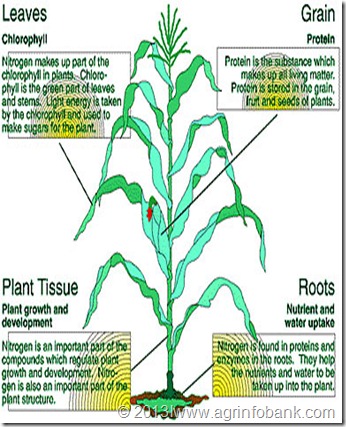

 Increasing the levels of nitrogen during the vegetative stage can strengthen and support your roots, enabling plants to take in more water and nutrients. This allows a plant to grow more rapidly and produce large amounts of succulent, green foliage, which in turn can generate bigger yields, tastier vegetables, and a crop that is more resistant to pests, diseases, and other adverse conditions.
A nitrogen-deficient plant is generally small and develops slowly because it lacks the nitrogen it requires to manufacture adequate structural and genetic materials. Older leaves become yellow or pale green due to the lack of chlorophyll, beginning in the tips of the lower leaves and eventually spreading throughout the plant. In extreme deficiencies, the affected leaves become brownish, wither, die and hang down around the lower stem.
Using too much nitrogen, however, can be just as harmful to plants as too little. When there are high levels of nitrogen present, plants may not produce flowers or fruit. As with nitrogen deficiency, the leaves may turn yellow and drop. Too much nitrogen can result in plant burning, which causes them to shrivel and die. If plants show any signs of nitrogen burn, immediately flush them with clean water.
It’s relatively normal for leaves to start turning yellow towards the end of the flowering cycle, as the plant uses excess nitrogen reserves for fruit and flower development instead. However, if you notice leaves turning yellow in the vegetative stage or during the beginning parts of the flowering stage, your plant may be experiencing a nitrogen deficiency, which should be treated.
All plants need nitrogen for healthy growth. Understanding the nitrogen requirements for plants makes it easier to meet their supplement needs. Use House & Garden’s Nitrogen Boost to raise nitrogen levels for your garden crops, helping to produce greener, more vigorous plants.
Source: House & GardenRole of Potassium in Crop Yield
Potassium is vital to many plant processes. A review of its role involves under-standing the basic biochemical and physiological systems of plants. While K does not become a part of the chemical structure of plants, it plays many important regulatory roles in development.
Enzyme Activation
Enzymes serve as catalysts for chemical reactions, being utilized but not consumed in the process. They bring together other molecules in such a way that the chemical reaction can take place.
 Potassium “activates” at least 60 different enzymes involved in plant growth. The K changes the physical shape of the enzyme molecule, exposing the appropriate chemically active sites for reaction. Potassium also neutralizes various organic anions and other compounds within the plant, helping to stabilize pH between 7 and 8...optimum for most enzyme reactions.
The amount of K present in the cell deter-mines how many of the enzymes can be activated and the rates at which chemical reactions can proceed. Thus, the rate of a given reaction is controlled by the rate at which K enters the cell.
Stomatal Activity (Water Use)
Plants depend upon K to regulate the opening and closing of stomates...the pores through which leaves exchange carbon diox-ide (CO 2), water vapor, and oxygen (O2) with the atmosphere. Proper functioning of stomates is essential for photosynthesis, water and nutrient transport, and plant cooling. When K moves into the guard cells around the stomates, the cells accumulate water and swell, causing the pores to open and allowing gases to move freely in and out.
When water supply is short, K is pumped out of the guard cells. The pores close tightly to prevent loss of water and minimize drought stress to the plant. If K supply is inadequate, the stomates become sluggish – slow to respond – and water vapor is lost. Closure may take hours rather than minutes and is incomplete. As a result, plants with an insufficient supply of K are much more susceptible to water stress.
Accumulation of K in plant roots produces a gradient of osmotic pressure that draws water into the roots. Plants deficient in K are thus less able to absorb water and are more subject to stress when water is in short supply.
Photosynthesis
The role of K in photosynthesis is complex. The activation of enzymes by K and its involvement in adenosine triphosphate (ATP) production is probably more important in regulating the rate of photosynthesis than is the role of K in stomatal activity.
When the sun’s energy is used to combine CO2and water to form sugars, the initial high-energy product is ATP. The ATP is then used as the energy source for many other chemical reactions. The electrical charge bal-ance at the site of ATP production is maintained with K ions. When plants are K deficient, the rate of photosynthesis and the rate of ATP production are reduced, and all of the processes dependent on ATP are slowed down. Conversely, plant respiration increases which also contributes to slower growth and development.
In some plants, leaf blades re-orient toward light sources to increase light interception or away to avoid damage by excess light, in effect assisting to regulate the rate of photosynthesis. These movements of leaves are brought about by reversible changes in turgor pressure through movement of K into and out of specialized tissues similar to that described above for stomata.
Transport of Sugars
 Sugars produced in photo-synthesis must be transported through the phloem to other parts of the plant for utilization and storage. The plant’s transport system uses energy in the form of ATP. If K is inadequate, less ATP is available, and the transport system breaks down. This causes photosynthates to build up in the leaves, and the rate of photosynthesis is reduced. Normal development of energy storage organs, such as grain, is retarded as a result. An adequate supply of K helps to keep all of these processes and transportation systems functioning normally.
Water and Nutrient Transport
Potassium also plays a major role in the transport of water and nutrients throughout the plant in the xylem. When K supply is reduced, translocation of nitrates, phosphates, calcium (Ca), magnesium (Mg), and amino acids is de-pressed. As with phloem transport systems, the role of K in xylem transport is often in con-junction with specific enzymes and plant growth hormones. An ample supply of K is essential to efficient operation of these systems.
Protein Synthesis
 Potassium is required for every major step of protein synthesis. The “reading” of the genetic code in plant cells to produce proteins and enzymes that regulate all growth processes would be impossible without adequate K. When plants are deficient in K, proteins are not synthesized despite an abundance of avail-able nitrogen (N). Instead, protein “raw materials” (precursors) such as amino acids, amides and nitrate accumulate. The enzyme nitrate reductase catalyzes the formation of proteins, and K is likely responsible for its activation and synthesis.
Starch Synthesis
The enzyme responsible for synthesis of starch (starch synthetase) is activated by K. Thus, with inadequate K, the level of starch declines while soluble carbohydrates and N compounds accumulate. Photosynthetic activity also affects the rate of sugar formation for ultimate starch production. Under high K levels, starch is efficiently moved from sites of production to storage organs.
Crop Quality
Potassium plays significant roles in enhancing crop quality. High levels of avail-able K improve the physical quality, disease resistance, and shelf life of fruits and vegetables used for human consumption and the feeding value of grain and forage crops. Fiber quality of cotton is improved. Quality can also be affected in the field before harvesting such as when K reduces lodging of grains or enhances winter hardiness of many crops. The effects of K deficiency can cause reduced yield potential and quality long before visible symptoms appear. This “hidden hunger” robs profits from the farmer who fails to keep soil K levels in the range high enough to supply adequate K at all times during the growing season. Even short periods of deficiency, especially during critical developmental stages, can cause serious losses.
Range Grasses--Screening and nutrient management
A study on “secreening and nutrient management of different indigenous
range grasses in Thal range area of Punjab” was carried out during
2007-08 at University of Agriculture,Faisalabad and Muzzafargar (Thal
area) respectively. Germination vigor of buffle grass (Cenchrus ciliaris
L.), dhaman grass (Cenchrus setigerous Vahl), blue stem grass
(Dicanthrium annulatum Forsk), gorkha grass (Elionurus hirsutus), blue
panic grass (Panicum Retz), lumb grass (Aristida depressa), fountain
grass (Pennisetum orientale Rich) and Johnson grass (Sorghum halepense
L. Perse) was tested against hydro and osmopriming treatments in the
laboratory, University of Agriculture, Faisalabad. Ammonium nitrate (NH4
NO3), urea and farm yard manure (FYM) were applied in the field to the
primed seed of grasses secreened on basis of the response of grasses to
different seed priming agents. Agronomic and nutritional performance of
each grass was assessed at different growth stages. Blue panic grass
(77.67%), dhaman grass (75.60%), Johnson grass (69.77%) and buffle grass
(63.33%), gave maximum germination percentage and got 1st, 2nd, 3rd and
4th position on over all basis of germination vigor. Whereas CaSO4 was
found best as an osmopriming agent. Primed seed of the grasses getting
first four positions was directly sown in the filed. Fertilizers and
Farm yard manure were applied as source of inorganic and organic of
nutrients to these grasses. All others agronomic characters were found
in maximum amount in Johnson grass due to FYM as compared to ammonium
nitrate and urea respectively except number of tiller per plant Maximum
number of tillers per plant of dhaman grass were counted under the
effect of urea. From nutritional point of view, FYM also exhibited
maximum protein (18.03) in buffle grass, DM (9.87%) and mineral contents
(13.33%) in Johnson grass respectively. On the basis of the results use
of CaSO4 is recommended for enhancing germination vigor of indigenous
grasses especially buffle, dhaman, blue panic and Johnson grass and FYM
should be applied as organic source of nutrients to increase the
performance of grasses under the conditions of Thal range area.
Source of Article: Qadir, Ihsan (2010) Screening and nutrient management of different indigenous range grasses in Thal range are of the Punjab. PhD thesis, University of Agriculture, Faisalabad .

