Nawabshah Street has likewise been submerged under breaking trench water influencing street movement to Sukkur. The populace of the influenced territories have begun moving to more secure spots. Watering system office's staff in the wake of having data arrived at the site and began the work of stopping the rupture.
Nawabshah canal breach
01:28Nawabshah Street has likewise been submerged under breaking trench water influencing street movement to Sukkur. The populace of the influenced territories have begun moving to more secure spots. Watering system office's staff in the wake of having data arrived at the site and began the work of stopping the rupture.
Sindh has adequate wheat stock to meet existing demand
02:15"New wheat crop is almost ready in several parts of Sindh and regular supply is likely to arrive in next few days as harvesting has already begun in some districts", said Hashim Sharja Wala, a leading wheat trader. There is neither panic nor wheat crisis in the market as sufficient wheat stock is available in the province. Even wheat grain prices are stable at Rs 39,000 per ton from last one month, he added.
Presently, wheat is being traded at Rs 39,000 to Rs 39,250 per ton in open market, while Sindh food department is supplying commodity to flour mills at a price of Rs 30,000 per ton, he mentioned. With the arrival of new crop, wheat grain prices in the domestic market are likely to face a drastic cut in next few weeks; he said and added that wheat harvesting has started in some parts of the province, where wheat crop is ready. However, arrival will increase after harvesting and thrashing in the belt of Dadu and MirpurKhas, Hashim mentioned.
Sindh government has planned to procure some 1.3 million tons this year to build its strategic reserves and Sindh food department has taken several steps to avoid any speculation in the market.Sindh government may impose an inter-district ban on wheat movement aimed to complete its procurement, he added.
"Presently, prices are higher than wheat support price of Rs 1200 per maund or Rs 30,000 per ton, but I m sure that wheat prices will gradually decline after arrival of new crop in the market and price is expected to be around Rs 30,000 to Rs 31,000 per ton by the end of this month", Hashim said.
Talking about the Thar famine, he said, this is only due to mismanagement and distribution/ transportation issues and there is no shortage of commodity in province. He said that as per food department they have distributed over thousands of wheat bags among masses of Thar in the last three days.
He said that during the last crop season, Sindh has failed to achieve its procurement target and some 1.05 million ton wheat was procured as against target of Rs 1.3 million tons. However this year, wheat procurement target will be achieved as Sindh will have a bumper wheat crop.
Akhtar Hussian, a leading flour miller, said that presently mills are getting some 300 bag per day from food department and there is no wheat crisis in the province. He said that new crop will arrive in the market from March 15 and after that stock position will further improve.
Source: Business Recorder
Pakistan and India trade to be promoted by protecting rights of stakeholders
02:15Trade between Pakistan and India should be promoted by protecting the rights of stakeholders particularly the growers. It was recommended by the roundtable conference titled "improving economic governance in agricultural sector through trade liberalisation between Pakistan and India" arranged at the University of Agriculture Faisalabad. The recommendation was made by the UAF Vice Chancellor Professor Dr Iqrar Ahmad Khan while Lahore University of Management Sciences (LUMS) Pro Chancellor Syed Babar Ali, MNA and Parliamentary Secretary Rana Afzal, Farmers Association Pakistan President Tariq Bucha and other progressive farmers were present on the occasion. While informing the audience about recommendations, the Vice Chancellor suggested the identification of the seasonal window for the commodities.
He quoted the examples of potato which has peak season in August and September in India and in Pakistan it has the peak season in October and November. The conference also recommended that trust deficit between the two countries needs to be bridged through dialogue. The strengthening of the domestic production market is also essential to tap the potential of the sector.
The Vice Chancellor said India is the big market of around one billion of the people. He said the trade with the seasonal window would open up new chapter of progress. He also sought the policy interventions in this regard to flourish the sector in Pakistan. He said India is providing the highest subsidy on the electricity. Even in the Indian Punjab, the subsidy on tube wells is amounting to Rs 1trillion. Syed Babar Ali said we need to tap the potential in flourishing the agricultural sector by promoting the state-of-the-art technologies in the country.
He said China has made tremendous work in the garlic. Our country can do the same. We have to get the benefit from others experience. He said 70 percent of the population is directly or indirectly linked to the agricultural sector that must be strengthened. He also suggested setting up entrepreneurship cell at the UAF in order to equip the youth with the skill and to transform the knowledge into goods and services.
MNA Rana Afzal said the Government is making all-out efforts to strengthen the agricultural sector in the country. He said the recommendations to be made before the government. He said agriculture is the backbone of our economy, contributing 21 percent in the Gross Domestic Product. Tariq Bucha urged the government to take the tangible steps to address the issues of the farming community. He said at least ten percent of the budget must be allocated for the agricultural sector. He said in the process of trade policy formulation, the farmers must be taken on board. ORIC Director Professor Dr Asif Ali, Dr Abdul Ghafoor, Dr Waseem Ahmad, Dr Mubashair Mehdi, Director Ayub Agriculture Research Institute Dr Abid Mehmood, Aiwan-e-Zarat President Dr Sadique Naseem and others also attended the meeting.
Source: Business Recorder
Kharif season: fertiliser makers not in favour of urea import
04:45Domestic chemical makers don't seem to be in favour of giant import of carbamide for Kharif season as they believe that spare stocks are obtainable for the approaching crop season. The Ministry of Industries & Production within the last meeting of the chemical Review Committee (FRC) had determined to import zero.125 million tons for Kharif season and therefore the chemical business supported the choice.
This acquisition are created against a $50 million loan facility recently approved by the Asian Development Bank (ADB) specifically for the acquisition of carbamide fertilizer.
As per estimates of chemical makers of West Pakistan consultive Council (FMPAC) - a representative body of native fertilizer makers - around three.01 million heaps of carbamide stocks, as well as domestic production and carryover stocks from Rabi season, are obtainable within the country for the approaching crop season against a most demand of two.8 to 2.9 million tons.
The country would have some zero.370 million heaps of carbamide stock at begin|the beginning} of Kharif season that may start from Gregorian calendar month one, 2014. calculable production from domestic fertilizer plants throughout the Kharif season can stay a pair of.64 million tons (with gas offer on SNGPL in line with the last year) which means there would be around three.01 million heaps of carbamide obtainable within the country against a requirement of two.8 to 2.9 million tons. As a result, the carryover stock at the tip of Kharif 2014 is probably going to be zero.21 to 0.110 million tons, a political candidate of FMPAC aforesaid.
He aforesaid recent demand of two.9 million tons continues to be more than needs reported by provinces. "Fertiliser plants will manufacture the specified and spare carbamide for domestic consumption by guaranteeing the required gas offer. The domestic production won't need precious interchange and billions of rupees grant, being spent on import on carbamide," he added.
The business sources aforesaid the govt call to import carbamide and distribute it through National chemical selling restricted (NFML) has additionally been politically motivated within the past so this observe ought to be discourage by the PML-N government. The centralized is already considering shifting the foreign carbamide distribution from NFML to non-public sector so as to confirm clear and timely distribution of foreign carbamide, they added.
Sources aforesaid some quarters ar proposing an enormous import of zero.7 million heaps of carbamide import for Kharif season. However, they believed that the planned conceive to import zero.7 million heaps of carbamide is contrary to the fact on ground and therefore the call can drain around $266 million from the funds, that is already facing a crisis of depleting forex reserves.
According to sources, this estimate of foreign carbamide has been calculated at a median $380 per ton price and Fright (C&F). On this basis, the landed price involves Rs a pair of,900 per fifty kilo bag as well as port incidentals and native freight, etc. To sell this foreign carbamide at a fix value of Rs one,786 per bag, the govt would ought to offer a further grant of roughly Rs sixteen billion on zero.7 million tons foreign carbamide.
Domestic fertilizer makers urged the govt to require any call on carbamide import whereas keeping in sight this stock handiness position. carbamide is foreign to supply profit to farmers, however in point of fact, farmers don't get any advantage of foreign carbamide and later grant by the funds, they added. Despite the country's current carbamide production capability of six.9 million tons, that is world's seventh largest, West Pakistan spent over $1.5 billion on carbamide import in last three years and additionally paid a grant of over Rs sixty billion on foreign carbamide.
Source: Business Recorder
Wheat output likely to remain below projected target this year
01:26Pakistan's wheat production is anticipated to stay regarding twenty four.5 to twenty five million tons this year, which is 0.25-0.75 million tons wanting the projected target of twenty five.25 million tons, Ministry of National Food Security and analysis officers aforementioned.
A senior official of the Ministry of National Food Security and analysis told Business Recorder, here on Wed that Asian nation is in an exceedingly position to supply bumper wheat crop this year however it depends on atmospheric condition in March: if the temperature remains average the country's wheat output is anticipated to cross twenty five million tons, however if temperature is on top of the common for the year wheat output is probably going to stay twenty four.5 million tons.
"This year wheat growers have brought nearly twenty one million acres underneath wheat cultivation, that is sort of one thousand thousand acres but the past year. In arid areas, a decline within the space underneath wheat cultivation, low tide provides and fertiliser shortages square measure probably to cut back the wheat production, however on national level we tend to predict a healthy wheat crop", the officers aforementioned.
"In Rabi season we've got 2 major crops wheat and gram, wheat production is probably going to cross twenty five million tons if atmospheric condition stay favourable, whereas gram production is anticipated to be 550,000 tons this year against set target of 600,000 tons" he added . Gram is especially cultivated in Bhakkar, Layyah, Khushab and Mianwali districts, whereas wheat is being cultivated across the country tho' geographical region is that the major wheat manufacturing province, followed by Sind and KPK.
"Pakistan wants around 900,000 loads of gram to feed its population on low-cost macromolecule, however the country is at the present manufacturing solely 550,000 loads of gram. within the past, Asian nation was manufacturing nearly 800,000 loads of gram pulse. Even in worst-weather years, the gram production was ne'er less than 5 maunds per acre. sadly throughout the past few years it absolutely was solely two.5 maunds per acre. however and why did the yield call in over seventy % at intervals a matter of few years nobody knows", Abraham Mughal Chairman Agri-Forum Asian nation aforementioned.
Mughal aforementioned the case could improve slightly if water and fertiliser handiness improves adding that at the present a bag of carbamide is obtainable at Rs one,900 to Rs two,000, that 3 years back was obtainable at Rs 800 per bag. the assembly value of various crops has increased manifold throughout past few years and farmers square measure unable to buy necessary inputs to extend yield. Farmers have planted wheat over a locality of very little over eight.5 million hectares this year, down from nine.13 million hectares last year once the country created a bumper crop of regarding twenty three.8 million loads of wheat, Mughal aforementioned.
Source: Business Recorder
Agriculture sector opposes granting NDMA/MFN status to India
01:26The Agriculture Task Force (ATF) of Pakistan-India Joint Business Forum (PIJBF) is vehemently opposition granting Non-Discriminatory Market Access/Most Favoured Nation (NDMA/MFN) to Asian country at this stage.
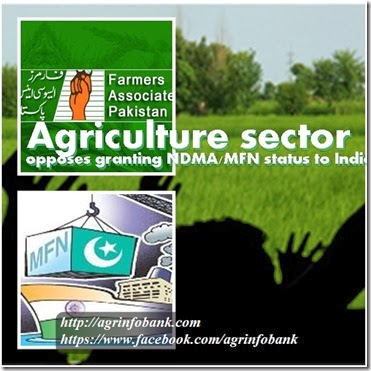
President, Farmers Associates West Pakistan (FAP) and Co-Chair of Agriculture Task force, PIJBF, Tariq Bucha in an exceedingly letter sent to the federal commerce minister has highlighted that agriculture sector, that is far and away the largest leader within the country, flatly opposes granting NDMA/MFN to Asian country until correct preparations are completed on our facet to guard our sectors from huge Indian subsidies, and find important market access from Asian country for Pakistani merchandise, to make sure the amount enjoying field as per the need ordered down within the cupboard call of bissextile day, 2012.
Unnecessary haste with that the govt of West Pakistan is continuing to open Wagah border and to over 137 things before Asian country lowers its agriculture tariffs and removes every kind of Non-Tariff Barriers (NTBs) and healthful and Phyto healthful (SPS) barriers that are undermining our negotiating leverage and position. "For Agriculture turn out and product, Wagah route can't be opened any longer, till a separate bilateral agri-trade agreement is negotiated involving stakeholders together with FAP, and is finalised and signed, supported associate impartial and freelance study for that purpose," he said.
Moreover, he said, SAFTA doesn't apply absolutely to the complexities concerned underneath the World Trade Organization regime with relevance agriculture. it's a 15-page agreement with incomplete annexes, and needs important and severe redefining, restructuring and amendments with careful neutral input and approval, just in case it contemplates agri trade between the countries owing to huge current and future subsidies given to agriculture in Asian country that ar an indicator of unfair trade.
Nowhere will the SAFTA agreement need West Pakistan to terminate its sensitive list in 5 years. "Pakistan's agriculture sector vehemently opposes any longer phasing out of agricultural things from the sensitive list. we've got scan the SAFTA Agreement rigorously, and apprehend that there's no such categorical demand. Any reductions created on the sensitive list ar discretionary, and despite the fact that a review of the list is needed each four years, a 'review' doesn't need a discount in it," he declared.
Within the ASEAN regime, that may be a way more sturdy FTA than SAFTA, as an example, there ar things that stay for good on a "highly sensitive list", he said, adding that any representatives of the govt of West Pakistan United Nations agency agrees to needless reductions of the sensitive list should apprehend that they'd be doing therefore with none legal demand, and would be violating the principle of keeping tier enjoying field that was set down within the aforesaid cupboard call, within the wake of the big subsidies given by the Indian government.
He steered that to effectively counter the big subsidies on agriculture before gap Wagha and granting NDMA/MFN to Asian country, the govt of West Pakistan should initial place in situ tariff rate quotas per crop that equal the grant given to every crop on the Indian facet, to make sure tier enjoying field. "The on top of steps should be verified by FAP, representing the agri-sector. Once that's done, we tend to may move forward on negotiating a separate agri-trade agreement for bilateral trade with Asian country," he added.
It has been discovered within the letter that granting NDMA means Wagah ought to still be closed to all or any Indian merchandise, as a result of no different country's merchandise comes through Wahga. "Therefore, if all merchandise are restricted from Wagah, that might accommodates Non-Discriminatory Market Access. By granting Wagah access to over 137 Asian countryn merchandise would quantity to granting India even additional favourable terms than needed by a grant of NDMA/MFN. Granting Wagah access to over the present agriculture things can considerably weaken Pakistan's economy, and already beleaguered agriculture sector," he said.
Tariq declared that Congress Party is probably going to lose within the coming elections in {india|India|Republic of Asian country|Bharat|Asian country|Asian nation} thus the agriculture sector powerfully opposes granting NDMA/MFN to India notably once the new Indian government is merely few months away and will lift any concessions that ar given to West Pakistan by the outgoing Congress government. 'At this juncture, National Tariff Commission (NTC) doesn't nevertheless have the capability or provisions to effectively counter unfair trade practices like the anticipated selling and significant subsidisation of agricultural merchandise by the Indian facet,' he said.
Before giving any longer trade concessions to the Indian facet, he same the Ministry of Commerce should demonstrate that the NTC has the power, capability and therefore the powers to effectively defend Pakistan's agriculture from the anticipated onslaught of unfair Indian trade practices of selling and significant subsidization. "Since 2011, the Ministry of Commerce has acknowledged that the NTC lacks such capability, and nevertheless the NTC has not visibly improved. The Ministry of Commerce thus cannot in sensible conscience open Wagah or to over 137 things before it may build a strong NTC'.
Concluding Tariq same, though the agriculture sector isn't loth to trade with Asian country in an exceedingly structured, phased and effectively negotiated agreement, we tend to feel that the govt of West Pakistan has so far did not improve the capability of its establishments or place in provisions to afford required protection to its domestic sectors, to assist survive the anticipated onslaught of Indian agricultural turn out and product. 'Thus, till such time that the govt of West Pakistan demonstrates that it's serious concerning safeguarding Pakistan's domestic agriculture from unfair competition, we'll oppose any move for granting NDMA/MFN and additional gap of Wagah'.
Source Business Recorder
IDA may give $160 million for rehabilitation of barrages in Sindh
23:15International Development Association (IDA) can possible provide to produce $160 million for Sindh Barrages Improvement Phase-I Project to safeguard the reliable supply of water to regarding a million hectares through the rehabilitation of the Guddu barrage and therefore the improvement of O&M capability of the Irrigation and Power Department. According to IBRD report, Pakistan's agricultural sector is sort of altogether enthusiastic about irrigation. Irrigated land provides over ninety p.c of agricultural production. Agriculture in most areas isn't doable while not irrigation as a result of the climate of Asian country.
Annual rain over abundant of the realm isn't over 150mm each year with high evaporation rate, starting from one,250mm to 2,800mm each year. Given temperature change and high increase rates, current varieties of water resources management square measure wide recognised as being unsustainable and inadequate to confirm future water convenience for food security, economic process, and therefore the wants of the setting, report mentioned. IBRD report mentioned that the barrages square measure strategic hydraulic assets.
Barrages square measure wont to raise the water level within the watercourse in order that irrigation water is amused to the most and link canals by gravity for varied uses. Barrages also are used for watercourse management and flood management, act as a supply of water system for all sectors of the economy, perform as bridges over rivers, and square measure usually used for utility crossings like gas pipelines. Therefore, the condition and therefore the safe and reliable operation of a barrage have extensive implications for the resource and economic process of all sectors of society. Guddu barrage has major issues of safety. The other, Sukkur barrage, is one in every of the oldest and serves regarding 3 million area unit of agricultural land. It conjointly has many issues of safety. The Kotri barrage was restored in 2000.
Wheat Yield Competition
03:09Under the directives of Punjab Chief Minister Shahbaz Sharif, provincial Agriculture department has finalised necessary arrangements for holding "Wheat Yield Competition" across the Punjab. Official sources told Business Recorder on Monday that prizes worth to Rs 125.775 million would be given to the winners of the competition of provincial, divisional and tehsils levels in the Punjab. Wheat Yield Competition would be held among the wheat growers across the Punjab and Agriculture department has already finalise the criteria, procedure, constitutions of Markaz, tehsil, district, divisional and provincial levels committees for the competition. At provincial level, first prize 85 HP tractor, second and third prizes 75 Hp tractors, at divisional level, first prize 75 HP tractor, second prize 65 HP and third prize 55 HP tractors will be given to the winners of the competition.
Source: Business Recorder
DAAM win 3rd Position in Pakistan Nature Carnival at PAF museum
01:10Overview:
WWF-Pakistan in collaboration with Horlicks Pakistan organised a fun-filled Nature Carnival at PAF Museum. The Nature Carnival attracted up to 30,000 individuals from various walks of life.
There were over 150 stalls set-up by schools, colleges and universities. The main competition revolved around 3D models set up by students of schools and universities. Expert judges including foresters, conservationists, and environmental historians amongst others graded the models.
Families, corporate and academia representatives including principals attended the carnival. Participants were engaged in eco-friendly games, puppet shows, lucky draw and other activities set up by WWF-Pakistan including pin the tail on the snow leopard and thematic art competitions.
Chief Guest at the event was famous Pakistani drama and film actress Atiqa Odho. She said that each and every one of us should start taking care of the things we need for our survival including forests, water and all our natural resources so that we can give a thriving planet to our children and their children.
DAAM win 3rd Position in Pakistan Nature Carnival at PAF museum:
Department of Agriculture and Agribusiness Management (DAAM) win third position under university category, DAAM represent Hydroponics model system for vegetable and fruit cultivation, hydroponics or soil-less farming system is one of the most discuss technology around the globe, hydroponics is the only solution to fulfill the requirement of world vegetable requirements.
Food security under threat despite surplus food
09:54Despite the country is enjoying surplus crops especially of wheat and rice, the food security seems extremely chaotic, as high inflation, declining income, unequal distribution of resources and stagnating domestic productivity are hampering attempts to achieve food security.
Experts are critically examining this situation giving a warning that the country’s food security is under threat due to the shallow approach of the economic managers.
Pakistan Agriculture Scientists Association Chairman Jamshed Iqbal Cheema said that there is a significant increase in the number of food insecure people in Pakistan, which now stands at 51 per cent of the total population as compared to about 22 per cent six years back; this is largely due to decline in agricultural production, especially in the Punjab, caused by ill-conceived policies. He said that investment in agriculture sector not only ensures food security of any country but also help to produce a healthy nation besides promoting rule of law in the society. Farming is just not a profession but an effort to save 194 million people of Pakistan from hunger.
Keeping in view the population growth, Pakistan needs 50 percent more agricultural production by 2025 and it can only be done by strengthening the agricultural sector and promoting good agricultural practices for maximum per acre yield.
He was of the view that the government should reduce the input cost by waiving taxes on the inputs and bringing down diesel and electricity prices. He was of the view that it would enhance usage of quality seeds, fertilizers, pesticides and other inputs which would result in better production thus ensuring more grain for ever increasing population of Pakistan.
PASA Chairman believed that undernourished Pakistani population were reduced to two meals a days from three meals. Due to increase in input cost, the per head person cost of Pakistani has increased to Rs 3,000 per month, Cheema said and added that due to increase in this cost people were compromising their meals to manage the other day to day affairs.
He said average family size in Pakistan was 5.5 persons which mean a family have to spend Rs 16,500 per month to ensure three meals a day.
He regretted that Pakistan which is attributed as basically agricultural country lacks in provision of sufficient food and it is in the ranks of those countries which have low grains per capita for its citizens.
Agri Forum Pakistan Chairman, Ibrahim Mughal, while commenting on the food security in Pakistan said that it happened first time in the history of Pakistan that despite food surplus, shortage and price hike has been created several times during last one decade. While farmer is producing more and more wheat but not getting any benefit,” he commented.
Source: The Nation
GMO challenges: Ministry asked to call crucial meeting
06:51The Federal Law Ministry has finally given a ruling, asking Climate Change Ministry to convene a meeting of National Bio-Safety Committee for granting approval to the long-awaited 15 Genetically Modified Organism (GMO) of cotton varieties for commercialisation, sources revealed.
Well-placed sources revealed to Business Recorder that Textile division had approached Prime Minister Nawaz Sharif after the reportedly delaying tactics by the Climate Change Ministry for convening a meeting of NBC.
Prime Minister on January 16, 2014 constituted a committee comprising Secretary Textile division, Secretary Law and Secretary Climate Change and directed them to hold a meeting within 10 days for resolving the issue. The committee met last week and Law division gave a ruling asking for convening a meeting of NBC to grant approval for commercialisation of cotton seeds, sources maintained.
Certified cotton seed was becoming a serious issue as no BT certified cotton seed would be available for cultivation for the upcoming crop season due to non-approval of GMO cotton varieties by NBC which might encourage the seed-mafia, besides negatively impacting commodity production, official maintained.
Official sources revealed that Pakistan being a signatory to the international Cartagena Protocol on Biosafety had to regulate GMO through establishing a Bio-safety system in the country. NBC and Technical Advisory Committee (TAC) of Pakistan Environmental Protection Agency (PEPA) have responsibility to evaluate, regulate and monitor GMO for lab or field research and their commercial scale production or marketing in the country.
The NBC had not held its meeting since February 2011, which had delayed the regulatory process required to test and approve GMOs crops, said sources, adding that applications submitted by various public and private sectors organisations seeking approval of different GMO crops were yet to be reviewed by the NBC.
Currently only transgenic crop commercially cultivated in Pakistan is cotton and eight BT varieties and one cotton Hybrid were approved by Punjab Seed Council (PSC) in April 2010 and commercialisation certificate was granted by NBC. In February 2012, PSC provisionally approved eight BT varieties (Tarzen-1, MNH-886, NS-141, FH-114, IR-NIBGE-3, CIM-598, Sitara-009, A-One) subject to the grant of commercialisation certificate from the NBC and TAC had to clear cases before consideration in NBC, sources maintained.
BT cotton varieties in Pakistan, which were granted certificate for three years (now expired) included IR-3701, Neelum-121, FH-113, Sitara-008, MG-6, Ali Akbar-703, Ali Akbar 802, IR-1524 and GN Hybrid-2085. BT cotton varieties waiting for commercialisation certificate included Tarzen-1, VH-259, MNH-886, BH-178, NS-141, CIM-599, FH-114, CIM-602, IR-NIBGE-3, FH-118, CIM-598, FH-142, Sitara 009, IR-NIBGE-824, A-One IUB-222, Sayaban-201, Sitara-11M, A-555, KZ-181, Tarzan-2 and CA-12.
Source: Business Recorder
Irrigation officers directed to overcome water theft
00:43Secretary Irrigation and MD PIDA Malik Hassan Iqbal has directed the field officers to take consolidated measures for overcoming water theft across the province. Water theft is a heinous crime which affects agri-production, it is important to ensure equitable distribution of water, he added.
He stated this while presiding over a meeting held to review departmental performance at Irrigation Department Headquarters. Additional Secretary (Operation) Malik Saleem, Additional Secretary (Technical) Khalid Hussain Qureshi, Chief Monitoring Habib Ullah Bodla, Chief Engineer Irrigation (Lahore Zone) Nazir Anjum, Director Reforms Aamir Khan, General Manager PIDA Afzal Anjum Toor and senior field officers were present on the occasion.
Secretary Irrigation directed the officers to further activate the system of action on the complaints of water theft so that problems of the farmers could be resolved on priority basis. Immediate implementation should be ensured on the complaints received on toll free number 0800-11333 of Irrigation Department, he added. He said performance of all the field officers should be reviewed in the monthly meetings and strict action be taken against those showing negligence.
Source: Business Recorder
SBP enhances per acre limits for crops financing
00:43State Bank of Pakistan has enhanced per acre limits for major and minor crops, orchards and forestry. According to revised report on Indicative Credit Limits & List of Eligible Items for Agri Financing, under major corps, financing limits per acre for rice, wheat, cotton and sugarcane have been increased to Rs 34,000, Rs 29,000, Rs 39,000 and Rs 53,000, respectively from existing limits of Rs 19,000, Rs 16,000, Rs 21,000 and Rs 30,000 fixed in 2008.
The revised report provides a yardstick for banks to assess the credit needs of different groups of farmers’ vis-à-vis their activities. Banks extensively use the report for reporting financing statistics to the SBP as per the list of eligible items. The report has been revised in consultation with Pakistan Agriculture Research Council, provincial government including AJK, agricultural universities, agri. lending banks and farmers’ representatives.
Source: Business Recorder
Politicians urged to show maturity on Kalabagh Dam issue
06:28Multan Chamber of Commerce & Industry (MCCI) has said that politicians should show their maturity on national issues like Kalabagh Dam, energy crisis, trade with neighbouring countries and achieving the goal of GSP-plus status. MCCI lauded the expression of political maturity and avoiding the politics of avenge by the leaders of the government and the opposition while inaugurating the Thar Coal Power Project worth around Rs 1.5 trillion.
The encouraging gestures of rival politicians have not only made history but also sent very positive signals arousing hopes among the masses and the business community. President of MCCI Khawaja Muhammad Usman has said country has lost a lot due to political conflicts but it seems that now the major political parties have decided to keep national interest and economic development above over the politics.
He said the opposition of nationalists and so-called intellectuals failed to dent the resolve of the government to launch the Thar Coal project, which is highly laudable. Usman said politics in Pakistan seems different now which will help stabilise democracy, boost economy and resolve the energy crisis soon. He asked the government and opposition to forge unity to get the long-awaited Kalabagh Dam (KBD) project started.
The KBD remains victim to politics transforming a technical issue into a hot topic, said Baig Raj, adding that enemies of Pakistan are behind opposition of the most viable project in the country. The so-called scholars and nationalists who are against KBD are dancing on the tunes of their foreign masters who don’t want a stabilise Pakistan, he said.
These elements have helped plunge a country like Pakistan with unmatched resources into darkness for their petty gains, he said. KBD is the best way to have dependable energy otherwise country will never be able to become Asian Tiger and will remain a beggar, said Khawaja Usman.
Title: Politicians urged to show maturity on Kalabagh Dam issue
Source: Business Recorder
Rabi crops: IRSA increases water supply by seven percent
02:142.434 MAF water is available in Tarbela dam on river Indus, 2.094 MAF in Mangla dam on river Jhelum and 0.079 MAF in Chashma barrage, he added. Siddiqui said Punjab Irrigation department has been running canals in central Punjab by drawing 20,000 cusecs water from the Mangla dam and 7,300 cusecs run of the river Chenab water, yet it will open canals emanating from river Indus on 5th February 2014.
ICTA fails to control high prices
22:25The survey noted that the Islamabad Capital Territory Administration (ICTA) and District Administration Rawalpindi have failed in establishing an affective price monitoring mechanism to control prices due to which essential food items were not being sold on uniform rates in the different markets of the twin cities. It was observed that food items, which were available in wholesale markets, were being sold on 10 to 15 percent higher rates in the retail markets. Almost all perishable food items, including vegetables and fruits were being sold on higher rate in different markets of the twin cities, while actual rate of the food items in vegetable markets were very low. When asked about reasons behind the price differential, traders in different markets of the twin cities stated that they have to pay transport, utilities charges and rent of their shops. In case of perishable food items mixed trend was noted as prices of majority of the vegetables remain unchanged, while some vegetables registered slight increase in their prices during the week under review. Tomato was being sold at Rs 40 per kg, while it was being sold at Rs 55-60 in retail market, onion was being available at Rs 40-45 per kg in wholesale market, while it was being sold at Rs 50 per kg in retail market, potato was being available at Rs 30-35 in wholesale market, while it was being sold at Rs 40 in retail market. Similarly, 10-15 percent price differential was witnessed in other vegetables, including peas which were being available at Rs 60-65 per kg in wholesale market, while they were being sold at Rs 75-80 per kg in retail market, green chili at Rs 70 in retail market, cucumber at Rs 90-100 per kg, carrot at Rs 30 per kg, radish at Rs 30 per kg, ginger at Rs 250-280 and garlic was being sold at Rs 140-180 per kg last week as compared to the preceding week.
However, prices of different kinds of fruits almost remained stable last week as compared to the preceding week as banana was being sold at Rs 60-80 per dozen, apple at Rs 100-180 per dozen, fruiter at Rs 60- 70 per dozen, malta at Rs 80-100 per dozen and guava was being sold at Rs 70-80 per kg last week as compared to the preceding week.
While prices of non-perishable food items were also not uniform in the different retail markets of the twin cities as sugar was being sold from Rs 54 to Rs 60 per kg, moong washed was being sold at Rs 150-160 per kg, masoor washed was available at Rs 130-140 per kg, mash washed at Rs 140-160 per kg, chicken at Rs 160-175 per kg, eggs at Rs 100 per dozen and rice basmati broken was being sold at Rs 80-90 per kg last week as compared to the preceding week. The survey noted that mutton was being sold at Rs 600-620 per kg, while beef was being sold at Rs 280-300 per kg last week as compared to the preceding week.
How sell-off of PSM can be forestalled
22:25Muhammad Zubair, minister of state for privatisation, said privatisation of Pakistan Steel Mills (PSM) can only be averted if PSM turns into profitable organisation. He was speaking at an interactive session on "Privatisation Policy and Priorities" organised by Pakistan- Korea Business and Friendship Council along with seven other business councils at a hotel here on Saturday.
He said that around 2500 employees in PSM were middle and inter pass and urged the participants to come forward and turn PSM around, if they want to stop its privatisation. He said that privatisation policy was aimed at avoiding heavy spending in public enterprises, adding that government was paying around Rs 500 billion per annum to run loss earning public organisations.
Zubair further said that if this amount was poured in health, education and other sectors, it would create a difference and added that people of Pakistan, who were entitled to get better services, were being burdened because of these loss earning public entities. He said that Nawaz government was committed to its privatisation policy and they had no IMF pressure in this regard. He said: "IMF has set milestones for its programme and government is striving to achieve it but it doesn''t mean that we are taking dictations from IMF".
In his welcome address, Ahsan Mukhtar Zubairi, chairman Pakistan Korea- Business and Friendship Council said that state owned enterprises (SOEs) were inefficient and generally slow in responding to public demands. On the other hand, private sector is driven by profit motive and it becomes ruthless in the pursuit of personal gain and profit. A proper balance needs to be struck between public interest and profit, he urged.
He said that Pakistan had experimented with privatisation during the last three decades. Over a 100 state owned enterprises have been sold to the private sector during the last 30 years. Many of these do not exist any more. Mostly expensive real estates have been sold at exorbitant profits and the state and the public have been deprived. Many SOEs have been sold at throw away prices. The case of HBL, UBL, ABL and PTCL can not be forgotten. The Privatisation Commission (PC) had followed all procedures well but government was deprived of its valuable assets, he said. Some privatisation''s have also gone well such as MCB and only a few others.
Source: Business Recorder
Rabi crops may suffer from water stress conditions
05:55He warned that availability of water in rain-fed areas would be limited and thus Rabi crops particularly wheat are likely to suffer from water stress conditions.
Weather forecast for today:
Mainly very cold and partly cloudy weather is expected over most parts of the country with scattered misty and isolated foggy conditions over plain areas of Punjab and upper Sindh.
However, thunder-rain with snowfall over the hills is likely to occur at scattered places of Malakand, Hazara divisions, Gilgit-Baltistan and Kashmir. Also, thunder-rain with snowfall over the hills may occur at isolated places of Makran, Quetta, Kalat divisions and Fata. Further, thunder-rain with snowfall over the hills would occur at a few places of Rawalpindi, Kohat, Peshawar, Larkana, Karachi divisions and Islamabad.
Weather forecast for next 48 hrs:
Mainly cold and dry weather is expected in most parts of the country. However cloudy weather with chances of light rain (light snowfall over the hills) expected in Malakand, Hazara divisions, Kashmir and Gilgit-Baltistan.
Coldest places in country:
Astore -13°C, Parachinar -12°C, Skardu & Hunza -10°C, Gupis -09, Kalam & Quetta -08, Gilgit -07, Malamjabba and Kalat -06°C, Rawalakot -04°C.
Tractors: business community concerned at increasing GST
01:18Agriculturists as well as business community have expressed its concern on increasing the General Sales Tax on tractors by 17 percent. Resultantly, the price of tractors has increased Rs 1, 75,000. They have called for the withdrawal of an increase of General Sales Tax on tractor industry from 10 percent.
The decision had hit the production of tractors in Pakistan which fell to merely 12,000 from 75,000 per annum. Now it would also hit the entire agriculture sector hard besides rendering thousands of skilled workers jobless. In a memorandum to Prime Minister Nawaz Sharif , Ministry of Industries and Production, Finance, the Multan Chamber of Commerce and Industry's sub-committee on engineering headed by Mian Iqbal Hassan said the tractor assemblers and their hundreds of vendors fear a severe drop in sales as a result of massive hike in GST with effect from 1st January 2014. The 17 percent GST to be paid by the country's farmers which will further curtail their ability to purchase tractors. Despite producing the cheapest tractor in the world, the farmer is still not able to afford a tractor and requires support in the form of subsidies and soft loans from the government to purchase a tractor. President of Multan Chamber of Commerce and Industry (MCCI) Khawaja Muhammad Usman said with no subsidies on tractors in the current federal and provincial budgets, meagre loaning by ZTBL in the absence of a Federal Agricultural Ministry (thanks to the 18th amendment) and GST set to go to 17 percent under IMF pressure, will all add up to massive drop in tractor sales.
The MCCI president said that Pakistan lags far behind India in crop yield, crop intensity and number of tractors per hectare. According to agri experts Pakistan currently needs 800,000 more tractors to match India in per hectare tractor population. He said that an industry with installed capacity of 100,000 units per annum is expected to close the current financial year with less than 30,000 units. This means 70 percent drop in revenues for the FBR from this industry in the fiscal year 2013-14. In sharp contrast India with 0 percent central GST, will close this year with the highest ever production of over 600,000 tractors, ie, 20 times higher than Pakistan. Mian Iqbal Hassan, a senior member of MCCI said drop in tractor sales means unemployment for thousands of skilled workers who work in hundreds of factories producing tractor parts for the tractor assembly plants.
He said that it was a good omen for the manufacturing sector that the government had decided to unveil new industrial and auto policies but he hoped the consultation with the stakeholders would be ensured before finalising these documents.
Source: Business recorder
Investment in agriculture seed market can boost economy
01:18Pakistan's agriculture seed market is worth almost $ 1500 million and it has huge potential and opportunities for investors. DG Federal Seed Certification & Registration, Syed Muhammad Nasir Ali expressed these views while talking to APP here on Sunday. He said that investment in agriculture seed and supply of certified seed was important not only to boost agriculture sector but also overall economy of the country.
He said the value of seed produced in Pakistan was $ 500 million while the value of imported seed was $ 300 million which showed a market gap for investment of $ 700 million. He said certified seed availability of major crops in Pakistan was just 20 per cent while authorities had set a target for certified seed availability of 30 percent for the next year.
He said the share of the public sector in seed availability was 22 per cent while private sector's share was 78 per cent.
He said that there were four public sector seed organisations while five multinational seed companies and 789 national seed companies were operating in the private sector.
Source: Business recorder