Latest Updates :
    Showing posts with label Wheat. Show all posts
    Showing posts with label Wheat. Show all posts

    Sindh has adequate wheat stock to meet existing demand

    Sindh province has adequate wheat stock to meet the existing demand till the arrival of next crop, traders said on Monday. Talking to Business Recorder they said that presently Sindh has some 0.113 million tons wheat stock in its godowns and recently the Sindh food department has also issued delivery orders of over 100,000 tons wheat quota to flour mills across the province. This quota will be sufficient for next 15 days.
    "New wheat crop is almost ready in several parts of Sindh and regular supply is likely to arrive in next few days as harvesting has already begun in some districts", said Hashim Sharja Wala, a leading wheat trader. There is neither panic nor wheat crisis in the market as sufficient wheat stock is available in the province. Even wheat grain prices are stable at Rs 39,000 per ton from last one month, he added.
    Presently, wheat is being traded at Rs 39,000 to Rs 39,250 per ton in open market, while Sindh food department is supplying commodity to flour mills at a price of Rs 30,000 per ton, he mentioned. With the arrival of new crop, wheat grain prices in the domestic market are likely to face a drastic cut in next few weeks; he said and added that wheat harvesting has started in some parts of the province, where wheat crop is ready. However, arrival will increase after harvesting and thrashing in the belt of Dadu and MirpurKhas, Hashim mentioned.
    Sindh has adequate wheat stock to meet existing demandHe said that some trucks of new wheat crop have also arrived in the market and commodity was traded at Rs 35,000 per ton, due to some moisture. "We are expecting wheat prices will decline to Rs 35,000 in next 10 day, when proper supply of new wheat crop will begin", Hashim said.
    Sindh government has planned to procure some 1.3 million tons this year to build its strategic reserves and Sindh food department has taken several steps to avoid any speculation in the market.Sindh government may impose an inter-district ban on wheat movement aimed to complete its procurement, he added.
    "Presently, prices are higher than wheat support price of Rs 1200 per maund or Rs 30,000 per ton, but I m sure that wheat prices will gradually decline after arrival of new crop in the market and price is expected to be around Rs 30,000 to Rs 31,000 per ton by the end of this month", Hashim said.
    Talking about the Thar famine, he said, this is only due to mismanagement and distribution/ transportation issues and there is no shortage of commodity in province. He said that as per food department they have distributed over thousands of wheat bags among masses of Thar in the last three days.
    He said that during the last crop season, Sindh has failed to achieve its procurement target and some 1.05 million ton wheat was procured as against target of Rs 1.3 million tons. However this year, wheat procurement target will be achieved as Sindh will have a bumper wheat crop.
    Akhtar Hussian, a leading flour miller, said that presently mills are getting some 300 bag per day from food department and there is no wheat crisis in the province. He said that new crop will arrive in the market from March 15 and after that stock position will further improve.

    Source: Business Recorder

    Growing Wheat of Your Own

    If you’re deep into horticulture and self-direction, sooner or later you’ll need to do growing wheat. Among alternative advantages, it permits you to urge far from the business method that grows a superbly sensible grain, then scrapes off the bran, peels out the germ, bleaches the flour, and sells all those things back to you individually.

    If you try, you'll discover wheat is simple to grow nearly anyplace within the u.  s., while a wide-row crop in your garden. One gardener in VT attests to having planted thirty pounds of winter wheat on simple fraction of Associate in Nursing acre and harvest 250 pounds of grain in July. On a somewhat smaller scale, although you have got a curtilage that’s twenty feet by fifty feet, you'll plant six pounds of wheat and harvest nearly fifty pounds of grain.

    Before you sky-high conceive to place in enough wheat to form all of your bread for consecutive year, begin with alittle trial space the primary year. This check run can enable you to be told however the grain behaves, what its cultivation issues area unit, however long it takes you to handle it, however it’s stricken by varied climate conditions, and more.
    Different Types of Wheat

    Growing Wheat of Your OwnAfter you’ve determined what proportion wheat to plant, you’ll have to be compelled to decide which kind to plant. It’s simple to urge confused concerning sorts of wheat. Winter wheat is planted within the fall and harvested from period within the South to late July within the North. Spring wheat is planted within the spring and harvested within the fall. each spring and winter wheat area unit additional divided into wheat (lacking a high protein content and used primarily for pastries and crackers), durum wheat (with a high protein content and used for breads), and corn (used for pasta). the variability you choose can rely on wherever you reside. seek advice from your native cooperative consultant to be told that varieties area unit best for your region. (To realize sources for little quantities of wheat seeds, strive our Seed and Plant Finder, or seek advice from your native farm stores.)
    Planting Wheat

    Plant winter wheat in fall to permit for 6 to eight weeks of growth before the soil freezes. this enables time permanently root development. If the wheat is planted too early, it's going to smother itself the subsequent spring and it may well be susceptible to some late-summer insects that won’t be a problem within the cooler fall weather. If winter wheat is planted too late, it'll not overwinter well.

    Spring wheat ought to be planted as early because the ground is worked in spring. Do the initial tilling within the fall, then until and sough the spring. to confirm Associate in Nursing equally distributed crop, find out the quantity of seed you’ll would like, divide it into 2 piles, and broadcast one half in one direction, like from east to west. Then broadcast the rest from north to south. A cyclone crank seeder can do a good job, however broadcasting by hand is ok for alittle plot. you furthermore mght will plant it in rows like alternative crops.
    Cover the seed by rototilling or raking it in to a depth two|of two} to 2 one⁄2 inches for winter wheat and one to 1 1⁄2 inches for spring wheat. For best results, roll or otherwise firm the bed to confirm sensible seed-soil contact.
    Harvesting Grain

    As you admire your wheat stand, you’ll notice in solstice (later for spring wheat) that the colour of the stalks turns from inexperienced to yellow or brown. The heads, serious with grain, tip toward the planet. this suggests it’s time to check the grain. opt for a head, detect a number of grains, and pop them into your mouth. If they're soft and soggy, the grain isn't nevertheless prepared. Keep testing. someday the grains are firm and firm, and it'll be time to reap.

    At harvest, however {should you|do you have got to|must you} cut the wheat? If you have alittle enough plot, you’ll simply snip the heads of wheat off the stems. It goes quickly if your wheat field is not any larger than concerning six feet wide by twenty five feet long.

    Using a scythe. If you prefer the stylish approach of doing things and area unit progressing to harvest a bigger quantity of grain, you would possibly use a scythe and cradle. The cradle could be a series of long wood fingers mounted on top of the scythe blade. The scythe cuts the wheat, so the cradle carries the cut wheat to the tip of every swing and deposits it during a neat pile, stacked with all the heads sorted along. you'll cut with the scythe alone, however you'd pay plenty of your time finding out the cut wheat and composition it for easier handling.

    Harvesting with a edge tool. Another potential tool for cutting little amounts of grain is that the edge tool. It’s a matter of grab and cut, grab and cut. Hold a few of wheat in your hand and swing the edge tool together with your right to chop the plants at nearly ground level. It’s potential to kneel or crouch in numerous positions to avoid obtaining too tired. As you narrow handfuls, lay them in little piles with all the heads pointed within the same direction.

    Binding sheaves. consecutive step is to bind the grain into sheaves, every concerning twelve to fourteen inches in circumference — a bunch you'll hold well in your hands. Bind an equivalent day you narrow the wheat. It’s nice to own 2 folks taking turns cutting and binding. you'll bind with wire or baler’s twine or maybe with a number of the wheat stems, twisting them during a approach that holds the bundle firm.

    Curing the grain. Stack sheaves upright during a well-ventilated, dry location safe from grain-eating animals. Our ancestors stacked sheaves to form shocks within the field, however with little quantities, it’s simple to bring the sheaves in out of the weather. The grain has been cured once it's laborious, shatters simply, and can't be damaged together with your fingernail.

    Threshing. currently it’s time to thresh the grain — to separate the straw and chaff from it. you'll set about this in any variety of the way. One technique is flailing. A flail consists of 1 piece of wood concerning three feet long — the handle — connected with a animal skin thong to a shorter piece concerning a pair of feet long. The shorter piece is flung at the heads of grain repeatedly, shattering a number of heads whenever. If you're mistreatment this technique, you'll expect to provide concerning three pounds of wheat in twenty to twenty five minutes. That’s slow work. Also, there’s a trick to learning to swing the tail while not rapping yourself on the top.
    Another way is to beat the individual sheaves against the within of an oversized, clean dustbin. In 2 hours a thresher will turn out a will filled with wheat, however with plenty of chaff and even solid heads in it. this can be quicker than flailing, however produces additional detritus that has got to be separated from the wheat.

    Winnowing. the same old technique for sifting is gushing the grain from one instrumentality to a different, property either the wind or the breeze from an electrical fan push the lighter chaff out of the grain. Repeat the method a number of times to urge the grain as chaff-free as potential.
    The Best ways that to Store Wheat

    The approach you store grain depends on what proportion you’re managing. Storing it properly means that protective it from heat, light, and wetness, still as from rats, mice, and insects. you'll keep alittle quantity of grain in plastic luggage within the electric refrigerator much forever, however it takes additional effort to store larger amounts.

    The general recommendation is to store laborious winter or spring wheat with but a ten % wetness content — a wetness level that's really tough to achieve while not further drying (see below). Five-gallon metal or plastic buckets with friction lids area unit ideal for storing all grains. 100 pounds of grain is keep in 3 of those containers. (Garbage cans don't seem to be sensible for storage as a result of creating them bug-proof is tough.)

    These cans forestall insects from going in the grain, however you want to take another step to eliminate any eggs or larvae already within the grain. an easy technique is to heat the grain within the kitchen appliance for half-hour at one hundred forty degrees Gabriel Daniel Fahrenheit, that conjointly can facilitate cut back the wetness content. If you’re undecided concerning the accuracy of your oven’s thermostat, check it with Associate in Nursing kitchen appliance thermometer: temperatures beyond one hundred forty degrees could injury the grain.
    Grinding Grain

    Some books counsel employing a liquidizer to grind the grain, however that doesn’t work well. You won’t be ready to create nice, fine flour — solely a rough meal with particles of uneven size. At first, shopping for a reasonable, hand-cranked mill sounds right and romantic — back to nature all the way! however what proportion flour area unit you progressing to be grinding? You’d need to grind all afternoon to urge enough flour for 6 loaves of bread, and that’s apt to discourage you from baking in the slightest degree when the primary few tries. mistreatment an electrical grinder could be a higher thanks to grind giant quantities. once you’re choosing a mill, raise the subsequent questions:

    • can it handle {the quantity|the quantity|the number} of flour you expect to grind during a affordable amount of time?
    • will it grind while not heating the grain?
    • will or not it's adjusted to grind totally different degrees of coarseness?
    • Is it simple to use and clean?
       
    • can replacement components be on the market if you would like them?
         
    • Is it factory-made by a honored company which will honor the warranty?

    When grinding grain, avoid the temptation to grind giant amounts for future use. Grind what you would like for maybe every week, Associate in Nursingd refrigerate the unused portion in an airtight instrumentality. Whole grains is keep for months while not loss of style or nutrition, however this can be not true of whole grain flour.

    Wheat: Quota of flour mill suspended

    Sindh food department on Thursday raided flour mills and suspended wheat quota of a flour mill. After receiving several complaints on the price issue, the food department has decided to take strict action against the flour mills that are selling wheat flour above the fixed price.
    Although, Sindh food department has fixed wheat flour price of Rs 395 for per 10-kg bag. However, the commodity is not available at this rate in the market and millers are selling commodity at higher rates. Wheat quota of flour mill suspendedFlour mills and Chakki owners have increased wheat prices by Rs 2 per kilogram during last two days due to short supply of wheat grains. Presently, Chakki flour is being sold at Rs 50-52 per-kg. While, regular wheat flour price has surged to Rs 43 per kg as against fixed price of Rs 39.5 per kg.
    Food department on Thursday conducted raid on a flour mill located at site area and suspended its wheat quota for non compliance of price condition. During the raid it found that the mill is being sold flour at Rs 42.5 per kg, some Rs 3 per kg higher than fixed price. Naseer Ahmed Jamali secretary food has also suspended Qamar Bhutto food inspector on the negligence of his duties.
    Millers said that wheat grain prices at the open market are gradually increasing, therefore, they are compelled to increase the commodity prices.
    News Source: Business Recorder  News Collected: agrinfobank.com  Team

    Wheat: Sowing methods in Pakistan

    Wheat is the largest grown grain crop and main staple food in Pakistan. It is cultivated on slightly more than 9 million hectares with average yield 2600kg/hec. However, progressive farmers are able to get up to 5000kg/hec. Various types of constraints are responsible for the low yield. It can mainly be attributed to poor quality of seed , broad cast method of sowing, late sowing, lack of irrigation water.Wheat: Sowing methods in Pakistan: agrinfobank.com
    Wheat is sown by four methods:
    1. Broadcasting: In this method the seeds are broadcast and then worked in by harrowing in order to cover them. However, the seeds are not uniformly distributed in the field. This method of sowing is very insufficient and should not be encouraged. Germination of broadcast seeds is relatively poor and the plant stand is often irregular. Wastage of seed also results because most of the seed is left on the surface where they can not germinate and may, therefore, be picked up and eaten by birds.
    2. Behind Local Plough: A majority of farmers uses this method. This method consists of dropping the seeds by hand into the furrows that have been opened with local plough. When seed is dropped in furrows by hand, it is called 'kera' method and when it is dropped through a Pora or Nai or Hazara a special attachment with local plough it is called 'Pora' method. In this method seeds are dropped of at a depth of 5-6 centimeters and germination is satisfactory.
    3. Drilling: In this method seed is sown by seed drill or ferti-seed drill. With the help of this implement seed drop at depth and results in uniform germination and regular stand. Seed bed should be fine and well leveled free from clods and weeds for the use of seed drill or ferti-seed drill. Seed drills are easily available in the market. They may be either bullock driven or tractor driven. Ferti-seed drill should be used wherever possible to ensure uniform depth of sowing, proper placement of fertilizers and good germination.
    4. Dibbling: This method is used in case where supply of seed is limited. Sowing is done with the help of a small implement known as 'Dibbler'. It is a wooden or iron frame with pegs. The frame is pressed in the field and lifted and then one or two seeds are dropped by hand in each of the hole. It is not a common method because it is a very time consuming process.
    5. Zero tillage technique: This new method is used in Rice-Wheat cropping system where showing of wheat is delayed beyond 25 November. Sowing is delayed due to multiple reasons, viz. preparation of field, uncertain rainfall and rice harvesting with traditional method. Out of these, the field preparation is one of the most important reasons, which causes delay in wheat sowing. Puddling in transplanted rice creates a hard pan in the field. After harvesting of rice crop , field requires at least 6-8 tillage operations in ploughing and harrowing for sowing of wheat, in which generally 10-15 days are required for proper field preparation. Yield of wheat decreases at the rate of 30 kg per hectare per day after 25 November sowing.

    A Zero-till-ferti-seed-drill machine has been developed at G.B.Pant University of Agriculture and Technology, Pantnagar by which direct sowing of wheat is done in Rice field without ploughing. This helps advancing the sowing of wheat as the time required for field preparation is saved. Zero-tillage can be adopted with following preparations.
    • At the time of sowing there should be proper moisture in the field.
    • Rice should be harvested near the ground and the left over stubble should not be more than 15 cm in height and field should be free from weeds.
    • At the time of sowing the seed-drill should be lifted up or lower down very slowly to avoid clocking of furrow opener by soil, otherwise seeds and fertilizer will not drill in the furrow.
    • Seed should be treated with vitavax or Bavistin at the rate of 2.5 g/kg of wheat seed. Seed rate should be 140-150 kg/ha (20-25% higher).
    • Sowing depth should be maintained about 5-6 cm.
    • Light planker may be used behind the zero-tillage machine.
    • After sowing by Zero-till-seed-drill, other package of practices remain the same as in other methods.
    The Zero-till-ferti-seed-drill has knife type lines in place of shovel type and is suitable for sowing under Zero-tillage conditions as well as conventional field preparation. The lines are fitted at a distance of 20 centimeters and have a provision to shift by 2.5 centimeters on either side. The machine is fitted with 2 boxes, one for seed and the other one for the fertilizer. On each box, lever is provided along with locking bolts and marking to get known quantity per hectare. Seedling depth can be manipulated by adjusting two side depth wheels with the help of screw bolts. Front driving wheel is provided with a groove to adjust as per requirement. A wooden platform is provided to keep a man to monitor the chocking of seed and fertilizer tube. Zero-tillage machines are provided with two lower link pins and a lift patti to attach the machine with tractor.
    Sources:
    1. http://www.bayercropscience.com.pk
    2. http://agropedia.iitk.ac.in


    Wheat sowing over 85 percent area completed in Punjab

    Wheat sowing over 14 million acres has been completed in Punjab which is 85 percent of the targeted 16 million acres to produce 19 million tons of wheat during 2013-14 Rabi season, Director General Agriculture Extension Services Dr Anjum Ali told Business Recorder here on Wednesday.
    He said the wheat sowing has been going on according to schedule in the province that produces 80 percent of the total staple food of the nation. Director General Pakistan Meteorological Department Dr Arif Mahmood told this scribe that mainly dry and cold weather is expected in plains of Punjab, Sindh, Balochistan and KPK till 16th December 2013. Wheat sowing over 85 percent area completed in Punjab I agrinfobank.comHe advised farmers of irrigated plains of Punjab, Sindh & Khyber Pakhtunkhwa to complete sowing of wheat crop before 15th December to get maximum yield. In case of late sowing in December, the recommended varieties should be cultivated to minimise the expected loss in yield.
    Dr Mahmood said wheat sowing is in progress in most of the irrigated areas. Farmers of irrigated areas should irrigate the crop as per requirement due to dry weather prevailing in most of the irrigated agricultural plains of the country. Normally first irrigation is given after 20-25 days after sowing.
    Meanwhile, the Indus River System Authority is releasing 1,06,400 cusecs water from the reservoirs and run of the river water for power generation and crop irrigation. 50,000 cusecs water is being released from the Tarbela dam, 40,000 cusecs from Mangla Dam, 8,700 cusecs from river Kabul and River Chanab 7,700 cusecs.
    News Source: Business Recorder News Collected: agrinfobank.com Team

    Provinces uninterested in raising wheat support price

    The delay in announcement of wheat support price would create serious crisis as it would decrease area under wheat cultivation that would ultimately lead to food crisis, said members of National Assembly Standing Committee on National Food Security and Research (NFS&R) on Thursday. They said that delayed announcement of wheat support price would badly affect production in the next season and the government had to import wheat to meet the domestic demand.
    The meeting presided over by Chairman Malik Shakir Bashir Awan was attended by MNA Muhammad Safdar, Chaudhry Naseer Ahmad, Chaudhry Iftikhar Nazir, Rao Muhammad Ajmal Khan, Syed Iftikhar Hussain, Pir Shafqat Hussain Jilani, Makhdoom Shah Mahmood Hussain Qureshi, Junaid Akbar, Shahida Akhtar Ali, Federal Minister for National Food Security and Research (NFS&R), Sikandar Hayyat Khan Bosan, Iftikhar Ahmad Rao, additional secretary (NFS&R) and other senior officials.Provinces uninterested in raising wheat support price
    Sikandar Hayat Khan Bosan told the committee that he endorsed the support price should have been announced two months ago, but provinces were not interested in increasing the support price. "We have consulted provinces in this regard and some provinces have given their response which shows that they are not interested in increasing support price of wheat," he said.
    The committee directed NFS&R to ensure the presence of provincial secretaries of Agriculture during the next meeting which would be held soon to fix wheat support price to avoid further delay in this regard.
    Makhdoom Shah Mahmood Hussain Qureshi said that the cultivation of wheat had started while the wheat support prices had not yet been announced. He said that the delay in the announcement of wheat support price would badly discourage the crop's cultivation.
    He said that after devolution of Ministry of Food and Agriculture the leading role of agriculture policy making had been shifted from the federal government to provinces, but unfortunately provinces had no capacity in this regard due to which food security was under threat. He said that the provincial governments supposed to look after this critical sector, had not given the requisite funds. This was alarming and showed the lack of priority given to this important sector, he said. Some functions of the Ministry, Shah Mahmood said, had been transferred to the provinces, while some functions had been distributed among 4 federal ministries resulting in utter confusion and inaction, he said.
    He said that after devolution of the MFS&R, the meeting of this committee would be useless without provincial representatives.
    Shah Mahmood also raised the issue of the phutti price (seed cotton). He conveyed the sentiments of the growers of southern Punjab and Sindh on the irrationally low price of phutti and expressed disappointment with the government. Farmers were getting Rs.2800-2900 per 40 kg, which was the same they got last year, whereas the dollar had shot up to almost Rs 110, he observed.
    "So the farmer is even being deprived of the benefit of the exchange rate at the hands of a small but powerful lobby," he further said.
    He said that Pakistan had the installed capacity to produce enough urea to meet national requirements, but because of myopic government policies and non-availability of gas to fertiliser plants, Pakistan was to import urea fertiliser when depleting foreign exchange reserves was a major issue.
    Rao Muhammad Ajmal Khan also said that delay in announcement of wheat support price would badly affect small farmers in the country as the input cost had increased to a great extent. He said that due to lack of water reservoir, the country could face acute shortage of water during the next five to seven years, which would hamper the country's agriculture production. There was a dire need to set up water reservoirs in the country to avert water shortage in future, he said.
    He said, "We need to facilitate researchers as we do not need atom bomb we need food for our children."
    Chaudhry Nazeer Ahmad said that India had given subsidy to farmers due to which our farmers unable to compete them. "When some crops produced in good quantity in India, the formers sent them to Pakistani market, however Pakistani formers are not allow to do so," he said, adding "We need to form laws like India to protect the interest of our farmers."
    Sikandar Bosan said that the development budget of the Ministry of Agriculture, which was Rs.25 billion at the time of devolution, had shrunk to Rs. 0.75 billion presently.
    News Source: Business Recorder  News Collected: agrinfobank.com Team

    100,000 wheat seed bags for small farmers

    Irrigation Department is distributing seeds to the eligible small farmers, having land up to five acres, in Thal Canal command area of Layyah and Muzaffargarh districts free of cost.100,000 wheat seed bags for small farmers
    According to the plan, 37,740 small farmers of 703 villages in these two districts will be provided with around 100,000 wheat seed bags, 50 kg each and 5,000 canola oilseed packets, 1 kg each packet, for Rabi crop 2013-14. The activity is a component of Social Development Action Plan of Jinnah Barrage Rehabilitation and Modernisation (Phase-II) Project. For the execution of seed procurement and distribution plan, the services of Punjab Rural Support Programme have been sought by the irrigation department. To ensure timely distribution of wheat seed to the farmers for early sowing of wheat crop, a number of distribution centres have been established at the union council level. The farmers of 703 villages, 533 villages of Layyah district and 170 villages of Kot Addu Tehsil of Muzaffargarh will benefit from this scheme.
    As of October 24 report, 16,374 eligible farmers have been provided with 43,161 wheat seed bags and 2,051 canola oilseed packets. The seed distribution activity which began on October 7, 2013, is scheduled to be completed by November 7, 2013. The seed distribution activity was planned to be carried out in two phases. During the first phase, 27,951 small farmers of Khushab, Mianwali and Bhakkar districts were provided with 75,491 certified wheat seed bags free of cost in 2012.
    Source: thenews.com.pk


    Met Office issues advisory for farmers

    The farmers of rain-fed areas should sow Rabi crops from November 1 to November 10 to get an optimum yield, the Met Office said on Monday in its 10-day advisory for growers. "After this time the yield of wheat crop will decreases gradually," it warned, urging the farmers to sow wheat crop during November 1 to November 10 span to get a maximum yield. "Farmers of wheat growing areas are advised to sow their crops in time to get the optimum yield," it said. Met Office issues advisory for farmers: agrinfobank.comIt said the recent rains have improved the soil moisture in rain-fed areas of Punjab and Khyber Pakhtunkhwa (KP), asking the farmers to complete sowing during the month for an optimum produce. Meanwhile, whether in most parts of Punjab is expected to remain mainly dry during the 10-day period. However, the Met Office said, rain was likely at isolated places in upper parts of the province during the last few days of the period.
    It said weather in Khyber Pakhtunkhwa was also likely to remain mainly dry. However, a rainfall is expected at isolated places in the upper parts of the province during the end days of the period. In Gilgit-Baltistan (GB), mainly dry/partly cloudy weather is expected. However, rainfall is expected at isolated places in GB by end of the period. In Kashmir, dry/partly cloudy weather is expected with chances of rains at isolated places by end of the period.
    Source: http://www.brecorder.com

    USDA to continue support to improve wheat productivity

    Clay Hamilton, Agriculture Counsellor (USDA) said that USA and Pakistan has long history of collaboration in agriculture and it will continue to provide support for improvement of wheat productivity in Pakistan. This he sated at inaugural session of two-day Annual Wheat Planning/ Wheat Productivity Enhancement Programme (W-PEP) meeting at NARC which was jointly organised by PARC- USDA - CIMMYT and ICARDA with the objective to review the progress make in wheat research and develop work plan for 2013-2014 here on Tuesday.
    Clay showed his satisfaction over the work done in W-PEP Project aimed at developing UG-99 resistant wheat varieties, seed and better production technologies to improve wheat productivity in Pakistan. Dr Shahid Masood, Member (PSD) PARC said their co-ordinated wheat programme is one of the more successful co-ordinated programmes. Dr Imtiaz Muhammed from CIMMYT briefed the participants about W-PEP achievement during last three years in Pakistan. Under this programme, research equipments, machinery and training has been provided to Wheat Research Institutes in Pakistan. Its success included release of UG-99 wheat varieties such as NARC-2011. USDA to continue support to improve wheat productivity
    Dr Abdul Majeed from ICARDA briefed about the achievements in seed and agriculture demonstrations and seed production of UG-99 resistant wheat varieties that has been done on large scale. The trials have showed that new technologies like relay cropping of wheat in cotton, ridge planting in irrigated wheat and introduction of legume in different cropping system like rice-wheat and rained cropping system can improve the wheat productivity.
    Dr Muhammad Azeem Khan, DG NARC highlighted the role of seed in wheat productivity. He shared the information on different wheat seed system of Pakistan. Dr Imtiaz Hussain, Co-ordinator (Wheat) briefed about co-ordinated wheat activities in Pakistan. PARC is collaborating with 25 different wheat research institutes/ universities, in germplasm distribution, national trials for variety release, building linkages with planning meetings and seminars, and capacity buildings of scientists.
    With the help of National trials, five new wheat varieties have released in 2013, this included 3 in KP and 2 in Sindh. Director General, FSC&RD also briefed the participants regarding the role of this organisation in seed provision and certification. He stressed the need for enhanced collaboration among researchers, seed sector and FSC&RD.-PR

    Government urged to appoint MD Passco

    President, Pakistan Agricultural Storage and Services Corporation (Passco) Employees Union, Rana Latafat, has urged the government to immediately post some competent officer as Managing Director Passco, as the office is lying vacant for long. He made the demand while addressing a seminar on 'safety of labourers' held at Lahore Press Club here on Monday. The seminar was also addressed by President Awami Worker Party Tariq Farooq and others. Government urged to appoint MD PasscoPassco Employees Union President alleged that illegal recruitments were made during the interim regime in the organisation on a large scale and the government should immediately declare all such appointment void. He also demanded that the contract employees should be regularised at the earliest. Tariq Farooq demanded that all the army officers posted in the Passco should be sent back to their barracks so that they could protect the frontiers which was their prime duty.

    Wheat flour price soars by Rs two per kg

    July 18, 2013

    The price of wheat flour soared by Rs 2 per kg on the local market after wheat grain became costlier by Rs 200 per 100-kg sack during the last week, traders said on Wednesday. The country missed wheat crop target by three percent this year as the yield stood at 25 million tons, as traders have started importing wheat grain to meet the local demand. Wheat flour price soars by Rs two per kg"Wheat grain price is up by Rs 200 per 100 kg bag on the wholesales market to Rs 3500 per 100 kg bag in the last one week," traders said, adding the increase in grain price occurred after the yield shortfall. As a result, traders said, the prices of wheat flour went up by Rs 2 per kg on the retail market. "Now, fine atta is selling at Rs 47 per kg and regular atta at Rs 42 per kg," they added.

    Source: Business Recorder

    Wheat: some semblance of clarity obtaining in mark

    July 11, 2013 
    Wheat
    As the provincial food departments enter the last leg of their procurement drives, things are finally gaining some semblance of clarity in the market.
    In a telephonic conversation earlier this week, sources within Punjab Food Department brought BR Research up to date with the government's wheat buying activities, which have been right on track as planned.
    From the onset, this year's harvest has been mired in innumerable controversies.


    First, market participants vehemently opposed the late start of the procurement process (food agencies meanwhile remained adamant that the moisture level of the crop merited the late purchases).
    And as things progressed, prices of the staple commodity began climbing as a fear took hold in the market vis-à-vis the size of the crop. As of this week, the banter between provincial food agencies and traders remains tense as officials blame the traders for hoarding in a bid to create panic, while market players point fingers at the food departments for extorting bribes from growers in exchange for gunny bags.
    Although, the size of the crop is indeed smaller than expected, there are ample indications that the market will come down. As it is, market sources reveal that the time is right for all growers who have been hoarding to sell the crop before the government leaves the market- which will be in another 10 to 15 days.
    In the meantime, wheat sowing in Russia's Siberia region has reportedly been delayed as the area suffers from a prolonged dry spell which has delayed grain sowing activities in the biggest spring wheat producing area. USDA reports spring wheat planting standing at 43 percent at the close of this week, well behind the 92 percent sowing completed at the same time last year.
    Consequently, European wheat futures gained during the week. The November milling wheat on the benchmark Paris futures market was up by 0.49 percent at $270/ton on Thursday. Wheat
    In the American futures market, wheat exhibited a similarly healthy stance this week, strengthening off the back of robust US export data. After having rallied for two days straight, Chicago Board of Trade wheat futures rose 2.1 percent on Thursday, hitting the highest price in more than a week. Kansas City Board of Trade hard red winter wheat futures and MGEX spring wheat also closed higher.
    COTTON
    Cotton trading this week remained slow once more as mills continued to buy hesitantly amid lacklustre exports and a quieter local spinning sector. Sources report that an unsold stock of 20,000 odd bales still lies with ginners, unable to find buyers who await the arrival of the new crop- which is expected to hit markets in Sindh as early as mid-July.
    Moreover, there is little indication that trading will pick up in the coming weeks. According to latest export numbers published by PBS, textile export figures for April show the full effect of the debilitating energy shortfalls in Punjab.
    Having slipped 3.9 percent month-on-month, exports for cotton yarn and textile made ups including garments have shed 9.6 and 10.42 percent respectively as the local industry struggles to fulfil export orders.
    On the international front, the week saw the supply situation finally easing in America and Chinese buying has also been slower as of late, prompting slippages in futures.
    The most-active July cotton contract on ICE Futures US subsequently fell 1.64 cents, or two percent, to settle at 81.78 cents/lb. Earlier in the week, the contract had dropped as low as 81.52 cents/lb after breaching a key technical support.
    RICE
    The week saw prices strengthen in the rice market, with Pakistani sellers raising their price quotations by as much as $5 for a number of varieties including the five and six percent brokens. Meanwhile, data released by PBS reveals China as the leading destination for Pakistani rice as of April- with over 23 percent of the country's non-basmati exports destined for Beijing during the Jul-Apr period.
    However, REAP reports that dispatches sent out to traditional markets of Basmati rice such as the UK and the Middle East were as much as 50 percent below last year's export numbers during the same period. This has largely been due to the much more attractive Indian Basmati rice, which at a cheaper price has not only captured a large chunk of the Iranian business, but has also managed to elbow Pakistan out of the traditional European markets effectively.
    One important piece of news to hit media outlets this week was that Chinese authorities had found traces of Cadmium in rice originating from the Hunan province. Sales have subsequently taken a major hit and many are predicting that this might help the Thai rice gain some much coveted lost footing in the market. Quotes for Thai rice however continue to remain unchanged for the time being.
    SUGAR
    The week saw a Presidential order levy a 16 percent GST on sugar before the budget announcement, in a bid to collect an estimated Rs10 billion to counter some of the loss of revenue to the exchequer. The news has predictably been met with much hand wringing by the PSMA associates who agree that the sector's profitability will on the whole be greatly jeopardised.
    But much worse off will be the much suffering growers who already bear the brunt of outstanding payments at the hands of the mills. Already weighed in by a supply glut, and without much leg room to pass off the additional costs onto the customers, industry experts agree that the local sugar industry might be in for hard times as a consequence of the imposition.
    On the global sugar scene, things remain once more in limbo. Mounting inventories, bountiful harvests and no foreseeable supply disruptions on the horizon have weighed in on prices and raw sugar futures in New York fell to a near 3-year low as expectations for a record sugarcane harvest in Brazil mounted for another week.
    The most-active July contract hence settled at 16.81 cents/lb, down eight points after futures reached, but failed to break through the psychological level of 17 cents/lb on Thursday. The contract also managed to touch 16.8 cents during the session, its lowest since July 2010.
    Source: Business Recorder
    News Collected by agrinfobank.com Team

    Wheat Imports From Pakistan May Climb to Highest in Five Years

    Wednesday, July-10-2013
    Wheat imports by Pakistan, Asia’s third-largest producer, may climb to the highest level in five years after a declined in the harvest boosted local prices, according to a traders group.
    “We may import up to 500,000 tons of wheat this year,” said Abdul Kalim Baakza, senior vice chairman of the Karachi-based Wheat Traders’ Association of Pakistan. That’s the highest since 2008-2009 when the country imported 3.1 million metric tons, according to U.S. Department of Agriculture data. Traders have already bought a total of 200,000 tons from the Black Sea region, broker Javed Yaseen Co. said July 5.
    Wheat Imports From Pakistan May Climb to Highest in Five YearsWheat futures in Chicago have tumbled 29 percent from a four year high as farmers around the world are set to boost production to a record this year and as importers shunned U.S. supplies for cheaper grain from Russia and Ukraine.
    Pakistan’s output probably reached 23.5 million tons in 2012-2013 that ended in June, down from 24 million tons a year earlier and compared with the government’s target of 25.5 million tons, Baakza said in a July 8 interview. Imports should help lower domestic prices that have climbed to about 1,300 rupees ($12.99) per 40 kilograms, above the rate of 1,200 rupees set by the government to support farmers’ income, he said.
    Futures dropped 13 percent to $6.77 a bushel on the Chicago Board of Trade this year. Prices reached $9.4725 in July 2012.
    Output reached 24.3 million tons in 2012-2013 from 23.4 million tons a year earlier, the Ministry of National Food Security and Research estimates.
    Four importers purchased cargoes of 50,000 tons each from Russia, Ukraine and Romania for delivery from August to October at prices from $280 to $289 a ton, including cost and freight, Karachi-based Javed Yaseen said.
    Source: Bloomberg
    News Collected by agrinfobank.com Team

    Pre and post harvest losses in wheat

    QAMAR-UL-HASSAN SIDDIQUI & MUHAMMAD SARWAR
    Nuclear Institute of Agriculture (NIA) Tandojam.
    Basically, Pakistan is an agricultural country and therefore, all roads to the nation's socio-economic progress and prosperity lead through a modernizing agricultural and a concurrent effort at industrializing particularly based on the home grown raw materials. Being the dominant sector of the economy, agriculture contributes 25% to gross domestic product (GDP), employees 44% of country's working force and contributes substantially to export earnings. Major crops such as, wheat, rice, cotton and sugarcane account for nearly 89% of value added in major crops. The value added in major crops accounts for 41% of value added in overall agriculture. Thus, these four major crops, on an average, contribute 36.5% to the value added in agriculture. While, the minor crops such as pulses, potato, vegetables, fruits etc. account for 10% of value added.
    Wheat pre and postharvest lossesOur major objectives are to increase the production, either by increase in areas or productivity. Acreage increase has limitations like scarcity of water and precariously established balance in land allocation between equally important cash crops. Any disturbance in this balance may cause another crisis, more or less of equal severity. Hence, productivity enhancement along with pre and post harvest losses management are the only alternative and is viable meaningfully, because of the existing differential between the national average and the potential. The low national average is due to the fact, that three-fourth of the farmers do not use proper technological management in adequate quantity and proper combination of local available resources.
    Wheat (Triticum aestivum L.) belongs to the Gramineae family. In Pakistan wheat is the most important food crop. The largest cropped area is devoted to wheat, which is about 8.5 million hectares and the quantity produced is more than that of 2.9% to GDP. The unprecedented drought conditions in the country have severely affected the wheat crop. Firstly, the area under the crop declined by 3.8% from 8463 thousand hectares to 8137 thousand hectares in the year 2000-2001. Secondly, according to the preliminary estimates, the size of wheat crop is 12.1% lower than the last year, declining from 21.079 to 18.535 million tons. The area, production and yield are 8306.6 thousand hectares, 18237.6 thousand tons, and 2196.0 thousand kg per hectare, respectively. On the other hand, its procurements, releases and stocks are 8582.0, 5537.0 and 3526.0 thousand tons, respectively.
    Losses in wheat
    Wheat is adapted to temperate regions, receiving annual rainfall of about 500-1200 mm. Higher precipitation causes lodging and diseases and interferes with field operations of planting and harvesting, so the yield is reduced. In rain fed areas, if rainfall occurs early, wheat can be planted in the last fortnight of October. Late planting of wheat can be done up to the middle of December, after which further delay in sowing reduced yield drastically. Wheat sowing however, after 20th November can cause a reduction of 15-20 kg per acre yield during each subsequent day. There are two critical periods, during which water stress reduces yield greatly; the period from the development of adventitious roots to the start of tillering, and the period from an thesis to the milk stage. According to an estimate the presence of weeds in wheat fields can reduce 14-42% of the produce. Thus, if 40 maunds of grains per acre are expected, it will reduce up to 23 maunds only. Seed rate for early, medium and late sowing varieties, should be 50, 60 & 70 kg/acre and any change in the seed rate causes substantial yield losses. Nitrogen and phosphorus fertilizers using ratio should be 1.5:1. Crops sown after rice and sugarcane or through tube well irrigated or sandy areas should be supplied with one bag of potash per acre, otherwise yield will adversely be affected.
    Wheat crop is damaged by a large number of insects such as grasshoppers, crickets, aphids, army worms, while standing in the field. Grasshoppers and white ants attack plants during the seedling stage, they are more serious in rain fed areas. Aphids and army worms attack the crop in spring after heading, causing considerable losses while the crop is still standing in the field. These pests also eat away the ears, including awns, immature grains, and tillers, tender leaves in the central whorl of the plant and even the older leaves. Rodents cause little damage to the seedling and most of the damage is caused at the ripening stage. Early and late wheat crop is more liable to damage by birds. They eat the seeds before emergence or soon after emergence at planting season. Birds also damage the crop after the dough stage by eating the grain directly from the spikes and by causing some years to shatter completely.
    Wheat is also attacked by a number of diseases that cause great losses to the quantity and quality of the produce. Rusts, smuts, powdery mildew and septoria are important diseases that reduce the yield of wheat in different parts of Pakistan. Powdery mildew sometimes attacks wheat in mountainous and sub- mountainous regions. Nematodes also infest wheat, in case of severe infestation, the seedlings may fail to come out of the soil, even if they grow, the infested plants remain stunted and give a shriveled unhealthy appearance. A variable number of grains in an infested ear head may produce galls, which are shorter and thicker than the healthy ones.
    Although, they cause little mechanical injury to the plant root, yet their presence stimulate the formation of branched rootlets. The main root remains shorter or bunchy, bearing small galls. In areas, where termites or weevils impose economic problems, the crop should be sown after mixing granular insecticides with soil. If the attack of insects persists, the insecticides can be dusted on the crop. In certain fields, where heavy doses of N and P are applied year after year, symptoms of zinc deficiency may be noted. These symptoms appear on leaves as small white irregular patches. Rodents and birds damage can be reduced to greater extent by the presence of alternative crops, lack of shelter, scaring devices and poison baits. To avoid damage from diseases, resistant varieties of wheat should be grown; seed treatment can also be effective. Nematodes can be controlled by a suitable crop rotation. Gall nematodes can be controlled by separating the galls from the wheat seed by floating them on water in a tub.
    Post harvest technology for wheat crop
    A plentiful harvest of wheat is only achieved, when all necessary inputs are put together with appropriate production technology. It has been observed that majority of the farmers including progressive growers, who take keen interest in growing high yielding varieties and adopt high production technology right from selection of soil to the harvest of crop, ignore losses those occur at, and after harvesting of the crop. Both wheat grain and straw have tremendous economic value, and is consumed with great desire by men, animals and birds. Some losses at post harvest levels are discussed below:
    1. Shattering: Shattering of grains from the arched occurs in the shattering susceptible varieties, before and after harvesting in the field. Substantial losses also occur during lying of wheat bundles and transportation from field to the threshing yard. The cultivation of shattering resistant varieties can be helpful in reducing these losses.
    2. Over-drying: Over-drying of the harvested crops in the field, results in shattering and damage by rodents, birds, animals and sometimes by dispersing wind. It is recommended that the crops should be heaped after proper drying in the threshing yard.
    3. Delayed threshing: Light to heavy losses may occur, if threshing is delayed. Untimely rains and fast winds may cause severe losses. It is recommended that threshing should be carried out without any delay. While, heaping the materials in threshing yard, it is recommended that earheads should face the centre, so as to prevent losses from periphery damage by animals etc.
    4. Improper threshing yards: Improper threshing yard is also responsible for the deterioration of grain and straw quality and losses in productivity. It is recommended that the threshing yard, if not cemented should be at least clean thoroughly, even and free from soil cracks. Losses during threshing: Losses may occur during threshing, if
    a) The crop at the time of heaping was not dried properly.
    b) The functioning of thresher is not proper.
    c) The inadequate skill of the thrasher opera to.
    d) The wind velocity and direction of the thresher are not proper;
    It is recommended that to avoid losses in threshing, due consideration should be given on the quality of thresher, skillness of the operator, wind velocity etc. Delayed threshing may result into, a)damage by rodents, white ants, birds and animals, b) damage by rains and wind, c) Insecurity from fire and occasional flood etc.
    It is recommended that crop after harvesting should be heaped in threshing yard and the process of threshing be completed at the earliest. Losses may occur during bagging, if the quality of bags is not maintained. It is recommended that new gunny bags should be used, and if such bags are not available, then gunny bags in good conditions be used. In that condition, bags may be cleaned thoroughly for other seeds inside to avoid impurities and mixture. It is recommended that bags may be treated with some insecticides such as Malathion to get rid of residues of stored grain pests.
    Wheat is to be stored by the producers, farmers and consumers in their homes and by the traders and official agencies in godowns. When this crop is harvested in the field, it is practically free from pest infestation. Grain often infested during the process of transportation, processing and storing.
    As a pests of this grain, rodents (rats, mice), birds (especially sparrows) and insects are worth mentioning. Rodents including rats, mice and moles are responsible for causing enormous losses to the stored grains and besides feeding, they destroy a substantial quantity by spillage and contamination with their droppings, urine and body hairs. A rat is estimated to consume about 27 grams of grain daily; in this way they consume several million tons of wheat grain annually.
    Sparrow, parakeet, crow, myna and pigeon are destructive and cause much damage by feeding and by causing the grains to shed in the storage.
    They also visit the thrashing-floors to feed and use up quite large quantity of wheat. At the time of harvest, wheat grains should be dried to have their moisture contents less than 9 %, which is ideal for storage. Grains kept in damp godowns, absorb moisture from ground or atmosphere. The warm season and high moisture content of grain are highly conducive to proper development and multiplication of insect pests of stored wheat. The insects reach the grains either through the infested gunny bags, receptacles or through the storage of fresh grains in godowns already having infested grains. Within one season, they may destroy 10-15 %of the grains and contaminate the rest with undesirable odors and flavours. There are 4 insects viz., the meal moth, grain moth, rice moth and almond moth belonging to order Lepidoptera; Khapra beetle, red flour beetle, grain borer, gram dhora, mung dhora and rice weevil in the order Coleoptera and mites in the order Acarina.
    The damage caused by these pests is the greatest during the monsoon season, when it is hot and humid. Only the larvae of these insects, cause damage by feeding on the grain kernels. The adults are active creatures, capable of short flights and fly about from one bin to another and spread infestation all around. Larval stages bore into the grain and feed on its contents, and about 30-50% of the contents are consumed. If infestation is severe, the devastation is completed, reducing the grain to a mere frass, the grains give out an unpleasant smell and present sickly appearance. Infested grains converted into flour have a characteristic off foul smelling odour.
    As a result of destructive activities of stored grain mites, the capacity of wheat to germinate is lowered up to 54%. The most notable result is reduction in protein content. Mites raise moisture contents of the grain generating sufficient heat for the growth of infectious bacteria and fungi.
    They contaminate the space between the grains with their dead bodies, cast skins and excrement, thereby hindering the circulation of air in the stock. Flour prepared from such contaminated grains has higher moisture contents, higher acidity and tends to stick together in addition to being cause of diseases. Such wheat flour has fusty smell, bitter taste and deteriorated baking quality.
    Control of stored grain pests
    Pakistani farmers are very hard working, they are busy all the time in growing tons of grains and fiber in adverse climatic conditions of heat and cold, but unfortunately still, we are not self sufficient in food even. Is it the fault of fortune? No. There are many factors responsible for it to which we are not paying attention. Among these factors non-availability of proper storage conditions is of prime importance.
    Losses in storing: Improper storing results in losses.
    It is recommended that wheat grain should not have the moisture content higher than 9-12%.
    a) The wheat should be stored at some elevated place,
    b) the store should have adequate air and sun light entrance,
    c) the store should be cleaned and treated with some chemicals to avoid insect pest attack,
    d) The store should not have the entrance place for foreign animals such as dogs, cats, birds, rodents etc. as that may spoil the quality and quantity of the stored grain,
    e) Gunny bags in the store be placed systematically in lines,
    f) After rainy season, the store should be fumigated and if possible, the grain may be sun dried to maintain the proper-moisture percentage.
    g) And overall a continuous regular periodical examination of the store and grain is required.
    h) Bhusa or straw is not less important than grain, care must be taken for its proper storage.
    There are several methods to control stored grain pests, helping to check the spread of harmful insects and mites to markedly reduce their potential of infestation.
    1. Quarantine
    Some dangerous pests enter in the country along with seed and food grain imported from other countries. So, quarantine measures towards preventing the import of foreign pests should be very strict. The material to be imported should be subjected to laboratory test to detect any kind of pests at the point of entry.
    2. Sanitation of stores
    Stores should be cleaned. All cracks, holes, crevices etc. should be properly sealed. All granaries, machines and grounds of enterprises must be completely disinfected. All the post harvest wastes should be burnt or buried in soil.
    3. Chemical control
    Contact pesticides are commonly used on the surface of the floor of stores as dust or emulsion. Fumigants are generally used in hermetically sealed places. They are highly effective, if the necessary concentration is maintained over the required period of time. Among the various methods of controlling stored grain pests, most widely used are chemical methods.
    4. Biological control
    Lepidopterous pests of wheat can be controlled through natural enemies. Predaceous mites and parasites can control the stored wheat pests e.g. Trichogramma, can control the Angoumois grain moth successfully. In NIA, Tandojam, a biocontrol laboratory is rearing this parasite, but no regular experimentation has been carried out due to lack ofmanpower and facilities. Certain predatory mites, Ichneumonids, brachonid, chalcid, protozons and microbes act as predators and parasites of stored grain pests.
    5. Resistant varieties
    Research observations have shown that some varieties of different agricultural crops have grain resistant to insect pest attack. Such stock of resistant cultivars may be used to raise the varieties, highly resistant to the stored grain pest infestation.
    6. Radiation control
    Ionizing radiations have been used by the scientist to disinfest various stored items. Gamma radiation, X-rays, Cobalt and Cesium can be used to combat the storage pests.
    7. Use of heat and cold environments
    Temperature of 140°F, given for 10 minutes is lethal to most of the stored grain pests. Many insects are inactive below 50°F, grain stored from 40 to 50°F can escape insect infestation. Special precautionary measures should be adopted when grains are kept under temperature treatments as they are deteriorated rapidly.
    For the control of bird pests of stored grain, measures should be taken to deprive them of their food and nesting places. For this purpose, covering windows and doors with wire screen, sealing holes &crevices, construction of granaries and warehouses in a way that there is no gap between walls where the birds could nest and rest, are of great importance.
    Rodent pest can be exterminated by keeping the grain and grain products dry, rodents should be deprived of water and food, nesting places should be destroyed, all holes should be plugged with concrete and cement and rubbish should be removed regularly. Rats and mice can be caught by using man made traps and cages, and then be killed. Use of natural predators like cats and dogs are fatal to the rats but at the same time harmless to humans and pets. Most effectively and widely methods used to control rats is the use of rodenticides poisoned baits. Fumigation may be done in godowns and rodents burrows. Different combinations of controlling methods may be used suited to individual situation.

    Crop biofortification

    Written by Fahim Nawaz
    A GROWTH rate of 1.2 per cent was estimated in the agriculture sector of the country during 2010-11 with a significant increase in staple food crops like wheat, maize and sugarcane.
    Crop biofortificationThese crops are grown to feed the country’s ever increasing population with little awareness about the hidden malnutrition. No real effort has been made to enrich crops with nutritional value required for improving human health.
    Most farmers are illiterate and do not have knowledge about modern farming. This is a real challenge for the extension workers, breeders and researchers to create awareness among them. Farmers need to be encouraged to replace modern varieties periodically, as these lose their resistance to new evolving strains of disease.
    In this respect, the role of plant breeders is very important and challenging. Plant breeding technology has great impact as breeding of micronutrient dense staple food crops can deliver most of the micronutrients. Micronutrient dense staple food crops can be introduced by using best traditional practices and biotechnology to achieve pro-vitamin A, zinc and iron concentrations.
    Plant breeders can work with nutritionists to introduce high nutrient traits into agronomically superior varieties and to determine the quantity of a nutrient required in a crop to improve human nutrition. The loss of nutrients also occurs during harvesting, storage, processing, or cooking and these losses must be considered before determining breeding target levels.
    International research organisations like Future Harvest Centers of the Consultative Group on International Agricultural Research have been working in the country to evaluate the feasibility of using modern breeding techniques to develop micronutrient-enriched new varieties of staple crops.
    Another international organisation Harvest Plus is working in collaboration with the scientists of Aga Khan University, Pakistan Agriculture Research Council (PARC) and University of Agriculture, Faisalabad, to develop zinc-fed wheat crop. The scientists in these research organisations are working on the breeding strategy to incorporate high zinc and iron traits into wheat varieties resistant to new strains of yellow and stem rust but their efforts would not bear fruit until farmers realise the importance of bio-fortification of crops.
    The enrichment of food crops with nutrients can also be achieved by adaptation of suitable agronomic practices. A recent research has shown that trace minerals also help plants to resist disease and biotic stresses. The survival of more seedlings will ensure rapid initial growth which ultimately results in higher yields particularly in trace mineral ‘deficient’ soils in arid regions.
    This suggests the dual benefit of enrichment of crops with nutrients.
    The extension workers can play a pivotal role in introducing new technology among farming communities. The best agronomic practices would help preserve and enhance nutrient balance of micronutrient dense seeds. In fact, biofortification would help increase farm productivity in an environmentally-beneficial way.
    It is time that agriculture and nutrition disciplines collaborate to improve human nutrition. A multidisciplinary research team of scientists from different disciplines should be made to work in this direction.
    Plant breeders should be encouraged to include micronutrients in their breeding portfolios along with higher yield, disease resistance and other agronomic traits. Public health officials must understand the importance of micronutrients consumption in food and help end micronutrient malnutrition.
    The biofortification of crops would get support among farmers, research scientists, health professionals, and policymakers, once it is proven a viable, cost-efficient and effective solution for combating micronutrient malnutrition.
    Courtesy: Dawn

    US wheat futures fall

    US wheat futures fell on Friday on continued pressure from storms in the US Plains that provided relief to the drought-stricken hard red winter wheat crop, traders said. Wheat prices closed at their session lows on a round of late selling as investors squared positions ahead of the weekend.

    For the week, the benchmark Chicago Board of Trade March soft red winter wheat contract was down 3.9 percent, the biggest weekly decline for the front-month contract in seven weeks and its fifth straight losing week. Wheat prices have fallen in 10 of the last 12 weeks.

    CBOT wheat, which closed at a near-eight month low, has shed 9.8 percent of its value during the past five weeks. US wheat exports will drop by 10 percent to 950 million bushels in the 2013/14 crop year as damage from drought in the US Plains hinders crop development, the US government said. 
    Source: http://www.brecorder.com/

    Insects Pests of Wheat


    Guide to Wheat Diseases and Pests
    Wheat and triticale can be attacked by a great many insects. Fortunately, only a few insect species are of major importance, causing severe damage over large geographical areas; most species are only occasional pests and/or are not geographically widespread. The "pest status" of many of species is not always well documented.
    Aphids (various species)
    Symptoms: Aphids are nearly transparent, soft-bodied sucking insects (56). When present in sufficient numbers, aphids can cause yellowing and premature death of leaves. They exude drops of sugary liquid known as "honeydew", which may cause tiny scorch marks on the foliage and tends to encourage the development of sooty molds. The feeding of Schizaphis graminin (57) is especially damaging, resulting in the development of necrotic areas sometimes accompanied by purpling and rolling of the infested leaves. The feeding of Diuraphis noxis produces long white stripes on the leaves (58), leaf rolling, postrate growth habit, and sterile heads.
    Life Cycle: The life cycle of aphids involve winged (alates), wingless (apterous), sexual, and asexual forms. When feeding on cereals, the females of most aphid species reproduce asexually (without being fertilized), giving rise to nymphs rather than eggs.
    Hosts/Distribution: Species commonly found on cereals throughout the world include:
    • Rhopalosiphum padi (bird cherry-oat aphid)
    • Schizaphis graminum (greenbug)
    • R. maidis (corn leaf aphid)
    • Metopoliphium dirhodum (rose grass aphid)
    • Sitobion avenae (English grain aphid)
    • Diuraphis noxis (Russian wheat aphid)
    Importance: Aphids are important and widespread pests on cereal crops. When feeding in sufficient numbers, they can cause significant damage. In addition, the species listed above may act as vectors of barley yellow dwarf virus.
    Stink Bugs (various species)
    Symptoms: Adult stink bugs feed on stem tissue or developing kernels (59). Saliva from this insect is toxic to the plant, and a single feeding puncture can kill a stem. Feeding on kernels during the milk dough stage will destroy the kernel, while feeding during later development stages will badly shrivel the grain. Feeding on the developing head may cause partial or total sterility. Adult stink bugs have a shield-shaped body (60) and emit a disagreeable odor when crushed.
    Life Cycle: Stink bugs over-winter as adults and may diapause. They tend to hibernate under dead leaves and grass. In the spring they migrate to cereal hosts, mate, and lay eggs at various places on the plant. These hatch into nymphs that feed on the plant. Mild winters and low rainfall seem to favor outbreaks of the insects.
    Hosts/Distribution: Stink bugs will feed on most cereals and grasses, as well as a large range of weeds (depending on the species). Stink bugs are of major economic importance in Asia Minor.
    Importance: Losses due to stink bugs are highly variable and depend on the density of the insects, weather conditions, and duration of the crop growing period. Losses are due primarily to reduced baking quality.
    Armyworms, Cutworms, and Stalk Borers (various species)
    Symptoms: The primary symptom is defoliation of the plant. Larvae feed on leaves, chewing from the edges to the midrib, or on the heads of cereal plants. Heavy infestations can be very destructive; larvae may climb the plant and sever the neck just below the head. Some species may be found feeding at the soil surface, others underground feeding on roots, and still others feeding inside the stem.
    Life Cycle: Adult cutworms (61) and army worms (62) are moths, and the females lay eggs on leaves and leaf sheaths near the ground. These eggs hatch within a few days and initially the larvae (63, cutworm; 64, armyworm) feed close to where they hatch. The larvae are found in cracks in the soil or under rocks during the day, feeding at night or early in the morning. In damp weather, they may feed all day.
    Hosts/Distribution: Larvae are generally omnivorous in attacking grasses. Species of these insects are found in most cereal-growing areas of the world.
    Importance: Cutworms and armyworms sporadically cause severe damage; when they do, they can devastate large areas.

    Cereal Leaf Beetle
    Oulema melanopa
    Symptoms: Adult beetles are 4-5 mm long, have a black head, light brown thorax, and a shiny blue-green wing cover with parallel lines of small dots (65). Larvae are a dull to bright yellow color, but soon take on the appearance of a slimy, globular, black mass due to the mound of fecal material they produce and accumulate on their backs (66; 67). The most prominent symptom of cereal leaf beetle infestations is the distinct, longitudinal stripes on leaves (68); these stripes are produced by the feeding of adult beetles and of larvae.
    Life Cycle: The insect produces one generation per year. Adults begin their feeding activity in the spring. They lay yellow eggs, either singly or in small chains, covering them with a sticky film that the soil and the adults emerge in summer. Adults overwinter underneath plant debris on the soil surface, in leaf sheaths and ears of standing maize, or under the bark of trees.
    Hosts/Distribution: Cereal leaf beetles can be a problem on fall-sown cereals. Wheats with hairy leaves are affected less.
    Importance: Significant yield losses can occur in winter wheat and fall-sown spring wheat. Yield losses of from 14% to more than 25% have occurred with natural infestations.

    Thrips (various species)
    Symptoms: Thrips are small (1 mm long), brown or black insects with a tapering, segmented abdomen. They have piercing and sucking mouthparts and usually have two pairs of narrow wings. They are usually found behind the sheath of the flag leaf, feeding on the stem (69). However, leaves, stems, and heads may be attacked. Adults and nymphs both can cause damage and, if present in large numbers, may cause the tissue on which they are feeding to take on a silver coloration.
    Life Cycle: Eggs are inserted into or attached to host tissue. The generation time is very short, and there may be 10 or more generations per year. Heavy rains will usually destroy a high proportion of they population.
    Host/Distribution: Several thrips species live exclusively on cereals, and on forage or weed grasses.
    Importance: Thrips rarely cause serious damage, and it is unusual to find infestations at such a level as to warrant control.

    Hessian Fly
    Mayetiola destructor
    Symptoms: Severe infestations of Hessian flies result in stunting of the plants, thin stands, lodging, and reduced yield. Injury is caused entirely by the larvae, which suck juices from plant tissues (70). If infestation occurs during jointing, infested stems often will break prior to maturity. The Hessian fly is 3-4 mm long, has a black head and thorax, and a pinkish or yellow-brown abdomen.
    Life Cycle: Adult flies emerge in the spring from pupae that have overwintered in straw or stubble. The minute, oblong eggs are reddish in color and are laid in rows on the upper sides of leaves. The eggs hatch within one week; the white, legless larvae settle behind the leaf sheaths and suck the sap of the plant. They develop into translucent, pale green, slug-like maggots. The reddish brown pupae, commonly called "flag seed" because of their resemblance to the seed of the flax plant, are oval shaped, flattened, taper to a point, and are 3-5 mm long. They are found behind leaf sheaths, usually at a node.
    Hosts/Distribution: The Hessian fly is mainly a pest of wheat, but it may attack barley, rye, and other grasses. This pest has been reported in most wheat-growing areas of the world.
    Importance: This is one of the most destructive insect pests on cereals. Widespread outbreaks have occurred and, in some locations (such as North Africa and the USA), the past recurs annually.

    Wheat Stem Maggot
    Meromyze americana
    Symptoms: When young tillers are attacked in the fall or early spring, the tillers usually die; infested plants show the "white head" condition typically produced by stem-boring insects (71). The adult flies are about 6 mm in length, and pale green to yellow with dark stripes.
    Life Cycle: Wheat stem maggot larvae overwinter in cereal plants or grasses (72). The females lay small white eggs, one per stem, near the sheath of the flag leaf; the larvae burrow into and consume the interior of the stem, killing the upper part of the stem and the head. There are normally three generations per year; one in the spring, one in the summer, and a third in the early autumn that overwinter as larvae.
    Hosts/Distribution: In addition to wheat, host crops include rye, barley, and other grasses. There are a number of other flies in various parts of the world that attack wheat in a similar fashion and produce the same kind of damage.
    Importance: In infested fields, 10-15% of plants may be injured. Damage can be severe in some years, but the insect seldom causes widespread damage. However, heavy infestations of individual wheat stands may kill a significant portion of the tillers.

    Sawfly
    Cephus cinctus
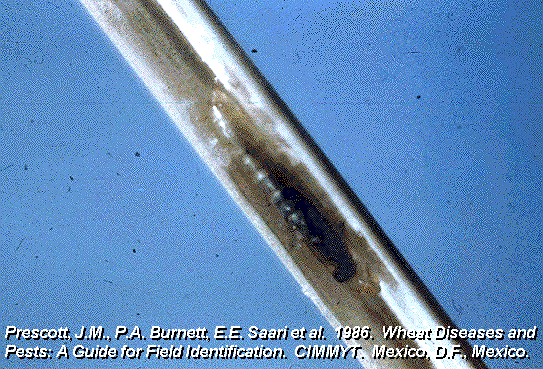
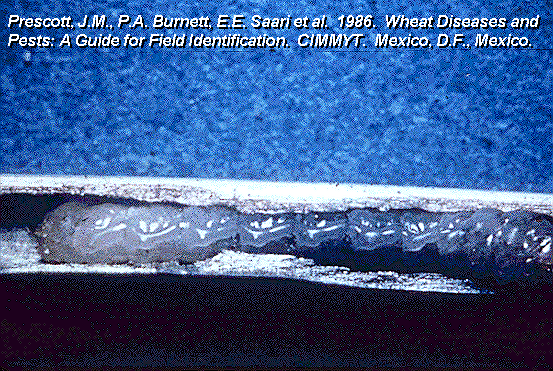
    Symptoms: Damage by sawflies includes premature yellowing of the head and shrivelling of the grain. The larvae girdle the stem (73) and, later in the crop cycle, lodging is common.
    Life Cycle: Sawflies produce one generation per year. The larvae overwinter in the straw (74); in the spring they pupate. Adult sawflies are small, fly-like wasps and appear from late spring to midsummer. The females deposit small white eggs in the upper nodes of stems just below the heads. Upon hatching, the legless white larvae bore into the stem and tunnel downward, feeding on the pith of the stem. When they have completed their feeding, they descend further and girdle the stem base.
    Hosts/Distribution: Nearly all cultivated cereals and native grasses act as hosts, although wheat is preferred. Fall-sown cereals are more commonly attacked. Wheat lines having solid or partially solid stems are much less susceptible to attack. The wheat stem sawfly is a major problem in the Mediterranean Basin.
    Importance: Sawfly can cause significant damage in some years, but infestations are usually discontinuous.

    White Grubs (various species)
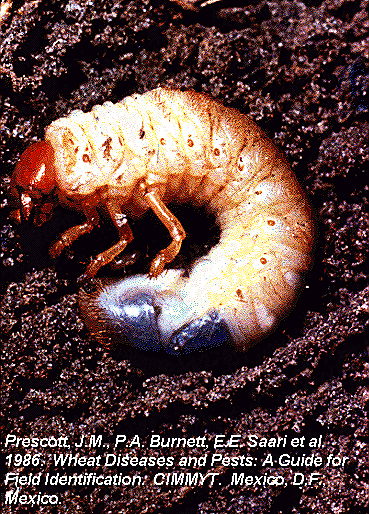
    Symptoms: White grubs can partially or completely sever the roots of the host plants. This causes patches of wilting and dying wheat plants (especially at the seedling stage), symptoms that could be attributed to root rots. However, when stunted patches are observed, the surrounding soil should be examined for the larvae (75). When fully grown, the largest of these larvae may be several centimeters long and nearly one centimeter thick. The larvae have three pairs of legs on their thorax (76).
    Life Cycle: White grubs are the larvae of May or June beetles. Eggs are deposited in the soil and the hatched larvae feed on roots. The duration of the larval stage varies from species to species.
    Hosts/Distribution: Many species of white grubs found throughout the world can attack wheat and many other plant species. Cereal crops may suffer significant damage if seeded into heavily infested grasslands.
    Importance: When the roots are not completely destroyed, the plants may survive, but are stunted and fail to produce heads. However, the distribution and extent of attack is not uniform.

    Wireworms (various species)
    Symptoms: Wireworm damage is very similar to that caused by other soil-inhabiting chewing insects; the only sure means of identifying wireworms as the causal agent is to find them in association with the damaged seedlings (77). The name "wireworm" refers to the tough, wire-like appearance of the larvae. They are 20-30 mm long and are often smooth, hard, and highly polished. They have three pairs of legs (78), and their color may vary from a rich cream to shades of brown. Wireworm larvae may attack wheat as soon as the crop is seeded, eating the endosperm of the kernels and leaving only the seed coat. A common sign of woreworm attack is the wilting and/or dying of a number of adjacent plants, either in a row or patch. The stems of affected seedlings will be chewed just above the seed.
    Life Cycle: Wireworms are the larvae of click beetles, of which there are many species. The adult beetles (79) lay eggs in the soil, usually in the spring, and the larvae may take several years to develop prior to pupating, depending on species. Generations overlap so that all stages and sizes of larvae may be found in the soil at the same time.
    Hosts/Distribution: Many species of wireworms are found throughout the world, all of which can attack wheat. These larvae are capable of attacking many different plant species as well.
    Importance: Woreworms are among the most damaging soil-infesting insects. Damage is usually most severe where wheat has been seeded after fallow or after a number of years of grass.

    Slugs, Snails, Grasshoppers, and Crickets (various species)
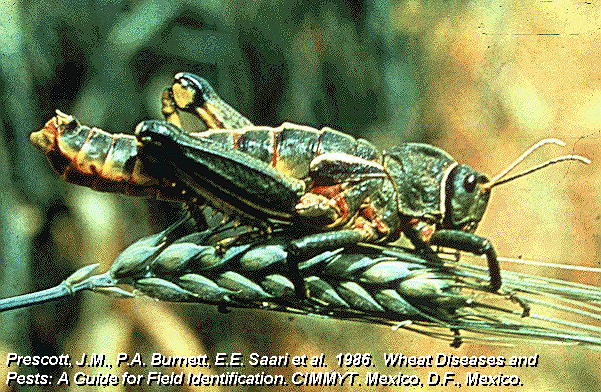
    Symptoms: Slugs and snails (80) can feed on the endosperm of germinating seed, bite seedlings off at ground level, and graze older plants, chewing longitudinal stripes on the leaves (81). This gives the adult plant a frayed appearance. Grasshoppers (82) and crickets cause damage that is very similar to that caused by cutworms and armyworms.
    Hosts/Distribution: All these insects will attack a large range of plant species, including the cereals. Distribution is worldwide.
    Importance: These insects usually are localized in their distribution, but can cause a great deal of damage to individual stands of wheat.

    Mites (various species)
    Symptoms: Adult mites are usually less than 1 mm long, and most of the plant-inhabiting species have sucking mouth parts. Mites are not insects. Adults typically possess four pairs of legs (83), while larvae have only three pairs. However, the wheat curl mite, Eriophye tulipae (syn. Aceria tulipae), has only two pairs of legs. When present in large numbers, mites cause a silvery flecking on leaves (84). Some species may produce webs and/or may cause infested plants to be severely stunted, to head poorly, and to turn white. Individual mites are so small they they can scarcely be seen with the unaided eye. Even so, if an infested leaf is held over a piece of white paper (folded to form a trough) and tapped sharply several time, hundreds of mites will fall onto the paper and can be seen moving about.
    Hosts/Distribution: Mites generally are not an important problem, with the exception of the wheat curl mite, which is a vector of wheat streak mosaic virus (WSMV).

    Reference:

    Wheat Diseases and Pests: a guide for field identification

    Original text by: J. M. Prescott, P. A. Burnett, E. E. Saari, J. Ranson, J. Bowman, W. de Milliano, R. P. Singh, G. Bekele. INTERNATIONAL MAIZE AND WHEAT IMPROVEMENT CENTER (www.cimmyt.org). CENTRO INTERNACIONAL DE MEJORAMIENTO DE MAIZ Y TRIGO. Lisboa 27, Apdo. Postal 6-641, 06600 Mexico, D.F., Mexico.
    HTML version developed with permission from CIMMYT by: J. Wong, USDA-ARS-WRRC, Albany, California; D. E. Matthews, Dep. of Plant Breeding and Biometry, Cornell University, Ithaca, New York and K. D. Kephart, Dep. of Agronomy, University of Missouri, Columbia, Missouri.


    Support : agrinfobank.com | Oasis Agro Industries Pakistan
    Copyright © 2012. Agriculture Information Bank - All Rights Reserved
    Template Created by agrinfobank.com Team Published by agrinfobank Blog Team
    Proudly powered by Blogger